

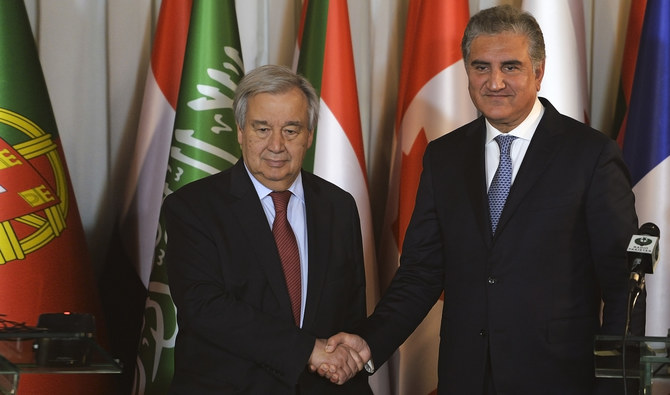

ISLAMABAD: Foreign Minister Shah Mahmood Qureshi on Tuesday hailed UN Secretary-General Antonio Guterres’s support for efforts to reject intolerance and “anti-Muslim bigotry.”
In a virtual meeting with member states of the Organization of Islamic Cooperation (OIC) on May 22, Guterres said, “You have my total commitment to actively challenge inaccurate and harmful messages, promote non-violence and reject anti-Muslim bigotry, hate and all forms of intolerance.”
“We also welcome @antonioguterres agreement on need to counter Islamophobia & OIC-IPHRC’s earlier censure,” Qureshi said in a Twitter post, referring to an earlier tweet by the OIC’s Independent Permanent Human Rights Commission (IPHRC).
“#OIC-IPHRC welcomes #UNSG’s rejection of anti-Muslim bigotry and #hatred as well as echoes his (Guterres’s) commitment to challenge and combat ethno-nationalism and all forms of intolerances which are rising in the post-#COVID scenario,” the commission said, adding that instances of Islamophobia violate human rights and pose a threat to international peace and security.
While Guterres made no direct reference to India, Qureshi in his tweet said that Pakistan “has consistently appealed” to the UN and OIC to condemn “relentless Islamophobia” of Indian Prime Minister Narendra Modi’s government.
Pakistan has consistently appealed to @UN & @OIC_OCI to condemn Modi’s Hindutva supremacist ideology with relentless Islamophobia & violence/regional instability perpetuated. We also welcome @antonioguterres agreement on need to counter Islamophobia & OIC-IPHRC’s earlier censure.
— Shah Mahmood Qureshi (@SMQureshiPTI) May 26, 2020
India has been under heavy criticism since December when it passed the controversial Citizenship Amendment Act (CAA), marginalizing its nearly 200 million Muslim minority. The law has sparked country-wide protests and led to deadly riots, in which most casualties were Muslims.
Anti-Muslim sentiment in India has also been fueled by officials blaming the Muslim community for the coronavirus outbreak.
In April, the OIC expressed its concerns over a “growing tide of Islamophobia” in the country.


