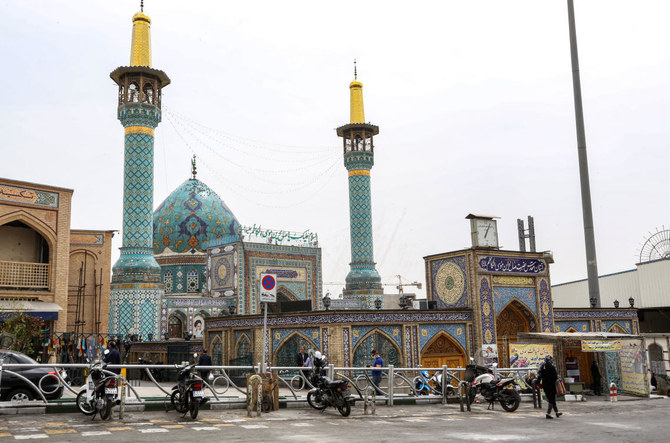
TEHRAN: Virus-hit Iran will reopen its mosques for three nights over the next week so that worshippers can pray during one of the holiest times of year, a minister said Tuesday.
The Islamic republic shut its mosques and shrines in March as part of its efforts to contain the Middle East’s deadliest outbreak of the novel coronavirus.
The reopening was granted for Laylat Al-Qadr — a high point during the fasting month of Ramadan that marks when the Qur'an was revealed to Prophet Muhammad.
But Health Minister Saeed Namaki sounded a note of caution as he announced that worshippers would be allowed to attend mosques and ceremonies for three of the next five nights.
“The biggest strategic mistake is to think that coronavirus is finished,” he said in remarks broadcast on state television.
“At any time, we can go back to bad circumstances” due to “negligence,” said Namaki.
“Our priority is to hold ceremonies outdoors” such as “in stadiums,” he said, “so that social distancing is properly observed.”
Namaki said his ministry agreed in a meeting to help “organize ceremonies from midnight to 2:00 am during the nights of Qadr.”
He said the move came in response to “concern” expressed by Ayatollah Ali Khamenei, but stressed the supreme leader “always supports all measures” to contain the virus.
All gatherings would need to respect “sanitary protocols to the maximum,” he added.
But he warned: “They shouldn’t blame the health ministry and say they wanted to open mosques but didn’t care about people’s health.”
His remarks came shortly before Iran announced another 48 deaths from the virus taking its overall toll to 6,733.
Health ministry spokesman Kianoush Jahanpour said another 1,481 people tested positive for the virus in the past 24 hours, bringing the total number of cases to 110,767 since the start of the crisis.
Iran has struggled to contain its outbreak of the virus that causes COVID-19 since announcing its first cases in the Shiite holy city of Qom on February 19.
The government closed schools, postponed major events and banned inter-city travel but it has eased restrictions gradually since April 11.
It allowed mosques to reopen on May 4 in 132 counties where the virus was deemed to be under control.
And on Friday last week worshippers were able to attend the main weekly prayers for the first time in more than two months, except for in the capital.
The government warned on Monday of a setback in its efforts to contain the virus.
“We have regressed in Khuzestan due to (people) not observing health protocols,” Deputy Health Minister Alireza Raisi said, referring to a southwestern province that is now the epicenter of the country’s outbreak.
“This can happen to any other province if we are not careful,” he added, noting that tighter measures would be reimposed in other places too if needed.
Experts inside and outside Iran have cast doubt on the country’s official COVID-19 figures, and say the real toll could be much higher.

Virus-hit Iran to reopen mosques for holy nights
https://arab.news/nfdrw
Virus-hit Iran to reopen mosques for holy nights
- The Islamic republic shut its mosques and shrines in March as part of its efforts to contain the Middle East’s deadliest outbreak of the novel coronavirus
- Health ministry spokesman Kianoush Jahanpour said another 1,481 people tested positive for the virus in the past 24 hours
Sudanese trek through mountains to escape Kordofan fighting
- For eight days, Sudanese farmer Ibrahim Hussein led his family through treacherous terrain to flee the fighting in southern Kordofan — the latest and most volatile front in the country’s 31-month-old
PORT SUDAN: For eight days, Sudanese farmer Ibrahim Hussein led his family through treacherous terrain to flee the fighting in southern Kordofan — the latest and most volatile front in the country’s 31-month-old conflict.
“We left everything behind,” said the 47-year-old, who escaped with his family of seven from Keiklek, near the South Sudanese border.
“Our animals and our unharvested crops — all of it.”
Hussein spoke to AFP from Kosti, an army-controlled city in White Nile state, around 300 kilometers (186 miles) south of Khartoum.
The city has become a refuge for hundreds of families fleeing violence in oil-rich Kordofan, where the Sudanese army and the Rapid Support Forces (RSF) — locked in a brutal war since April 2023 — are vying for control.
Emboldened by their October capture of the army’s last stronghold in Darfur, the RSF and their allies have in recent weeks descended in full force on Kordofan, forcing nearly 53,000 people to flee, according to the United Nations.
“For most of the war, we lived in peace and looked after our animals,” Hussein said.
“But when the RSF came close, we were afraid fighting would break out. So we left, most of the way on foot.”
He took his family through the rocky spine of the Nuba Mountains and the surrounding valley, passing through both paramilitary and army checkpoints.
This month, the RSF consolidated its grip on West Kordofan — one of three regional states — and seized Heglig, which lies on Sudan’s largest oil field.
With their local allies, they have also tightened their siege on the army-held cities of Kadugli and Dilling, where hundreds of thousands face mass starvation.
Running for their lives
In just two days this week, nearly 4,000 people arrived in Kosti, hungry and terrified, said Mohamed Refaat, Sudan chief of mission for the UN’s International Organization for Migration.
“Most of those arriving are women and children. Very few adult men are with them,” he told AFP, adding that many men stay behind “out of fear of being killed or abducted.”
The main roads are unsafe, so families are taking “long and uncertain journeys and sleeping wherever they can,” according to Mercy Corps, one of the few aid agencies operating in Kordofan.
“Journeys that once took four hours now force people to walk for 15 to 30 days through isolated areas and mine-littered terrain,” said Miji Park, interim country director for Sudan.
This month, drones hit a kindergarten and a hospital in Kalogi in South Kordofan, killing 114 people, including 63 children, according to the World Health Organization.
Adam Eissa, a 53-year-old farmer, knew it was time to run. He took his wife, four daughters and elderly mother — all crammed into a pickup truck with 30 others — and drove for three days through “backroads to avoid RSF checkpoints,” he told AFP from Kosti.
They are now sheltering in a school-turned-shelter housing around 500 displaced people.
“We receive some help, but it is not enough,” said Eissa, who is trying to find work in the market.
According to the IOM’s Refaat, Kosti — a relatively small city — is already under strain. It hosts thousands of South Sudanese refugees, themselves fleeing violence across the border.
It cost Eissa $400 to get his family to safety. Anyone who does not have that kind of money — most Sudanese, after close to three years of war — has to walk, or stay behind.
Those left behind
According to Refaat, transport prices from El-Obeid in North Kordofan have increased more than tenfold in two months, severely “limiting who can flee.”
In besieged Kadugli, 56-year-old market trader Hamdan is desperate for a way out, “terrified” that the RSF will seize the city.
“I sent my family away a while ago with my eldest son,” he told AFP via satellite Internet connection, asking to be identified only by his first name. “Now I am looking for a way to leave.”
Every day brings “the sound of shelling and sometimes gunfire,” said Kassem Eissa, a civil servant and head of a family of eight.
“I have three daughters, the youngest is 14,” he told AFP, laying out an impossible choice: “Getting out is expensive and the road is unsafe” but “we’re struggling to get enough food and medicine.”
The UN has issued repeated warnings of the violence in Kordofan, raising fears of atrocities similar to those reported in the last captured city in Darfur, including summary executions, abductions and rape.
“If a ceasefire is not reached around Kadugli,” Refaat said, “the scale of violence we saw in El-Fasher could be repeated.”