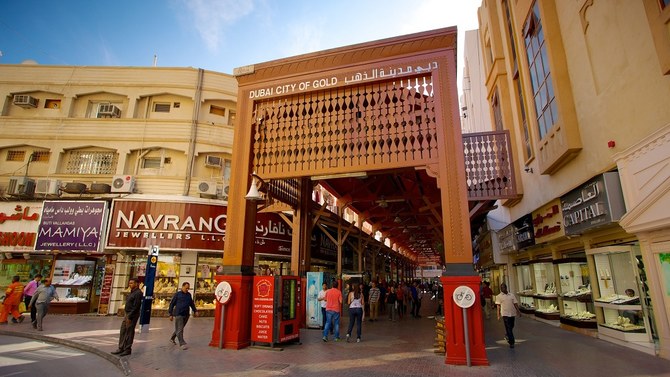
DUBAI: The managers of Dubai’s famous gold souk have reaffirmed their commitment to ensuring the safety of workers and members of the public, as the popular tourist destination reopened following the coronavirus lockdown.
Stores operating in the souk area were able to reopen this week, under the strict supervision of the Dubai Gold and Jewelry Group (DGJG), the trade body for the gold and diamond jewelry sector in Dubai
Traders are operating at reduced trading hours, from 11 a.m. to 9 p.m. and wholesale offices from 10 a.m. to 5 p.m.
Prior to the opening, the Gold Souk and individual stores had completed an extensive sterilization program within strict health and safety guidelines issued by the government.
“The UAE has led by example and left no stones unturned before easing the COVID-19 restriction and opening shopping malls, markets and commercial outlets,” Tawhid Abdullah, Chairman of DGJG said.
“It is a good step towards safely opening the economy and as an industry we are all gearing up to meet the Govt. expectations and consumer confidence,” he added, stating that plans were in place as they prepare in stages in the coming months to work towards 100 percent capacity operations.


Iconic Dubai Gold Souk reopens with high safety measures
https://arab.news/chf2d
Iconic Dubai Gold Souk reopens with high safety measures

- The Gold Souk and individual stores had completed an extensive sterilization program within strict health and safety guidelines issued by the government.

EU investments in Saudi Arabia to prosper over next 5 years, says ambassador
RIYADH: European investments in Saudi Arabia are set to see notable growth over the next five years, encompassing green energy, metals, critical raw materials, advanced industry, and the digital sector.
Christophe Farnaud, the EU Ambassador to Saudi Arabia, confirmed to Al-Eqtisadiah that an anticipated memorandum of understanding with the Kingdom in the energy field will provide an organized framework for cooperation in energy transition and sustainability, boosting investor confidence in the long-term partnership between the two sides.
The volume of trade in goods and services between Saudi Arabia and the EU amounts to €90 billion ($105.6 billion), according to the latest data from 2024, making the EU the Kingdom’s second-largest trading partner, according to Farnaud.
Currently, 2,500 European companies operate within the Saudi market, highlighting the depth of economic relations between the two sides.
A qualitative development in relations
Farnaud affirmed that Saudi-European relations are witnessing qualitative development, especially since the EU’s adoption in 2022 of its strategy towards Gulf Cooperation Council countries, which is based on enhancing political, security, and economic cooperation, in addition to cultural and humanitarian exchange.
He noted that Saudi Arabia’s Vision 2030 constitutes an attractive framework for strengthening this partnership.
The ambassador also pointed out that the launch of the European Chamber of Commerce in the Kingdom of Saudi Arabia during 2024 represented an important step to support cooperation between European and Saudi companies and enhance mutual investments, reflecting a positive outlook for the future of economic relations.
Economic relations are no longer limited to traditional trade exchange but have transformed into a multi-sector partnership, including investment, services, manufacturing, energy, and sustainability, according to Farnaud.

Relaunching Free Trade Agreement negotiations
The ambassador revealed ongoing discussions to relaunch negotiations for a Free Trade Agreement between the EU and GCC countries, which have been stalled since 2008, aiming to reach a modern agreement covering investment, services, intellectual property protection, technical standards, and government procurement.
He also indicated readiness to launch negotiations for a bilateral strategic partnership agreement with Saudi Arabia, including industrial cooperation, critical raw materials, energy, and sustainability, alongside working to sign a memorandum of understanding in the energy field in the coming period.
The EU, according to Farnaud, is the largest foreign investor in Saudi Arabia, holding 29 percent of the total foreign direct investment stock, which amounted to 30.7 billion euros in 2023.
Investments are concentrated in the transport, energy, industry, tourism, education, and training sectors, with major European companies participating in strategic projects like the Riyadh Metro.
Sectors of common priority
The ambassador explained that the energy sector, especially renewable energy and green hydrogen, represents a common priority, amidst the global shift towards sustainability, in addition to significant opportunities in the high-tech manufacturing sector, industrial localization, and knowledge transfer.
He pointed to the growing interest of European investors in Saudi Arabia’s tourism sector, driven by Vision 2030’s targets to raise tourism’s contribution to the gross domestic product to 10 percent.
Wide opportunities stand out in areas of hospitality, tourist destination management, cultural tourism, transport, and sustainability, especially in major projects like NEOM, AlUla, the Red Sea Project, and Diriyah.
Farnaud cited existing partnerships with leading European companies such as Accor and Kempinski, in addition to French cooperation in developing AlUla as a global heritage and tourist site.


