

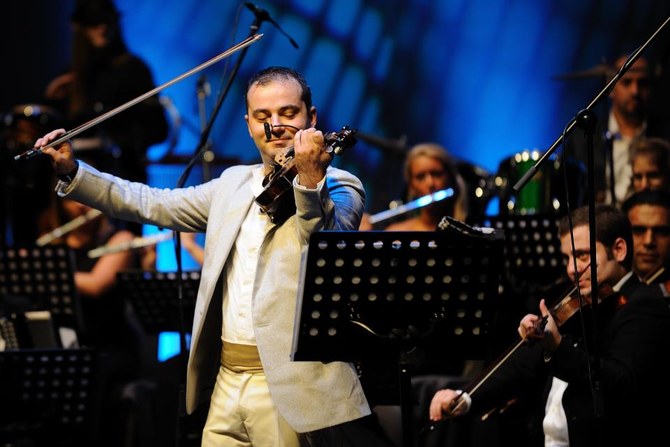
Syrian violinist Mohamad Hamami to kick off series of online shows
Updated 09 April 2020
Arab News
DUBAI: The Dubai Opera is bringing the music home to locked-down fans because of coronavirus restrictions with a series of performances from famous artists that would be livestreamed on social media.
Kicking of the series would be Syrian violinist Mohamad Hamami, who will perform famous Arabic and International tunes from his home for 45 minutes on Thursday, starting 6:00 p.m. Dubai time.
Hamami’s live session, with repeat performances on April 16 and 23, will be streamed on Dubai Opera’s Facebook and YouTube accounts.
#MohamadHamami will perform famous Arabic and International tunes from his home to yours.
Tune in to our Facebook and YouTube accounts on 9th,16th and 23rd April from 6 to 6:45 pm, Dubai time. pic.twitter.com/IR7P5yOHkQ
“Dress up at home and watch the concert at the Dubai Opera,” the Syrian violinist, founder of the renowned Sharq Orchestra, commented in his Facebook account.
Internationally acclaimed pianist and composer Guy Manoukian is also scheduled to perform on April 11, which will feature 45 minutes of his new releases and all-time Arabic classics.
This interactive live Instagram session, which starts at 7 p.m. Dubai time, will be on Dubai Opera’s Instagram account.
OPINION: Saudi Arabia’s cultural continuum: from heritage to contemporary AlUla
The director of arts & creative industries at the Royal Commission for AlUla writes about the Kingdom’s cultural growth
Updated 12 February 2026
Hamad Alhomiedan
AlUla: Saudi Arabia’s relationship with culture isa long and rich. It doesn’t begin with modern museums or contemporary installations, but in the woven textiles of nomadic encampments, traditional jewellery and ceramics, and of course palm‑frond weaving traditions. For centuries, Saudi artisans have worked with materials drawn directly from their environment creating objects that are functional, but also expressions of identity and artistry.
Many of these traditions have been recognised internationally, with crafts such as Al-Sadu weaving inscribed on UNESCO’s Intangible Cultural Heritage list.
Sadu weaving. (Getty Images)
This grounding in landscapes, resources, and collective history means Saudi Arabia’s current cultural momentum is not sudden, but the natural result of decades — even centuries — of groundwork. From the preservation of heritage sites and, areas, some of which have been transformed into world-renowned art districts, to, the creation of institutions devoted to craft, the stage has been set for a moment where contemporary creativity can move forward with confidence, because it is deeply rooted.
AlUla, with its 7,000 years of human history, offers one of the clearest views into this continuum. Millennia-old inscriptions at Dadan and Jabal Ikmah stand alongside restored mudbrick homes in Old Town and UNESCO-listed Hegra. In the present, initiatives like Madrasat Addeera carry forward AlUla’s craft traditions through design residencies and material research. And, each winter, the AlUla Arts Festival knots these threads together, creating a season in which heritage and contemporary practice meet.
Hamad Alhomiedan, the director of arts & creative industries at the Royal Commission for AlUla. (Supplied)
This year, that dialogue began in the open desert with Desert X AlUla 2026. Now in its fourth edition, the exhibition feels like the pinnacle of the current moment where contemporary art, heritage, and forward-thinking meet without boundaries. The theme of Desert X AlUla 2026 was “Space Without Measure,” inspired by the work of Lebanese-American artist and writer Kahlil Gibran[HA1] [MJ2] . The theme invited artists to respond to the horizons of AlUla’s landscape and interpret its wonder through their perspective.
Works by Saudi and international figures converse directly with nature: Mohammed Al-Saleem’s modernist sculptures bring in celestial-inspired geometry; Maria Magdalena Campos-Pons translates the colour of AlUla’s sunsets; Agnes Denes “Living Pyramid” turns the oasis into a vertical landscape of indigenous plants, . The 11 artists of this year’s edition were able to capture AlUla’s essence while creating monumental works that speak directly to our relationship with the environment.
Artist Performance at Desert X AlUla 2026 by Maria Magdelena Compos Pons and Kamaal Malak. (Courtesy of Arts AlUla and AlUla Moments)
In AlJadidah Arts District, “Material Witness: Celebrating Design From Within,” features heritage craft and material research from Madrasat Addeera alongside work by regional and international designers, showing how they translate heritage materials into contemporary forms.[HA3] [MJ4]
Music adds another element of vitality, filling the streets of AlJadidah Arts District, with performances supported by AlUla Music Hub, featuring local musicians.
The opening of “Arduna,” the first exhibition presented byof the AlUla Contemporary Art Museum, co-curated with France’s Centre Pompidou, adds another layer to this conversation. Featuring Saudi, regional, and international artists, from Picasso and Kandinsky to Etel Adnan, Ayman Zedani and Manal AlDowayan, the [HA5] [MJ6] exhibition signals the emergence of a global institution rooted in the heritage and environment of AlUla, placing local voices in context with world masters.
Each activation in this year’s AlUla Arts Festival is part of the same Saudi cultural continuum, . This is why the Kingdom’s cultural rise feels different from rapid developments elsewhere. The scale of cultural infrastructure investment is extraordinary, but its deeper strength lies in how that investment connects to living traditions and landscapes.
The journey is only accelerating. Rooted in heritage yet open to the world, the Kingdom’s cultural future is being shaped not by sudden inspiration, but by our traditions and history meeting the imagination and creative voices of our present.