

The sound of silence - Italians no longer singing on balconies as coronavirus toll rises

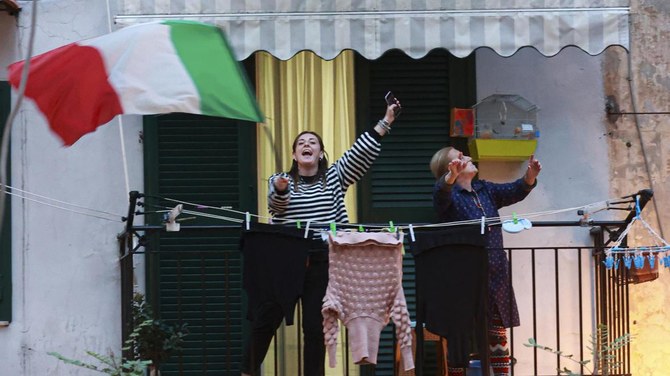
In the early days of the coronavirus lockdown, the idea of a daily musical flash mob was a hit across the country. (Reuters/File Photo)
Short Url
Updated 06 April 2020
Follow

The sound of silence - Italians no longer singing on balconies as coronavirus toll rises

  • The country's COVID-19 death toll mounts and the national lockdown continues

ROME: As Italians adjusted to life under quarantine, 6 p.m. had become the highlight of the day for many. Every day, people would take to their balconies and rooftops to take part in a “musical flash mob” aimed at lifting people’s spirits.

But as the national lockdown due to the coronavirus pandemic is set to go on at least until Easter, if not longer, Italians are no longer singing.

In the early days of the lockdown, the idea of a daily musical flash mob was a hit across the country.

Day after day, right before sunset, people would open their windows, put out a national flag and start singing as loudly as possible.

Social media was quickly filled with videos of people singing from their windows and playing tambourines on their balconies nationwide.

Even Lombardy, the region with the highest number of infections and fatalities, joined in enthusiastically.

Some musicians put powerful loudspeakers on their balconies and performed concerts. Every daily performance was opened by the national anthem, followed by well-known Italian songs.

Musical competency was not a requirement, nor was possessing an instrument. A pot or wooden spoon could suffice. A recording made in the city of Siena has been viewed more than 600,000 times on Twitter.

Italian singer Andrea Sannino made a compilation on his Instagram feed that shows people singing his song “Abbracciame” (“Embrace Me”) in his hometown Naples.

The 1990s song “Grazie Roma,” with the lyric “tell me what it is that makes us feel like we’re together, even when we’re apart,” is also popular online.

Quieter neighbors had been using social media to encourage Italians to put up placards on their homes that read “andra tutto bene” (“everything will be OK”), accompanied by a picture of a rainbow.

Everyone seemed happy to let off steam while effectively living under house arrest. “Music has provided unity in times of division throughout history; now Italians are showing the world that, if only for a moment, it can also help them transcend the anxiety brought by a pandemic,” said sociologist Bruno de Masi.

But as the death toll rose and restrictions remained, people stopped joining the flash mobs. Now, if one sings, they might be interrupted by somebody shouting “smettila, vai a casa” (“stop it and go home”). Meanwhile, social unrest is mounting, especially in the poorer south.

“They’re no longer singing or dancing on the balconies. Now people are more afraid, not so much of the virus but of poverty,” Salvatore Melluso, a priest at Caritas Diocesana di Napoli, a church-run charity in Naples, told Arab News.

“That applies everywhere. Both in the more affluent north and in the historically poorer south of the nation, many are out of work and hungry,” he said while counting donated packs of pasta and cans of lentils and beans.

“Queues at food banks are becoming longer and longer. In this situation, there’s nothing to sing about at all,” he added.

“Every Italian likes to sing. Everyone feels like a little Pavarotti here, and we’re all fond of music. But let’s face it, singing may cheer you up for five minutes, then you need to eat something — or you die.”


Gaza student evacuated to UK with her family after government climbdown

Updated 9 sec ago
Follow

Gaza student evacuated to UK with her family after government climbdown

  • Manar Al-Houbi was initially denied permission to bring her husband and children after changes to UK rules on foreign scholarship recipients
  • Several students still stranded in Gaza as relocation deadline looms, after refusing to abandon family members

LONDON: A student from Gaza granted permission to live and study in the UK has been evacuated from the Palestinian territory, with her family, by the British government.

Manar Al-Houbi won a full scholarship to study for a doctorate at the University of Glasgow. It also allowed her to bring her husband and children with her, and they applied for the required visas. But shortly before her studies were due to start, UK authorities told her the rules for international students and their dependents had changed and her family could no longer accompany her.

Shortly after her story was reported in October, however, the government backed down as said it would consider evacuation of international students’ dependents on a “case-by-case basis.”

Al-Houbi and her family are now in Jordan, on their way to the UK, The Guardian newspaper reported on Friday. The British scheme for the evacuation of students from Gaza is due to expire on Dec. 31. People who have attempted to use it have described it as being riddled with issues, as a result of which some students with scholarships have been left stranded in the Palestinian territory.

Several told the Guardian they had decided not to travel to the UK because they had felt pressured into leaving loved ones behind, including children.

Wahhaj Mohammed, 32, said he was told by the Foreign, Commonwealth and Development Office to travel to the UK alone, and his wife and children would be allowed to join him later. Two months after he arrived in Glasgow, his family are still in Gaza with no time frame for them to follow him.

“The uncertainty affects every aspect of my life here,” he told The Guardian. “It’s difficult to settle, to feel present or to engage academically when the people you love most remain living under constant threat.”

The Guardian said UK officials were “hopeful” his family would be evacuated in 2026 but could offer no guarantee about when this might happen.

Another student, Amany Shaher, said she refused to leave her family behind in Gaza and as a result was denied permission to travel to the UK this week. She does not know whether she will be permitted to defer her scholarship to study at the University of Bristol.

The 34-year-old, who has three children, said: “How can I even consider leaving my children behind in Gaza? Nowhere else in the world would a mother be expected to part so easily from her children. It’s dehumanizing. We have a right to stick together as a family and not be forced to separate — that should not be too much to ask.

“None of us know if the UK’s student evacuation scheme will be extended or not. We haven’t been given any clear guidance or timelines and have no idea what 2026 will bring.”

Mohammed Aldalou also refused to leave behind his family, including his 5-year-old autistic and non-verbal son, to take up a scholarship for postgraduate studies at the London School of Economics.

He said the Foreign Office had suggested to him he travel separately from them, as they did with Mohammed.

“They should ask themselves what they would do if they were in my shoes,” he said. “It’s heartbreaking that after everything we’ve been through, we’re being asked to make this impossible decision.”

Sources told The Guardian it was unlikely the Foreign Office would extend the scheme to allow students to travel from Gaza to the UK later, but that a meeting took place last week with the Department for Education to discuss whether students could begin their studies online.