Virus pain easing in Spain, Italy; UK braces for bleak days

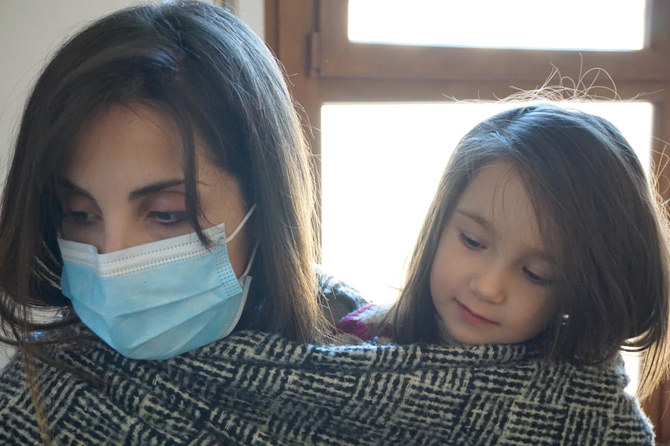
Italian doctor Cecilia Bartalena, 35, hugs her 4-year-old daughter Petra Marianelli, after returning home from a shift looking after COVID-19 patients in Cisanello hospital, Pisa, Italy. (Reuters)
Short Url
Updated 06 April 2020
Follow

Virus pain easing in Spain, Italy; UK braces for bleak days

  • The two countries, Italy and Spain, that have suffered more virus deaths than anywhere else in Europe are starting to see their crisis ease
  • Britain’s outbreak was headed in the opposite direction as the country reported more than 600 deaths Sunday

MADRID: A week ago, emergency rooms and intensive care wards in Spain and Italy were overflowing with woozy, coughing coronavirus patients and literally buzzing with breathing machines.
So many died that Barcelona crematories have a waiting list of up to two years, forcing some people to bury loved ones temporarily in cemeteries with the expectation of exhuming them for cremation later on.
But now the two countries that have suffered more virus deaths than anywhere else in Europe are starting to see their crisis ease, while Britain, where the prime minister has been hospitalized, seems headed in the opposite direction.
Between them, Italy and Spain saw nearly 30,000 deaths and 265,000 confirmed infections in the pandemic. They, and other European countries that locked down weeks ago and ramped up testing, are now seeing the benefits.
Britain’s outbreak was headed in the opposite direction as the country reported more than 600 deaths Sunday, surpassing Italy’s daily increase for the second day in a row.
“I think that we are just a week away from the surge of this,” the deputy chief executive of Britain’s NHS Providers, Saffron Cordery, told Sky News.
In Spain, deaths and new infections dropped again on Monday. The health ministry reported 637 new fatalities, the lowest toll in 13 days, for a total of over 13,000 dead. New recorded infections were the lowest in two weeks.
Emergency rooms in the hard-hit Madrid region of 6.6 million were returning almost to normal a week after scenes of patients sleeping on floors and in chairs.
Patients awaiting treatment in Madrid-area ERs went down Monday to 390 cases, one-tenth of the arrivals last week, the regional government said. The number of people being treated for coronavirus in intensive care stabilized at about 1,500 for five straight days.
Transport, Mobility and Urban Affairs Minister José Luis Ábalos said the figures show Spain is entering “a new phase of the battle.”
“This new phase does not mean we can let down our guard. We are assessing the measures that we will need to adopt,” Ábalos said.
At the San Carlos Clinic Hospital in Madrid, nearly 15% of the hospital’s 1,400-strong staff contracted the coronavirus, in line with the national average,
“Our priority at the moment is to bring health workers back to work,” said Dr. Julio Mayol, the facility’s medical director.
Still, there are fears for a new outbreak as Spanish authorities begin talking about loosening the grip on mandatory confinement, and the strain on hospitalizations will still be seen for another week while that in intensive care units for another two weeks, Mayol said.
Italy still has, by far, the world’s highest coronavirus death toll — almost 16,000 — but the pressure on northern Italy’s ICUs has eased so much that Lombardy is no longer airlifting patients to other regions.
In the northern city of Bergamo, one of Europe’s virus epicenters, hospital staff were still pulling long, difficult shifts even if the numbers of new patients had eased a bit.
“There has been no reduction in the work,” said Maria Berardelli, a nursing coordinator at Pope John XXIII hospital. “There have been fewer admissions to the emergency room, but our intensive care units are still full, so the activity hasn’t been reduced.”
In a public housing project in the city of Seville, 90-year-old Manuela Jiménez has been confined to her home for more than 20 days. She speaks to neighbors from her window as they deliver food and says she has never seen anything like it, despite having lived through the Spanish Civil War and Second World War.
“Back then my mother would lock me up and I would stay calm but now, look, there is my neighbor and I can’t see her”, says Jiménez.
Illness has been compounded by shocking economic pain as all the world’s largest economies have ground to a halt, including in Italy and Spain. In France, which slightly trails its two neighbors to the south in deaths and infections, the government shut the country down two days after Italy — and has also seen a slight easing.
The UK initially resisted taking some of the tough measures seen in other European countries, which banned large events, shut schools and closed their borders to slow the spread of the COVID-19 illness.
The government’s first advice was that people should wash their hands frequently. As the number of cases soared, the response escalated to include the closure of schools, bars, restaurants and non-essential shops and a nationwide order for everyone but key workers to stay home.
Now, Austria and the Czech Republic are openly discussing how to ease some of the crippling restrictions. Austria’s chancellor said the plan is to let small shops and garden centers reopen next week, with limits on the number of customers inside, and the rest on May 1. The Czech government is proposing an end to the ban on travel abroad as of April 14 and the reopening of small stores.


US forces stop oil tanker off the coast of Venezuela as Trump follows up on promise to seize tankers

Updated 7 sec ago
Follow

US forces stop oil tanker off the coast of Venezuela as Trump follows up on promise to seize tankers

  • Trump following the first tanker seizure, of a vessel named the Skipper, this month vowed that the US would carry out a blockade of Venezuela

WASHINGTON: US forces on Saturday stopped an oil tanker off the coast of Venezuela for the second time in less than two weeks as President Donald Trump continues to ramp up pressure on Venezuelan President Nicolás Maduro.
The pre-dawn operation comes days after Trump announced a “blockade” of all sanctioned oil tankers coming in and out of the South American country and follows the Dec. 10 seizure by American forces of an oil tanker off Venezuela’s coast.
Homeland Security Secretary Kristi Noem confirmed that the US Coast Guard with help from the Defense Department stopped the oil tanker that was last docked in Venezuela. She also posted on social media an unclassified video of a UShelicopter landing personnel on a vessel called Centuries.
A crude oil tanker flying under the flag of Panama operates under the name and was recently spotted near the Venezuelan coast, according to MarineTraffic, a project that tracks the movement of vessels around the globe using publicly available data. It was not immediately clear if the vessel was under US sanctions.
“The United States will continue to pursue the illicit movement of sanctioned oil that is used to fund narco terrorism in the region,” Noem wrote on X. “We will find you, and we will stop you.”
The action was a “consented boarding,” with the tanker stopping voluntarily and allowing US forces to board it, according to a US official who was not authorized to comment publicly and spoke on the condition of anonymity.
Pentagon and White House officials did not immediately respond to a requests for comment.
Venezuela’s government in a statement Saturday characterized the US forces’ actions as “criminal” and vowed to not let them “go unpunished” by pursuing various legal avenues, including by filing complaints with the United Nations Security Council.
“The Bolivarian Republic of Venezuela categorically denounces and rejects the theft and hijacking of another private vessel transporting Venezuelan oil, as well as the enforced disappearance of its crew, perpetrated by United States military personnel in international waters,” according to the statement.
Trump following the first tanker seizure, of a vessel named the Skipper, this month vowed that the US would carry out a blockade of Venezuela. It all comes as Trump has ratcheted up his rhetoric toward Maduro and warned that the longtime Venezuelan leader’s days in power are numbered.
And the president this week demanded that Venezuela return assets that it seized from US oil companies years ago, justifying anew his announcement of a “blockade” against oil tankers traveling to or from the South American country that face American sanctions.
Trump cited the lost US investments in Venezuela when asked about his newest tactic in a pressure campaign against Maduro, suggesting the Republican administration’s moves are at least somewhat motivated by disputes over oil investments, along with accusations of drug trafficking. Some sanctioned tankers already are diverting away from Venezuela.
“We’re not going to be letting anybody going through who shouldn’t be going through,” Trump told reporters earlier this week. “You remember they took all of our energy rights. They took all of our oil not that long ago. And we want it back. They took it — they illegally took it.”
US oil companies dominated Venezuela’s petroleum industry until the country’s leaders moved to nationalize the sector, first in the 1970s and again in the 21st century under Maduro and his predecessor, Hugo Chávez. Compensation offered by Venezuela was deemed insufficient, and in 2014, an international arbitration panel ordered the country’s socialist government to pay $1.6 billion to ExxonMobil.
The targeting of tankers comes as Trump has ordered the Defense Department to carry out a series of attacks on vessels in the Caribbean and eastern Pacific Ocean that his administration alleges are smuggling fentanyl and other illegal drugs into the United States and beyond.
At least 104 people have been killed in 28 known strikes since early September.
The strikes have faced scrutiny from US lawmakers and human rights activists, who say the administration has offered scant evidence that its targets are indeed drug smugglers and that the fatal strikes amount to extrajudicial killings.
The Coast Guard, sometimes with help from the Navy, had typically interdicted boats suspected of smuggling drugs in the Caribbean Sea, searched for illicit cargo, and arrested the people aboard for prosecution.
The administration has justified the strikes as necessary, asserting it is in “armed conflict” with drug cartels aimed at halting the flow of narcotics into the United States. Maduro faces federal charges of narcoterrorism in the US
The US in recent months has sent a fleet of warships to the region, the largest buildup of forces in generations, and Trump has stated repeatedly that land attacks are coming soon.
Maduro has insisted the real purpose of the US military operations is to force him from power.
White House chief of staff Susie Wiles said in an interview with Vanity Fair published this week that Trump “wants to keep on blowing boats up until Maduro cries uncle.”