Global rights groups condemn deadly attack on Yemen jail

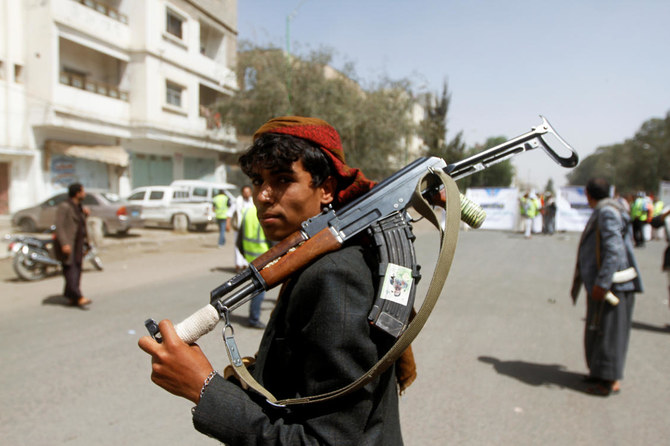
A Houthi supporter looks on as he carries a weapon during a gathering in Sanaa. The Iranian-backed Houthi militia have been blamed for an attack on a woman's jail which killed six women and a child. (Reuters/File Photo)
Short Url
Updated 06 April 2020
Follow

Global rights groups condemn deadly attack on Yemen jail

  • Internationally-recognized government has accused Iranian-backed Houthi militia of carrying out the attack

LONDON: Two international rights groups on Monday condemned an attack on a prison in Yemen’s besieged city of Taiz that left six women and a child dead.

The internationally-recognized government has accused Iranian-backed Houthi militia of carrying out Sunday’s attack.

The Houthis targeted the female section of the prison with mortar shells, according to the government’s Saba news agency.

“This is a criminal and bloodthirsty gang that has long targeted civilian gatherings and residential areas. In addition to the carnage in the prison, they gunned down today two children in eastern Taiz, killing one and leaving the other in critical condition,” Abdul Basit Al-Baher, a Yemeni army spokesman in Taiz, told Arab News, adding that the prison is almost 12km from the nearest battlefield.

“They targeted the prison with a Katyusha rocket followed by five mortal shells which show that they deliberately sought to kill civilians.”

Doctors Without Borders (MSF) said its hospital in Taiz received the casualties.

“MSF-supported Al-Thawra Hospital in Taiz city received the bodies of six women and one child who were killed in an attack on the central prison in Taiz,” it said on Twitter.

The government said 28 other female prisoners were wounded.

“Taiz citizens continue to suffer from the ongoing violence in the sixth year of the protracted conflict in Yemen,” MSF said.

“These attacks on civilians, whether indiscriminate or targeted, are unjustifiable breaches of international humanitarian law.”

The International Committee of the Red Cross said attacks on prisons were banned under international law.

“The ICRC deplores yesterday’s attack on Taiz central prison that left women and children dead and injured,” the ICRC said on Twitter.

“Prisons and their inmates are protected under international humanitarian law and can not be a targeted, it said.

Meanwhile, the UN's envoy to Yemen, Martin Griffiths condemned the attack on Twitter, saying: "I condemn the heinous attack on Taiz's central prison which killed and injured several women and children.Civilians and civilian objects including prisons must be protected as per international humanitarian law."


The attack was also blasted by the International Committee for the Red Cross in Yemen.


Taiz, a city of 600,000 people in southwest Yemen, is under government control but has been under siege by Houthi militia for the past six years.

Tens of thousands of Yemenis have been killed in more than five years of fighting.

Yemen’s health care system has so far recorded no case of the COVID-19 illness, but aid groups have warned that when it does hit, the impact will be catastrophic. The country is already gripped by what the UN calls the world’s worst humanitarian crisis.

(With AFP)


Saudi intervention ends Socotra power crisis

Updated 5 sec ago
Follow

Saudi intervention ends Socotra power crisis

  • Sudden shutdown of the power plants after the operating company withdrew and disabled control systems
  • Saudi engineering and technical teams moved immediately after receiving an appeal from local authorities

ADEN: Electricity has returned to Yemen’s Socotra archipelago after urgent Saudi intervention ended days of outages that disrupted daily life and crippled vital institutions, including the general hospital, the university and the technical institute.

The breakthrough followed a sudden shutdown of the power plants after the operating company withdrew and disabled control systems, triggering widespread blackouts and deepening hardship for residents.

The Saudi Development and Reconstruction Program for Yemen said that its engineering and technical teams moved immediately after receiving an appeal from local authorities. Specialists were dispatched to reactivate operating systems that had been encrypted before the company left the island.

Generators were brought back online in stages, restoring electricity across most of the governorate within a short time.

The restart eased intense pressure on the grid, which had faced rising demand in recent weeks after a complete halt in generation.

Health and education facilities were among the worst affected. Some medical departments scaled back services, while parts of the education sector were partially suspended as classrooms and laboratories were left without power.

Socotra’s electricity authority said that the crisis began when the former operator installed shutdown timers and password protections on control systems, preventing local teams from restarting the stations. Officials noted that the archipelago faced a similar situation in 2018, which was resolved through official intervention.

Local sources said that the return of electricity quickly stabilized basic services. Water networks resumed regular operations, telecommunications improved, and commercial activity began to recover after a period of economic disruption linked to the outages.

In the health sector, stable power, combined with operational support, secured the functioning of Socotra General Hospital, the archipelago’s main medical facility.

Funding helped to provide fuel and medical supplies and support healthcare staff, strengthening the hospital’s ability to receive patients and reducing the need to transfer cases outside the governorate, a burden that had weighed heavily on residents.

Medical sources said that critical departments, including intensive care units and operating rooms, resumed normal operations after relying on limited emergency measures.

In education, classes and academic activities resumed at Socotra University and the technical institute after weeks of disruption.

A support initiative covered operational costs, including academic staff salaries and essential expenses, helping to curb absenteeism and restore the academic schedule.

Local authorities announced that studies at the technical institute would officially restart on Monday, a move seen as a sign of gradual stabilization in public services.

Observers say that sustained technical and operational support will be key to safeguarding electricity supply and preventing a repeat of the crisis in a region that depends almost entirely on power to run its vital sectors.