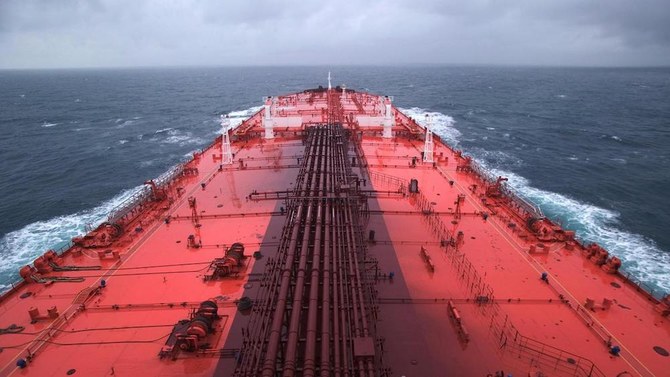

RIYADH: Six Arab countries have filed a request to the UN to access the Safer oil tanker — filled with 138 million liters of Yemeni oil — to prevent an environmental disaster of drastic proportions.
The tanker’s decay in Hodeidah would cause an environmental disaster with dire economic and humanitarian consequences, threatening millions of residents in the Hodeidah governorate and the Red Sea riparian countries.
“It’s a great danger,” political analyst Dr. Hamdan Al-Shehri told Arab News. The tanker has been lying in the port of Ras Isa for five years without any maintenance.
UN ambassadors from Djibouti, Egypt, Jordan, Saudi Arabia, Sudan and Yemen said in the letter that an explosion or leak from the Safer would close the port of Hodeidah for several months. This would halt critical imports and “could increase fuel prices by 800 percent and double the price of goods and food, resulting in more economic challenges for the people of Yemen,” they said.
A leak or explosion would also affect 1.7 million people working in the fishing industry and their families, the six countries said.
Al-Shehri said: “The tanker is used as a strong-arm point by the Houthis. Using it from time to time and reaping its goods but denying access to the UN.”
He added that one of the main reasons the Houthis have kept the international community and the UN at bay is “if the tanker was maintained and fixed it would affect their revenue. But the Houthis do not keep their word and have lied over and over again to their benefit.”
On July 18, 2019, Mark Lowcock, the UN’s undersecretary-general for humanitarian affairs, told the UN Security Council that its assessment team had been denied the necessary permits by Houthi rebels who control the area.
The tanker could face two potential hazardous scenarios.There could be an explosion or leak, which could lead to one of the worst environmental disasters the world has seen. The spill would be four times worse than the oil spill of the Exxon Valdez off the coast of Alaska in 1989, where the region still has not fully recovered. The aftermath of a fire or explosion would prevent the recovery of nearshore species in nearly 25 years, 1.7 million people would need food aid as the closure of the port can create shortages.
Fuel prices would increase by 800 percent and double the price of goods and food, shifting operations to an already busy port of Aden.
“The Houthis have nothing to lose, to them … this is just an oil spill in the sea.”
Dr. Hamdan Al-Shehri
After the end of the Gulf War, the region suffered from damage caused by oil pollution in the waters off the Arabian Gulf. Marine life required many years to recover. In addition, it suffered from damage caused by oil fires to the health of many people in the region, after they were exposed to toxic fumes.
The second potential scenario would be a major fire. Some 3 million people in Hodeidah would be affected by toxic gases, four percent of productive agricultural lands in Yemen would be covered with dark clouds, destroying beans, fruits and vegetables that could cause an estimated loss of over $70 million. Humanitarian organizations would suspend their services in Hodeidah, cutting off services for 7 million people in need.
“The Houthis have nothing to lose, to them, in the end, this is just an oil is spill in the sea, they do not care about any dangers it poses whether on regional or international waters,” said Al-Shehri. “The Houthis want to blackmail the Yemenis, raise problems for them, steal the oil and sell it on the black market,” he said.
From a military perspective, the political analyst explained that at some point the tanker could be used as leverage. The spilt oil could be set ablaze to cause a devastating fire in the Red Sea, as revenge against the coalition.
“The international community is required to assume its responsibilities and exert maximum pressure on Houthi militias before the oil tanker causes the world’s biggest environmental and human disaster,” added Al-Shehri.
“If the international community does not interfere a severe backlash of two devastating scenarios will take place, an environmental disaster or major fire unleashed.
“The UN must take a firm, decisive and strong stance against the Houthis and stop appeasing them,” said Dr. Hamdan.