

Yemenis meet truce calls with both hope and skepticism

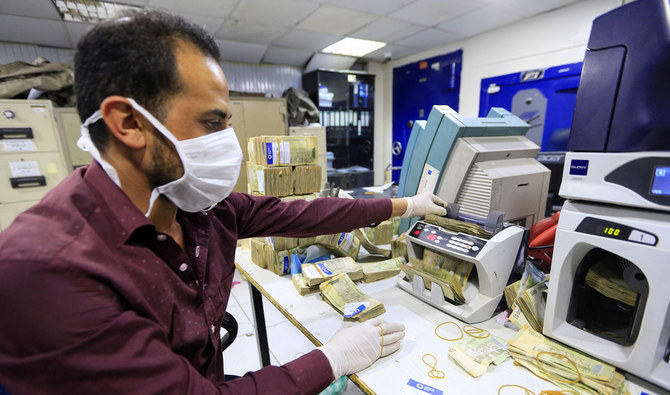
An employee wearing a face mask and gloves counts local currency at a bank in the Yemeni capital Sanaa on March 24, 2020 amid the COVID-19 coronavirus pandemic. (AFP)
Short Url
Updated 28 March 2020
Follow

Yemenis meet truce calls with both hope and skepticism

  • Government commanders said that they had received orders from their superiors to stop fighting in response to the UN envoy’s call

AL-MUKALLA: When the Iran-backed Houthi militias advanced toward his home city of Taiz in early 2015, Ibrahim Al-Zubairi decided not to flee the city, hoping that the war would come to an end. 
“I stayed put because I heard people saying the war would end soon,” Al-Zubairi, a 21-year-old college student, told Arab News. 
To his disappointment, Taiz, Yemen’s third most important city, saw the fiercest clashes between government forces and the rebels, which claimed the lives of hundreds of people and ruined most of the city’s infrastructure.

Each time he thought of leaving the city, he heard about a new round of peace talks that would end the conflict.

In 2017, he abandoned hope and fled to the southern port city of Al-Mukalla, where he enrolled at college.

“The war must stop immediately and completely,” Al-Zubairi said, expressing hope that pressure by the international community would lead to halting the hostilities. “I hope that peace prevails in Yemen.”

Al-Zubairi is an example of tens of thousands of Yemenis who have been displaced over the last six years as the Houthis began expanding militarily across Yemen, triggering bloody battles.

On Thursday, positive responses by Yemen’s warring groups rekindled hopes for a ceasefire that could pave the way for a comprehensive settlement to end the war in Yemen.

The UN's Yemen Envoy Martin Griffiths called upon Yemeni parties to convene for an urgent meeting to discuss the ceasefire.

“I am calling the parties to an urgent meeting to discuss how to translate their stated commitments to the Yemeni people into practice. I expect the parties to heed Yemen’s desire for peace and immediately cease all military hostilities,” Griffiths said in a statement on Thursday.

Citing many previous short-lived truces, many Yemenis doubt the factions will adhere to their commitments.

Speaking to Arab News from Marib, Kamal Al-Muradi, a government soldier, said his forces were currently battling a heavy offensive by the Houthis in Marib’s Serwah, ruling out ending the war any time soon.

“The Houthis are more dangerous than the coronavirus,” Al-Muradi said, noting he and other troops who hail from the central province of Marib would keep fighting until the rebels were repelled.

“There is no way we stop fighting before we end the Houthi threat to Marib,” he added.

The war must stop immediately and completely. I hope that peace prevails in Yemen.

Ibrahim Al-Zubairi, Student

The Houthis have scored major territorial gains in northern Yemen by seizing control of two districts in Jawf and pushing government troops out of the mountainous Nehim district, near Sana’a.

Their next target is the oil and gas rich city of Marib, according to local officers.

Government commanders said that they had received orders from their superiors to stop fighting in response to the UN envoy’s call.

Abdul Basit Al-Baher, the Yemeni army spokesperson in Taiz, told Arab News: “We welcome any humanitarian initiative. But from our experience with the Houthis, they have never committed to any peace initiative.

“The Houthis should first lift their blockade on Taiz and stop shelling residential areas and planting landmines ahead of any truce.”

Doubts

Given Yemen’s weak health system, amid the outbreak of the coronavirus across much of the world, experts have encouraged the country’s warring factions to stop fighting to allow health workers to divert efforts to preventing the spread of the disease.

“We all have to be united to save Yemen from a potential coronavirus outbreak which, if happens, will have disastrous consequences given that our health system has collapsed,” said Nadwa Al-Dawsari, a Yemeni conflict analyst and a non-resident fellow at the Middle East Institute.

Based on the scale of the Houthi offensive in northern Yemen and their breaches of previous agreements and truces, Nadwa predicted the proposed truce would not last.

“The Houthis have used every truce and agreement they had with others before to refuel, regroup and launch military offensives. Their actions on the ground don’t always match their rhetoric when it comes to commitment to peace unfortunately.”

This time, Nadwa said, the Houthis would exploit the truce to prepare for a push to take Marib.

“My worry is that the Houthis will use this truce to push into Marib, which will be disastrous. The Houthis definition of a truce is not about suspending military operations. Their definition is the suspension of airstrikes and Saudi-led coalition support for the government. Their definition of peace is for the government to collapse and everyone else to accept them as their rulers.”


UN nuclear watchdog says it’s unable to verify whether Iran has suspended all uranium enrichment

Updated 58 min 22 sec ago
Follow

UN nuclear watchdog says it’s unable to verify whether Iran has suspended all uranium enrichment

VIENNA: Iran has not allowed the United Nations nuclear watchdog to access nuclear facilities affected by the 12-day war in June, according to a confidential report by the watchdog circulated to member states and seen Friday by The Associated Press.
The report from the International Atomic Energy Agency stressed that therefore it “cannot verify whether Iran has suspended all enrichment-related activities,” or the “size of Iran’s uranium stockpile at the affected nuclear facilities.”
The IAEA report on Friday warned that due to the continued lack of access to any of Iran’s four declared enrichment facilities, the agency “cannot provide any information on the current size, composition or whereabouts of the stockpile of enriched uranium in Iran.”
The report stressed that the “loss of continuity of knowledge over all previously declared nuclear material at affected facilities in Iran needs to be addressed with the utmost urgency.”
Iran long has insisted its program is peaceful, but the IAEA and Western nations say Tehran had an organized nuclear weapons program up until 2003.
Highly enriched material should be verified regularly
According to the IAEA, Iran maintains a stockpile of 440.9 kilograms (972 pounds) of uranium enriched up to 60 percent purity — a short, technical step away from weapons-grade levels of 90 percent.
That stockpile could allow Iran to build as many as 10 nuclear bombs, should it decide to weaponize its program, IAEA director general Rafael Grossi warned in a recent interview with the AP. He added that it doesn’t mean that Iran has such a weapon.
Such highly enriched nuclear material should normally be verified every month, according to the IAEA’s guidelines.
The IAEA also reported that it had observed, through the analysis of commercially available satellite imagery, “regular vehicular activity around the entrance to the tunnel complex at Isfahan.”
The facility in Isfahan, some 350 kilometers (215 miles) southeast of Tehran, was mainly known for producing the uranium gas that is fed into centrifuges to be spun and purified.
Israel has struck buildings at the Isfahan nuclear site, among them a uranium conversion facility. The US also struck Isfahan with missiles during the war last June.
The IAEA also reported that through the analysis of commercially available satellite imagery, it has observed “activities being conducted at some of the affected nuclear facilities, including the enrichment facilities at Natanz and Fordow,” but it added that “without access to these facilities it is not possible for the Agency to confirm the nature and the purpose of the activities.”
The confidential IAEA report also said Friday that Iran did provide access to IAEA inspectors “to each of the unaffected nuclear facilities at least once since the military attacks of June 2025, with the exception of Karun Nuclear Power Plan, which is in the early stages of construction and does not contain nuclear material.”
IAEA joined Geneva talks between Iran and US
The IAEA reported on Friday that Grossi attended negotiations between the US and Iran on Feb. 17 and Feb. 26 in Geneva at which he “provided advice on issues relevant to the verification of Iran’s nuclear program.” The report said that those negotiations are “ongoing.”
The Trump administration has held three rounds of nuclear talks this year with Iran under Omani mediation. Thursday’s round of talks in Geneva ended without a deal, leaving the danger of another Mideast war on the table as the US has gathered a massive fleet of aircraft and warships in the region.
Oman’s Foreign Minister Badr Al-Busaidi said technical talks involving lower-level representatives would continue next week in Vienna, the home of the IAEA. The agency is likely to be critical in any deal.
The US is seeking a deal to limit Iran’s nuclear program and ensure it does not develop nuclear weapons.
Iran says it is not pursuing weapons and has so far resisted demands that it halt uranium enrichment on its soil or hand over its stockpile of highly enriched uranium.
Similar talks last year between the US and Iran about Iran’s nuclear program broke down after Israel launched what became a 12-day war on Iran, that included the US bombing Iranian nuclear sites.
Before the June war, Iran had been enriching uranium up to 60 percent purity.