


NEW DELHI: It has been more than four days since New Delhi resident Shubha Prasad has been able to dine on his favorite biryani.
None of the food delivery apps that he usually orders from has been working since Wednesday when India announced a 21-day lockdown to counter the spread of coronavirus in the country.
“I stay alone in the rented apartment, and food delivery websites are a lifeline for me,” Prasad, an engineering graduate, told Arab News on Saturday.
The 24-year-old joins thousands across the country whose life has come to a standstill following the imposition of the curfew.
With a restriction on movement, authorities are encouraging people to stay at home to contain the spread of the virus. However, it means that those who rely on delivery services for food and grocery options are left in the lurch.
At the time of the lockdown, the government said that essential services would not be disrupted and restaurants would remain open for takeaway or delivery.
However, companies offering food and grocery deliveries now say they are struggling to stay afloat.
“We are operating only in 15 percent of the 500 cities where we were present,” said Vivek Sunder, chief operating officer of Swiggy, one of India’s largest online delivery platforms.
“There are still lots of disruptions. We are not operating in most of the cities because only 20 percent of restaurants are operating.”
India has more than 15 major food delivery unicorn startups in India, with Swiggy and Zomato sharing the bulk of orders in major urban centers.
According to market research firm Unomer, the Zomato app is installed in 12 percent of all Indian smartphones, compared with Swiggy, which is at 10 percent and enjoys a presence in more than 500 cities.
However, following the lockdown, both apps are finding it difficult to operate business as usual.
Media reports at the weekend suggested that several unicorn startups had been asked by some state governments, such as Tamil Nadu, Uttar Pradesh, Gujarat, Goa, Chhattisgarh, Bihar, Assam and Pondicherry, to suspend operations.
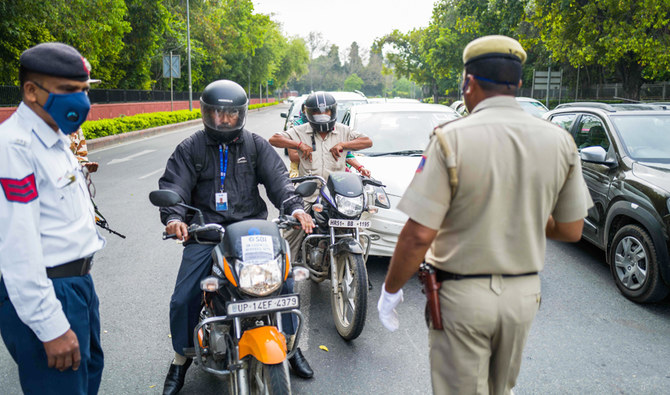
Those that are open said their delivery staff are being harassed and questioned by police for continuing their services during a lockdown.
Trucks carrying essential items are also barred from movement, making it tough for e-commerce startups, such as Amazon and Flipkart, to continue services.
Amazon said that the administrative confusion is causing problems, and varying guidelines by state governments are adding to the difficulties.
“We are asking both the central government and local authorities to help us with detailed on-ground operating procedures to ensure priority goods are delivered across the country without any disruption,” an Amazon spokesperson told Arab News on Saturday.
“We have made several changes to our delivery process and rolled out new processes to ensure that packages are delivered to customers safely,” he added.
Sunder said that Swiggy is also planning to start grocery deliveries in 150 major cities if it faces no disruptions in the supply chain because 85 percent of its staff are lying idle.
Zomato also claimed that lack of government clarity is causing disruption for its business.
“Our delivery partners are facing several hurdles across cities while trying to deliver food that has been classified as an essential service. We are communicating with the relevant authorities and hoping these issues are sorted out soon,” a spokesperson told Arab News on Saturday.
Deepender Goyal, Zomato’s founder, said on Wednesday that hundreds of the firm’s employees “have taken deep salary cuts.”
“To conserve our cash flow hundreds of Zomato employees have taken deep voluntary salary cuts,” he tweeted, adding that the firm is working with local authorities to make the e-commerce outlet work.
“The next immediate problem is to solve the restaurant and cloud kitchen availability. We need to ensure that kitchens stay open during these times so that we can help with food delivery as much as possible,” he said.
More than 18,000 employees working for Zomato and Swiggy are also facing uncertain times.
“We don’t know how many months this lockdown will last. The economy is going to shrink further. If I sit idle for three months, how will I feed the family?” asked Pawan Kumar, a Patna-based Zomato employee.
“The lockdown has affected lots of businesses, including food and beverage. Although the government offered exemption to essential services, the story at ground level is different. I am sure things will improve in coming days, but it’s terrible at the moment,” Bhanu Rohila, of Biryani by Kilo, a popular online food delivery app in New Delhi, told Arab News.
Experts agree, with Prof. Arun Kumar, of New Delhi-based Jawaharlal University, saying that the lockdown is “going to affect unorganized sectors the most.”
“It’s a case where you have 94 percent of the employment and 45 percent of the output, ” he said.


