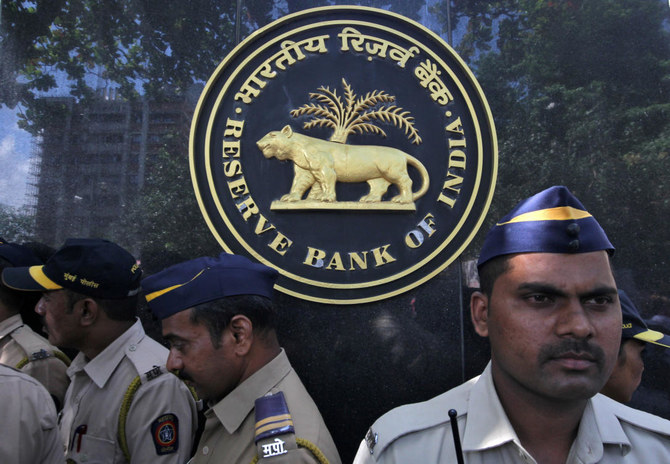
MUMBAI: India’s central bank cut interest rates sharply Friday as the coronavirus outbreak deepens fears for Asia’s third largest economy, which was already battling a prolonged slowdown.
The move, which came ahead of the bank’s scheduled meeting next month, followed similar measures around the world as finance chiefs struggle to stave off what could be the worst economic crisis in decades.
As manufacturing activity and consumption grinds to a halt under a lockdown, the Reserve Bank of India (RBI) said the benchmark repo rate — the level at which it lends to commercial banks — would be cut by 75 basis points to 4.40 percent.
The reverse repo rate, the rate at which it borrows from commercial banks, was lowered 90 basis points.
The bank also cut the amount of cash lenders must set aside as reserves by one percentage point to three percent to encourage lending to small businesses hit by the crisis.
“This kind of uncertain outlook has never been seen before... finance is the lifeline of the economy and keeping it active is of paramount importance for the RBI,” central bank governor Shaktikanta Das said in a surprise announcement in Mumbai.
He added that India needed conventional and non-conventional measures to tackle the unprecedented situation depending on the spread, intensity, and duration of the COVID-19 outbreak.
India has so far registered 694 cases for its 1.3-billion-strong population but experts believe the numbers could rise exponentially in the weeks ahead.
Earlier this week, the government imposed strict restrictions asking citizens to stay indoors, only allowing essential services to function.
Das said India would struggle to achieve fourth-quarter growth projections of 4.7 percent as major global economies faced the risk of recession.
The bank last slashed its rates by 75 points in November 2008, during the global financial crisis.
Analysts say India’s economy is likely to see its lowest annual expansion since that year, as the virus batters its industries.
“The RBI announcement ensures banks will have enough funds for lending and will inject liquidity into parts of the economy ... through this tremendously challenging period,” Sameer Narang, an economist with the Bank of Baroda, said.
The measures “cannot improve the growth rate because the growth rate depends on revenue and that depends on how COVID-19 progresses and how the lockdown is managed,” said Sujan Hajjra, an economist with Anand Rathi Securities in Mumbai.
But they “will keep the economy from plunging into a deep recession,” he said.
India on Thursday announced an economic welfare package of 1.7 trillion rupees ($22.54 billion) to help its poorest citizens with direct cash transfers and food subsidies for three months.
After Das’s announcement, shares on the Bombay Stock Exchange Sensex Index rose almost one percent, while the Nifty 50 jumped by almost two percent.


![]()

India’s central bank slashes interest rates as coronavirus spreads
Short Url
https://arab.news/5v4jd
India’s central bank slashes interest rates as coronavirus spreads
- The reverse repo rate, the rate at which it borrows from commercial banks, was lowered 90 basis points
- Analysts say India’s economy is likely to see its lowest annual expansion since that year, as the virus batters its industries


Latest updates


© 2026 SAUDI RESEARCH & PUBLISHING COMPANY, All Rights Reserved And subject to Terms of Use Agreement.