

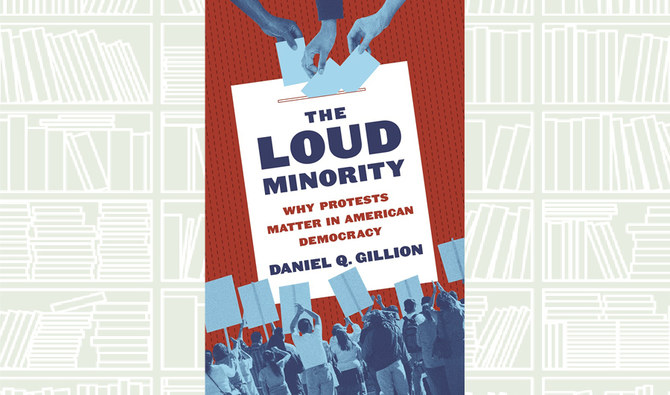
What We Are Reading Today: The Loud Minority by Daniel Q. Gillion

Short Url
Updated 12 March 2020
Follow

What We Are Reading Today: The Loud Minority by Daniel Q. Gillion

The “silent majority” — a phrase coined by Richard Nixon in 1969 in response to Vietnam War protests and later used by Donald Trump as a campaign slogan — refers to the supposed wedge that exists between protesters in the street and the voters at home. 

The Loud Minority upends this view by demonstrating that voters are in fact directly informed and influenced by protest activism, says a review on the Princeton University Press website. Consequently, as protests grow in America, every facet of the electoral process is touched by this loud minority, benefiting the political party perceived to be the most supportive of the protestors’ messaging.

Drawing on historical evidence, statistical data, and detailed interviews about protest activity since the 1960s, Daniel Gillion shows that electoral districts with protest activity are more likely to see increased voter turnout at the polls. Surprisingly, protest activities are also moneymaking endeavors for electoral politics, as voters donate more to political candidates who share the ideological leanings of activists.


Book Review: ‘The Alchemist’ by Paulo Coelho

Updated 21 January 2026
Follow

Book Review: ‘The Alchemist’ by Paulo Coelho

I first picked up “The Alchemist” at a time when I felt restless; not unhappy but unsettled, with the quiet sense that I was meant for something more than routine and familiarity.

From the very first pages, Paulo Coelho’s novel felt less like a story I was reading and more like one that spoke to me gently.

The book follows Santiago, a young shepherd who dares to leave behind what is comfortable in search of a dream he cannot ignore. His journey across unfamiliar lands mirrors the internal journey many of us experience but rarely act on.

I found myself reflecting on my own hesitations, the dreams I had postponed, and the fears I had allowed to guide my decisions. 

What struck me most about “The Alchemist” was its simplicity. Coelho’s writing is clear and almost meditative, yet the ideas carry emotional weight.

The concept of a “personal legend” stayed with me long after I finished the book. It made me question whether I was truly listening to my own desires or simply following the path that felt safest. 

There were moments while reading when certain lines felt uncomfortably accurate, as if the book was holding up a mirror. It reminded me how easy it is to convince ourselves that timing is wrong, that circumstances are not ideal, or that dreams can wait. Coelho challenges that thinking, suggesting that the real risk lies in never trying at all. 

While some may find the book idealistic, I found comfort in its optimism. “The Alchemist” does not promise success without struggle, but it reframes setbacks as part of the journey rather than signs of failure. That perspective felt reassuring and grounding. 

By the time I reached the final pages, I did not feel like I had found all the answers, but I did feel more aware. “The Alchemist” encouraged me to trust my instincts, accept uncertainty and believe that ambition does not need justification.

For anyone who senses there is more waiting beyond fear and familiarity, this book has the power to gently shift how you see your own path.