US urges Tehran to release American prisoners amid virus crisis

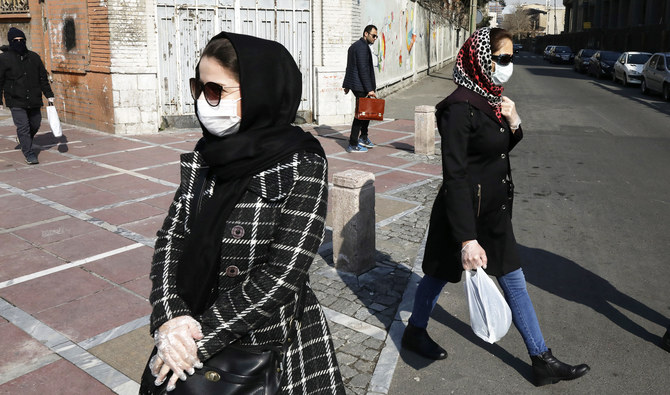
Pedestrians walk as some of them wear masks in downtown Tehran, Iran. (AP)
Short Url
Updated 11 March 2020
Follow

US urges Tehran to release American prisoners amid virus crisis

  • Iran’s response to the deadly coronavirus outbreak ‘too little, too late’ – UN rights expert

WASHINGTON: The United States on Tuesday called for Iran to release all American prisoners held in the country as the coronavirus outbreak reportedly spreads through its prisons.
“The United States will hold the Iranian regime directly responsible for any American deaths. Our response will be decisive,” US Secretary of State Mike Pompeo said in a statement.
“Reports that COVID-19 has spread to Iranian prisons are deeply troubling and demand nothing less than the full and immediate release of all American citizens.
“Their detention amid increasingly deteriorating conditions defies basic human decency.”
Iran’s response to the deadly coronavirus outbreak, including temporarily releasing 70,000 prisoners, was “too little, too late,” a UN rights expert said Tuesday.

Opinion

This section contains relevant reference points, placed in (Opinion field)


Javaid Rehman, the United Nations special rapporteur on human rights in Iran, said Tehran was trying to “fudge” its handling of the outbreak, one of the deadliest outside China, where the disease originated.
“The situation on coronavirus is highly disturbing within Iran,” Rehman told reporters at the UN in Geneva.
Iran on Tuesday reported 54 new deaths in the past 24 hours, the highest single-day toll since the start of the outbreak there. That brought the numbers killed in the country to 291 out of 8,042 infected.
The Iranian judiciary’s Mizan Online official news agency cited Asghar Jahangir, the head of Iran’s prisons organization, as saying that “about 70,000 prisoners” had been released in a bid to combat the outbreak.
Iran said in December it was ready for more prisoner swaps with the United States after it secured the return of scientist Massoud Soleimani in exchange for Xiyue Wang, a Chinese-born American held in the Islamic republic.
Decades-old tensions between Tehran and Washington have escalated steeply since 2018, when US President Donald Trump unilaterally withdrew from a landmark 2015 nuclear deal and reimposed sanctions on Iran.


UN warns of abuse of Palestinians returning to Gaza through Rafah crossing

Updated 7 sec ago
Follow

UN warns of abuse of Palestinians returning to Gaza through Rafah crossing

  • Human Rights Office describes pattern of ill-treatment, abuse and humiliation of returnees by Israeli forces, and by armed Palestinians allegedly backed by Israeli military
  • Meanwhile, reports continue of airstrikes, gunfire and shelling across Gaza, and Israeli forces demolish a UN-run school

NEW YORK CITY: The Rafah crossing on the border between Gaza and Egypt opened for a fourth consecutive day on Thursday, allowing a limited number of people to pass through.
However, the UN voiced concerns about reported mistreatment of Palestinians returning to the war-ravaged enclave.
The UN’s Office for the Coordination of Humanitarian Affairs also said reports continue across civilian areas in Gaza of airstrikes, gunfire and shelling, resulting in casualties and damage to infrastructure.
And Israeli forces on Wednesday demolished Jabalya Preparatory Boys’ School in northern Gaza, OCHA said. Run by the UN Relief and Works Agency for Palestine Refugees, it was the last remaining school in a compound of six. Its destruction means the entire educational complex has been razed to the ground.
A limited flow of people were allowed to use the Rafah crossing, Gaza’s main physical connection to the outside world, for four days in a row since it reopened on Monday, OCHA said. Only 98 returnees were received by UN teams inside Gaza between Monday and Thursday, it added, and the crossing remains closed on Fridays.
The UN Human Rights Office warned of what it described as a pattern of ill-treatment, abuse and humiliation of returnees by Israeli forces, and by armed Palestinians allegedly backed by the Israeli military.
According to accounts collected by the UN’s Human Rights Office, armed Palestinians handcuffed and blindfolded returnees, threatened and intimidated them, conducted searches and stole personal belongings and money. Returnees also reported violence, degrading interrogations and invasive body searches upon arrival at Israeli checkpoints.
The accounts point to conduct that violates the rights of Palestinians to personal security and dignity, and freedom from torture and other ill-treatment, the Human Rights Office said.
Meanwhile, the UN said it attempted to coordinate 11 humanitarian missions with the Israeli authorities on Wednesday and Thursday. Six were fully facilitated, but four faced lengthy delays at holding points along designated routes. Two of those missions were only partially completed, the other two eventually went ahead despite the delays.
A mission to monitor humanitarian cargo at the Kissufim crossing, east of Khan Younis, was denied on Wednesday after the crossing was closed.
The purposes of the missions included the collection of water, sanitation supplies, fuel and other items, medical evacuations through the Rafah crossing, and the transportation of returnees to Nasser Hospital in Khan Younis, OCHA said.