Russia rules out military pact with Philippines

Russia has no interest in further military alliances because “they provide security for a selected few member states at the expense of others.” (AFP)
Short Url
Updated 25 February 2020
Follow

Russia rules out military pact with Philippines

  • Russia seeks ‘equal partnership’ after Duterte scraps US troops deal

MANILA: Russia has ruled out the possibility of a military alliance with the Philippines despite President Rodrigo Duterte’s decision to end a major defense pact with the US.

Instead, Russian Ambassador to Manila Igor Khovaev said on Monday that Moscow’s aim was to build a “robust, equal partnership” with Manila.

“The goal of our common work here is not trying to contain someone or to create some sort of alliance,” he told senior Philippine defense officials and diplomats at a reception for Russian Armed Forces Day.

Early in February, the Duterte administration announced it would end a visiting forces agreement signed with Washington in 1998 that sets the terms for joint exercises with US troops in the Philippines.

According to Khovaev, Russia has no interest in further military alliances because “they provide security for a selected few member states at the expense of others.”

“The Russian Federation proceeds from the premise that security has to be indivisible. This is why we are not in the habit of entering into alliances,” he said.

“Equal partnerships” are necessary for stability and prosperity in the region, he added.

Asked if this ruled out a Russia-Philippines alliance similar to that between Manila and Washington, Khovaev said: “Yes. Our aim is to build a strong, robust partnership, not a military alliance. We have no military alliance in the Asia-Pacific region,” he told Arab News.

He also reiterated the importance of military cooperation between Russia and the Philippines, which was highlighted by President Vladimir Putin and Duterte during their meetings in Moscow in May 2017 and in Sochi in October 2019.

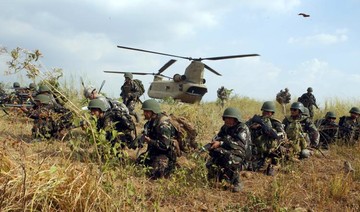
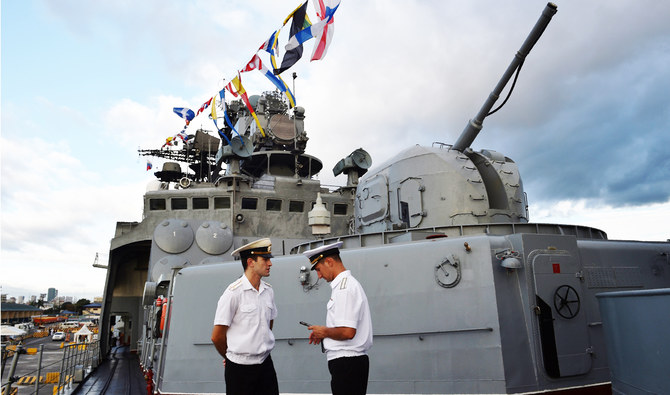
The two nations have organized joint military exercises, and the exchange of visits by Russian and Philippine navy ships in Manila and Vladivostok.

“But to tell you the truth, the full potential of our cooperation has yet to be explored,” Khovaev said. “It is indispensable because we have common threats and challenges, including terrorism, international drug trafficking, piracy and other kinds of transnational crime that we need to overcome together.”


Russia awaits an answer from the US on New START as nuclear treaty ticks down

Updated 4 sec ago
Follow

Russia awaits an answer from the US on New START as nuclear treaty ticks down

  • Russian leader Vladimir Putin has proposed keeping the treaty’s limits
  • US President Donald Trump has said Putin’s proposal sounded ‘like a good idea’
MOSCOW: Russia on Wednesday said it was still awaiting a formal answer from Washington on President Vladimir Putin’s proposal to jointly stick to the last remaining Russian-US arms control treaty, which expires in less than two months.
New START, which runs out on February 5, caps the number of strategic nuclear warheads that the United States and Russia can deploy, and the deployment of land- and submarine-based missiles and bombers to deliver them.
Putin in September offered to voluntarily maintain for one year the limits on deployed strategic nuclear weapons set out in the treaty, whose initials stand for the (New) Strategic Arms Reduction Treaty.
Trump said in October it sounded “like a good idea.”
“We have less than 100 days left before the expiry of New START,” said Sergei Shoigu, the secretary of Russia’s powerful Security Council, which is like a modern-day politburo of Russia’s most powerful officials.
“We are waiting for a response,” Shoigu told reporters during a visit to Hanoi. He added that Moscow’s proposal was an opportunity to halt the “destructive movement” that currently existed in nuclear arms control.
Nuclear arms control in peril
Russia and the US together have more than 10,000 nuclear warheads, or 87 percent of the global inventory of nuclear weapons. China is the world’s third largest nuclear power with about 600 warheads, according to the Federation of American Scientists.
The arms control treaties between Moscow and Washington were born out of fear of nuclear war after the 1962 Cuban Missile Crisis. Greater transparency about the opponent’s arsenal was intended to reduce the scope for misunderstanding and slow the arms race.
US and Russia eye China’s nuclear arsenal
Now, with all major nuclear powers seeking to modernize their arsenals, and Russia and the West at strategic loggerheads for over a decade — not least over the enlargement of NATO and Moscow’s war in Ukraine — the treaties have almost all crumbled away. Each side blames the other.
In the new US National Security Strategy, the Trump administration says it wants to reestablish strategic stability with Russia” — shorthand for reopening discussions on strategic nuclear arms control.
Rose Gottemoeller, who was chief US negotiator for New START, said in an article for The Arms Control Association this month that it would be beneficial for Washington to implement the treaty along with Moscow.
“For the United States, the benefit of this move would be buying more time to decide what to do about the ongoing Chinese buildup without having to worry simultaneously about new Russian deployments,” Gottemoeller said.