

Philippines to end joint military drills with US

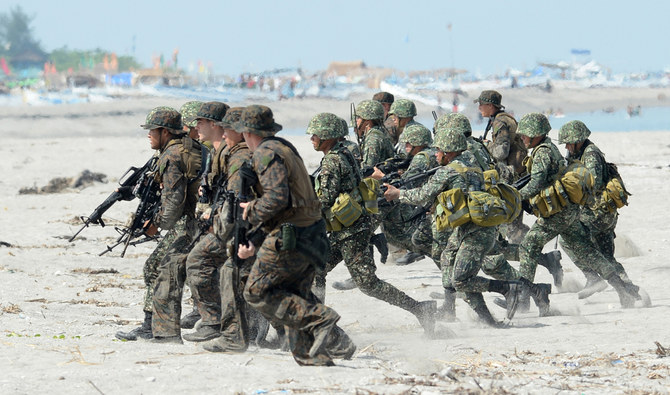
Signed in 1998 and ratified in 1999, the VFA provides legal cover to American troops temporarily deployed in the Philippines to participate in military activities including joint exercises. (AFP)
Short Url
Updated 14 February 2020
Follow

Philippines to end joint military drills with US

  • Over 300 military exercises between the two armed forces are scheduled for this year

MANILA: Joint combat drills between Philippine and US forces will end with the termination of the Visiting Forces Agreement (VFA) in August, Defense Secretary Delfin Lorenzana said on Thursday.

“Once the termination is final, we will cease to have exercises with them,” Lorenzana said in his first public statement since the Philippines formally served notice of the termination of the VFA to the US.

Signed in 1998 and ratified in 1999, the VFA provides legal cover to American troops temporarily deployed in the Philippines to participate in military activities including joint exercises.

Article IX of the VFA says: “This agreement shall remain in force until the expiration of 180 days from the date on which either party gives the other party notice in writing that it desires to terminate the agreement.”

However, Lorenzana said military drills between the Philippines and US armed forces scheduled to take place while the VFA is still in effect will still happen.

“With the formal serving of the notice of termination of the Visiting Forces Agreement, this year’s planned military exercises with the Americans shall proceed as scheduled within the 180 days that the VFA remains in force,” Lorenzana explained.

SPEEDREAD

Over 300 military exercises between the two armed forces are scheduled for this year, including the annual Balikatan (shoulder-to-shoulder) exercise scheduled to take place May 3 to 15.

This year marks the 36th iteration of the annual training event, which is focused on a variety of missions including humanitarian assistance, disaster relief, counterterrorism, and mutual defense. 

The Balikatan exercise, the most prominent of the Philippines-US joint exercises, also focuses on interoperability training events.

Lorenzana, however, said their American counterparts “may opt to discontinue the scheduled exercises before the 180 days are up.”

On Wednesday, Armed Forces of the Philippines (AFP) Chief of Staff Felimon Santos said around half of the 318 activities laid out this year with their US counterparts will be affected once the VFA is terminated.

Santos added that the Armed Forces support President Rodrigo Duterte’s decision to scrap the agreement, and said that the Philippines will survive without the VFA.

The AFP chief also said that to make up for losing the VFA with the US, the Philippines will increase its engagements with other countries, including Japan and Australia, and will look to sign VFAs with such allies.


Airspace closed, flights canceled as US-Iran conflict flares

Updated 01 March 2026
Follow

Airspace closed, flights canceled as US-Iran conflict flares

  • Major carriers from the Middle East, Europe, Asia-Pacific and the US announced widespread cancelations
  • FlightAware said more than 19,000 flights had been delayed globally and more than 2,600 were canceled as of Sunday

PARIS: Thousands of flights have been delayed or canceled in the biggest disruption to global air transport since the Covid pandemic as airlines suspend services to the Middle East following the US and Israeli attacks on Iran.
Iran, Iraq, Israel, Syria, Kuwait and the United Arab Emirates all announced at least partial closures of their skies after Saturday’s strikes and Iran launching missiles at capital cities around the wealthy Gulf region.
Major carriers from the Middle East, Europe, Asia-Pacific and the United States announced widespread cancelations, leaving thousands of passengers stranded.
Notable airlines that canceled services included Emirates, Etihad, Air France, British Airways, Air India, Turkish Airlines, and Lufthansa.
According to aviation analytics company Cirium, of around 4,218 flights scheduled to land in Middle Eastern countries on Saturday, 966 (22.9 percent) were canceled, with the figure rising above 1,800 if also including outbound flights.
For Sunday, 716 flights out of 4,329 scheduled to the Middle East have been canceled, Cirium said.
Flight tracking website FlightAware meanwhile said more than 19,000 flights had been delayed globally and more than 2,600 were canceled as of 0230 GMT Sunday.
Airspace closures
Iran swiftly closed its airspace as the strikes began “until further notice,” said the spokesman of Iran’s Civil Aviation Organization, quoted by the Tasnim news agency.
Israel also closed its airspace to civilian flights, Transport Minister Miri Regev announced.
Qatar’s civil aviation authority said it had temporarily closed the Gulf state’s airspace.
Iraq shut down airspace, state media said.
The United Arab Emirates said it was closing its skies “partially and temporarily.”
Syria closed part of its airspace in the south along the border with Israel for 12 hours, the Civil Aviation Authority said.
Jordan’s air force was conducting drills to “defend the kingdom’s skies,” its military said.
Kuwait closed its airspace.
Middle East and North Africa airlines
Gulf carriers Emirates and Etihad canceled 38 percent and 30 percent of their flights respectively, Cirium said.
Qatar Airways suspended all flights from Doha. It canceled 41 percent of total flights, according to Cirium.
Syria Air, the country’s national carrier, canceled all flights until further notice.
Egypt’s national airline, EgyptAir, announced the suspension of its flights to cities across the Middle East, including Dubai, Doha, Manama, Abu Dhabi, Beirut and Baghdad among others.
European airlines
Russia’s air transport authority Rosaviatsia said all commercial flights to Israel and Iran were canceled “until further notice.”
Turkish Airlines canceled flights to Lebanon, Syria, Iraq, Iran, and Jordan until March 2.
Air France canceled its Dubai, Riyadh and Beirut flights for Saturday, and flights to Tel Aviv until Sunday.
British Airways said it was not flying to Tel Aviv and Bahrain until March 4, and canceled flights to the Jordanian capital Amman on Saturday.
Swiss International Air Lines suspended flights to and from Tel Aviv until March 7, and canceled flights from Zurich to Dubai scheduled for Saturday and Sunday.
Germany’s Lufthansa, which comprises Swiss and ITA Airways, canceled its flights to and from Tel Aviv, Beirut, Amman, Irbil and Tehran until March 7.
The airline group and its subsidiaries suspended flights to and from Dubai and Abu Dhabi until Sunday.
North America airlines
Delta Air Lines suspended New York-Tel Aviv flights until Sunday.
American Airlines “temporarily suspended” Doha-Philadelphia flights.
United flights to Tel Aviv are canceled until Monday, and flights to Dubai until Sunday.
Air Canada said it canceled flights from Canada to Israel until March 8 and to Dubai until March 3.
Asia-Pacific airlines
India’s two largest private carriers IndiGo and Air India suspended flights to all destinations in the Middle East.
Pakistan International Airlines, the flag carrier of the country that borders Iran, said it had suspended flights to the UAE, Bahrain, Doha and Kuwait.
Hong Kong’s Cathay Pacific suspended flights to Dubai and Riyadh.
Garuda Indonesia, Indonesia’s flag carrier, temporarily suspended flights to and from Doha “until further notice,” the company said in a statement Sunday.
Singapore Airlines and Singapore’s Scoot canceled six flight routes in the region until the end of Sunday, local media reported.
Philippine Airlines flights from Manila to Doha, Riyadh to Manila, and Dubai to Manila were canceled on Saturday, as well as one Doha-Manila flight on Sunday.
Other major airlines including Australia’s Qantas and Japan’s All Nippon Airways did not announce any flight cancelations.
Africa airlines
Ethiopian Airlines canceled its flights to Amman, Tel Aviv, Dammam, and Beirut.
Kenya Airways has suspended its flights to Dubai and Sharjah until further notice.