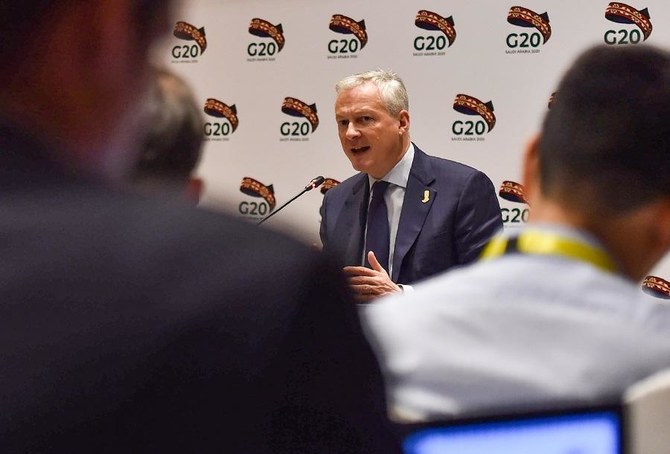
RIYADH: Finance officials from the world’s 20 biggest economies (G20) meeting in Riyadh on Sunday reached agreement on the wording of a final communique that includes a reference to climate change for the first time, G20 diplomatic sources said.
Overcoming US objections, the compromise language retained a reference to work by the Financial Stability Board to examine the implications of climate change on financial stability, although it dropped climate change from its list of downside risks to global economic growth.
One of the sources said it was the first time a reference to climate change had been included in a G20 finance communique, even though it was removed from the top of the joint statement.
G20 finance ministers and central bankers are meeting in the Saudi capital to discuss top global economic challenges, including the spread of the new coronavirus.
G20 officials completed work on the communique on Sunday morning. The final wording was not immediately available.
Delegates worked out a compromise after Washington objected to the initial proposed language, which had included “macroeconomic risk related to environmental stability” in a list of downside risks, two G20 diplomatic sources said.
The communique forecasts a modest pick-up in global growth this year and next, but cites downside risks to this outlook stemming from geopolitical and remaining trade tensions and policy uncertainty.

G20 agrees final communique with reference to climate change
https://arab.news/8yapt
G20 agrees final communique with reference to climate change
- One of the sources said it was the first time a reference to climate change had been included in a G20 finance communique
- G20 officials completed work on the communique on Sunday morning
EU should consider forming combined military force: defense chief
- Kubilius floated creating a “powerful, standing ‘European military force’ of 100,000 troops” that could eventually replace US forces
- Trump has heightened fears among NATO allies over Washington’s reliability by insisting he wants to take over Greenland
BRUSSELS: EU countries should weigh whether to set up a combined military force that could eventually replace US troops in Europe, the bloc’s defense chief said Sunday.
EU defense commissioner Andrius Kubilius floated creating a “powerful, standing ‘European military force’ of 100,000 troops” as a possible option to better protect the continent.
“How will we replace the 100,000-strong American standing military force, which is the back-bone military force in Europe?” he asked in a speech in Sweden.
The suggestion comes as US President Donald Trump has heightened fears among NATO allies over Washington’s reliability by insisting he wants to take over Greenland.
Worries over Trump’s commitment to Europe have already spurred countries to step up efforts to bolster their militaries in the face of the threat posed by Russia.
Ideas about establishing a central European army have floated around for years but have largely failed to gain traction as nations are wary of relinquishing control over their militaries.
The US has pushed its European allies to increasingly take over responsibility for their own security, and raised the prospect it could shift forces from Europe to focus on China.
“In such times, we should not run away from the most pressing questions on our institutional defense readiness,” said Kubilius, a former Lithuanian prime minister.
In his speech Kubilius also advocated for the creation of a “European Security Council” of key powers — including potentially Britain — that could help the continent take decisions over its own defense quicker.
“The European Security Council could be composed of key permanent members, along with several rotational members,” he said.
“In total around 10-12 members, with the task to discuss the most important issues in defense.”
He said the first focus of such a body should be trying to change the dynamics in the war in Ukraine to ensure that Kyiv does not end up losing.
“We need to have a clear answer — how is the EU going to change that scenario?,” he said.
“This is the reason why we need to have a European Security Council now!“


