

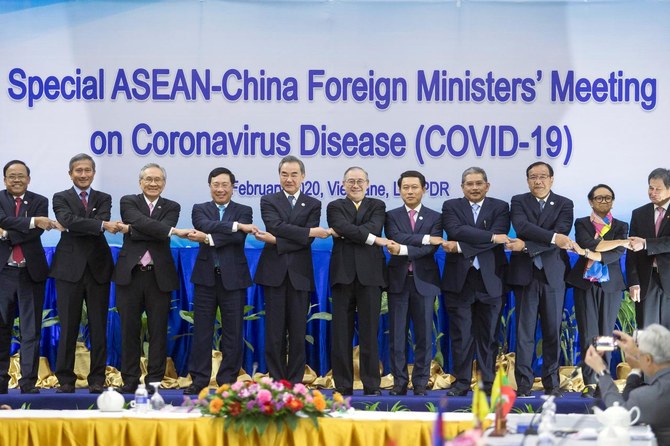
Asian countries pledge ‘regional solidarity’ with China over coronavirus outbreak

ember states of the Association of Southeast Asian Nations (ASEAN) declared their “solidarity” with China and in working to reduce the economic and social impact of the pandemic on the region. (Reuters)
Short Url
Updated 20 February 2020
Follow

Asian countries pledge ‘regional solidarity’ with China over coronavirus outbreak

  • China in emergency summit plea for more people-to-people cooperation to contain pandemic

KUALA LUMPUR: An intergovernmental group of Asian countries on Thursday pledged support to China in its fight against the killer coronavirus outbreak.

Member states of the Association of Southeast Asian Nations (ASEAN) declared their “solidarity” in working to reduce the economic and social impact of the pandemic on the region.

“ASEAN expressed its confidence that China would be able to handle the outbreak, however, each ASEAN country offers their help to China to address the crisis together,” said the Malaysian Minister of Foreign Affairs Saifuddin Abdullah.

Speaking on the sidelines of the Special ASEAN-China Foreign Ministers’ Meeting on the Coronavirus Disease 2019 (COVID-19), being held in Vientiane, the capital of Laos, he added: “There are impacts, especially economic impacts. We will work together to overcome this.”

The minister pointed out that the association had pinpointed a need to strengthen information exchange between ASEAN and China. He said that it was still unclear how the virus was being spread, which was “all the more reason for us to exchange notes.”

Chinese Foreign Minister Wang Yi urged nations to strengthen people-to-people cooperation in the region, as ASEAN ministers and Chinese officials held hands while chanting, “stay strong, Wuhan. Stay strong, China. Stay strong, ASEAN.”

The World Health Organization (WHO) has estimated that more than 77,000 people have contracted the virus worldwide, the majority of them in China.

Dr. Oh Ei Sun, senior fellow with the Singapore Institute of International Affairs, told Arab News on Thursday that the special China-ASEAN meeting sent a strong message to the world that the region was taking the virus outbreak “very seriously. These countries are seeking a more collaborative approach in handling the matter. Hopefully, it could at least improve the mechanism of sharing timely information and best practices in countering the outbreak.”

Thomas Daniel, senior analyst at the Malaysian Institute of Strategic and International Studies, said the main outcome of the meeting was “regional solidarity” and cultivating a sense of confidence-building in the wider region.

“It is more about the images and messaging than it is about concrete actions putting forward,” he added.

Daniel noted that China had been very appreciative of the support shown by ASEAN for the ongoing health crisis and said: “The emergency meeting definitely could have been done earlier. In cases like this, most of the time reactions are ‘nation first.’ It takes time for a multilateral approach to take place.”

However, ASEAN member states have so far been uncoordinated in implementing preventive measures to stop the virus’ spread.

While Malaysia won praise from the WHO and Singapore was lauded by Harvard University experts on Tuesday, Cambodia on Feb. 14 allowed hundreds of passengers on the Westerdam cruise ship to disembark in the port of Sihanoukville. Days later, coronavirus infections were reported among those who were allowed to go ashore.


Indian teacher who created hundreds of learning centers wins $1 million Global Teacher Prize

Updated 1 sec ago
Follow

Indian teacher who created hundreds of learning centers wins $1 million Global Teacher Prize

DUBAI: An Indian teacher and activist known for creating hundreds of learning centers and painting educational murals across the walls of slums won the $1 million Global Teacher Prize on Thursday.
Rouble Nagi accepted the award at the World Governments Summit in Dubai in the United Arab Emirates, an annual event that draws leaders from across the globe.
Her Rouble Nagi Art Foundation has established more than 800 learning centers across India. They aim to have children who never attended school begin to have structured learning. They also teach children already in school.
Nagi also paints murals that teach literacy, science, math and history, among other topics.
The prize is awarded by the Varkey Foundation, whose founder, Sunny Varkey, established the for-profit GEMS Education company that runs dozens of schools in Egypt, Qatar and the UAE.
“Rouble Nagi represents the very best of what teaching can be – courage, creativity, compassion, and an unwavering belief in every child’s potential,” Varkey said in a statement posted to the Global Teacher Prize website. “By bringing education to the most marginalized communities, she has not only changed individual lives, but strengthened families and communities.”
Nagi plans to use the $1 million to build an institute that offers free vocational training.
Stefania Giannini, UNESCO Assistant Director-General for Education, said Nagi’s prize “reminds us of a simple truth: teachers matter.”
In comments carried on the prize website, Giannini said UNESCO was “honored to join the Global Teacher Prize in celebrating teachers like you, who, through patience, determination, and belief in every learner, help children into school — an act that can change the course of a life.”
Nagi is the 10th teacher to win the award, which the foundation began handing out in 2015.
Past winners of the Global Teacher Prize have included a Kenyan teacher from a remote village who gave away most of his earnings to the poor, a Palestinian primary school teacher who teaches her students about non-violence and a Canadian educator who taught a remote Arctic village of Inuit students. Last year’s winner was Saudi educator Mansour Al-Mansour, who was known for his work with the poor in the kingdom.
GEMS Education, or Global Education Management Systems, is one of the world’s largest private school operators and is believed to be worth billions. Its success has followed that of Dubai, where only private schools offer classes for the children of the foreigners who power its economy.