



JEDDAH: Saudi Arabia’s economic development program aims to increase the gross domestic product (GDP) contribution of small and medium-sized enterprises (SMEs) from 20 percent at present to 35 percent by 2030.
Along the way, entrepreneurship opportunities will grow across a wide range of sectors, in what is by all accounts a significantly underserved market.
The Kingdom’s youth agree, with 76.3 percent of young adults seeing business prospects improving, according to a 2019 Global Entrepreneurship Monitor report.
In technology alone, venture capital (VC) leaders STV project that annual aggregate investments could expand tenfold from $50 million in 2018 to $500 million in 2025. But what sectors should entrepreneurs be looking at?
Fintech
Riyadh Bank’s launch of a SR100 million ($26.65 million) fund to support Saudi Arabia’s financial technology (fintech) startups in October 2019 shows just how quickly the country has moved to create a cashless economy by 2030.
Key events include the launch of the supporting body Fintech Saudi, the addition of fintech to the commercial register, and the Saudi Arabian Monetary Authority’s creation of a regulatory sandbox for local and international fintech startups to run tests in a supervised live environment.
Those in the space say established players are eager to collaborate with fintech startups to improve financial inclusion.
FlexxPay, a Dubai-based company that provides individuals with advances on their earned salary via deals, is relocating to the Kingdom.
“In (Saudi Arabia), there has been a huge shift over the past 12-18 months, where banks are eager to adopt new technologies and support fintech,” cofounder Michael Truschler said.
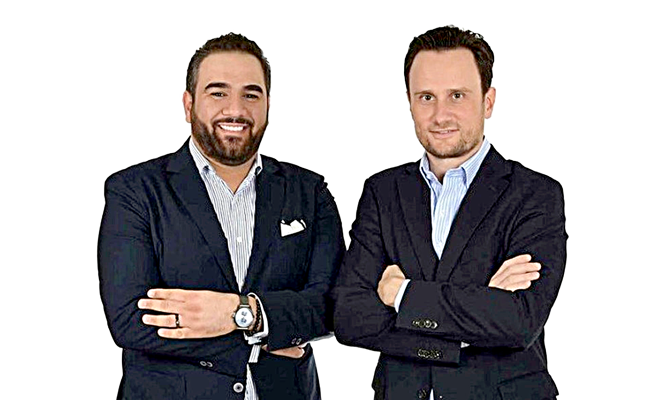
Flexxpay founders Charbel Nasr, left, and Michael Truschler. (Supplied)
Health care, life sciences
A fundamental shift is underway as the country of 35 million people moves from public-funded care toward a model that puts patients in charge of their own health.
As Saudi Arabia looks to combat obesity, heart disease and other chronic illnesses, the focus has shifted from hospitals and specialist settings to outpatient clinics. The market is growing at 12 percent a year, and is forecast to hit $160 billion by 2030.
Enterprise gaps exist in diagnostics and delivery, and manufacturing local alternatives to imported medical devices, about 9 percent of the market.
Recent investments indicate the sector’s strength. Medical records app Sihatech has raised $1.33 million, while diagnostics platform Nala won $1 million of funding.
Edtech
Saudi youth spend large amounts of time online in a country where mobile usage and Internet penetration are nearing 100 percent.
Add in the sector’s transition from a traditional teacher-centered approach to a learner-centered focus, and the country’s attraction for educational technology (edtech) startups is apparent: The market is estimated at $237.1 million by 2023.
The Saudi-born Noon Academy, which closed the largest-ever funding round by an edtech startup at $8.6 million last year, has expanded from two tutors and 30 students in 2013 to 1.6 million students in the country. It now expects to grow to 50 million students, partly by expanding into other markets.
Entertainment
The thousands of visitors attending music concerts as well as the first Japanese-themed anime expo testify to the market for entertainment in Saudi Arabia.
The Kingdom believes it can rank among the top 10 global entertainment destinations.
Plans for new entertainment facilities include 149 art galleries, 45 cinemas, 18 theaters, 27 electronic games venues, 16 family entertainment centers and an opera house.
The General Entertainment Authority (GEA) wants to attract investment of SR240 billion from local and global companies, and artists.
“SMEs, entrepreneurs and creative talents mainly fuel entertainment across many fields, hence this segment will benefit from the lion’s share of these investments,” said former GEA CEO, Amr Banaja, said.
Travel and tourism
Saudi Arabia’s first tourist visas in September 2019 made headlines worldwide. It was only one aspect of a strategy to build 100 million international and domestic overnights annually by 2030, while creating a million jobs and contributing 10 percent to GDP.
The country needs about SR250 billion in new business investment and 500,000 new hotel rooms over the next decade.
Ross McAuley, vice president of marketing at the travel-focused Seera Group, said that travel and tourism is a “key driver and beneficiary” of social change in the Kingdom.
• This report is being published by Arab News as a partner of the Middle East Exchange, which was launched by the Mohammed bin Rashid Al Maktoum Global Initiatives and the Bill and Melinda Gates Foundation to reflect the vision of the UAE prime minister and ruler of Dubai to explore the possibility of changing the status of the Arab region.




