

Muslim nations reject Trump’s Mideast plan in Saudi meeting

1 / 3
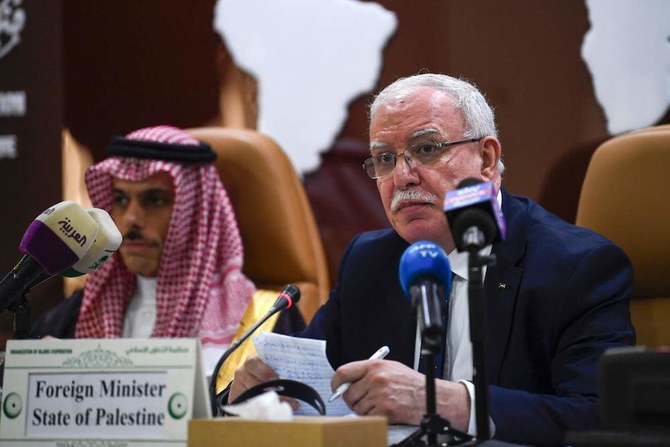
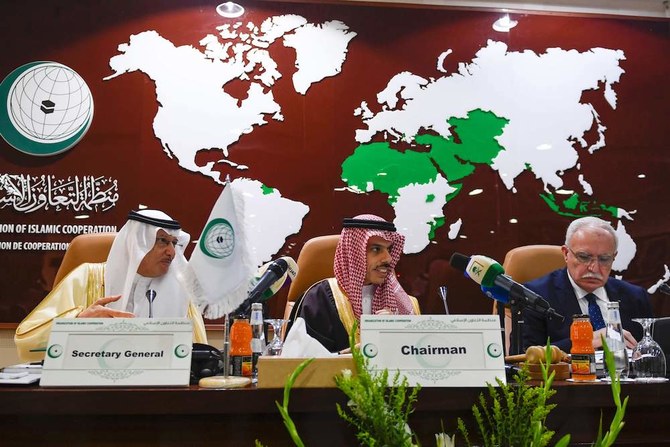
Palestinian Foreign Minster Riyad Al-Maliki (R) delivers a speech during an emergency ministerial meeting of the Organization of Islamic Cooperation (OIC) in Jeddah on Feb. 3, 2020, to address US President Donald Trump’s Middle East plan. (AFP)
2 / 3
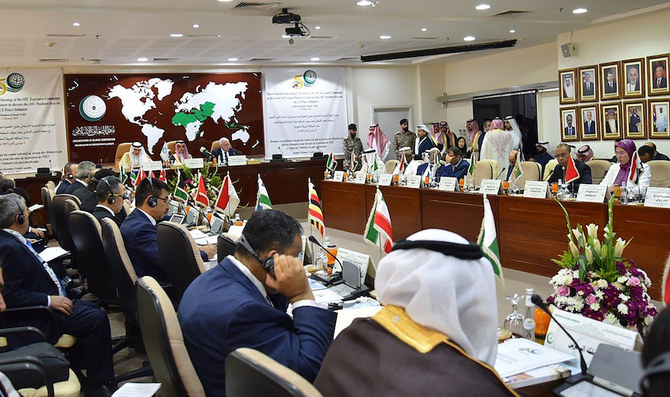
General view showing an emergency ministerial meeting in Jeddah, Saudi Arabia, Monday, Feb, 3, 2020. (Organization of Islamic Cooperation via AP)
3 / 3
Palestinian Foreign Minster Riyad Al-Maliki (R) delivers a speech during an emergency ministerial meeting of the Organization of Islamic Cooperation (OIC) in Jeddah on Feb. 3, 2020, to address US President Donald Trump’s Middle East plan. (AFP)
Short Url
Updated 03 February 2020
Follow

Muslim nations reject Trump’s Mideast plan in Saudi meeting

  • OIC slammed ‘the biased approach’ of the White House
  • It stressed east Jerusalem as ‘the eternal capital’ of a future Palestinian state

JEDDAH: The Organization of Islamic Cooperation (OIC) on Monday rejected the US administration’s peace plan for the Middle East and called on its member states not to help implement it.
The OIC “rejects this US-Israeli plan as it does not meet the minimum aspirations and legitimate rights of the Palestinian people and contradicts the terms of reference of the peace process,” it said in a statement.
 A meeting of foreign ministers at OIC headquarters in Jeddah called on “all member states not (to) deal with this plan or cooperate with the US administration efforts to enforce it in any way or form.”
 Under the US plan unveiled last week, Israel would retain control of the disputed city of Jerusalem as its “undivided capital” and annex settlements on Palestinian lands.

BACKGROUND

Under the US plan unveiled last week, Israel would retain control of the disputed city of Jerusalem as its ‘undivided capital’ and annex settlements on Palestinian lands.

The OIC reiterated its support for East Jerusalem as the capital of a future Palestinian state, stressing its “Arab and Islamic character.”
 It said peace would “only be achieved with the end of the Israeli occupation, the full withdrawal from the territory of the State of Palestine, in particular, the holy city of Al-Quds Al-Sharif (Jerusalem) and the other Arab territories occupied since (the) June 1967 (Middle East war).”
The organization urged the US administration to abide by legal terms of reference for a just resolution of the issue and for lasting peace in the region.
The OIC warned Israel against taking any measures to consolidate its “colonial occupation” of the Palestinian territories. It called on the international community to confront all such measures.



Yemen humanitarian crisis to worsen in 2026 amid funding cuts, says UN

Updated 5 sec ago
Follow

Yemen humanitarian crisis to worsen in 2026 amid funding cuts, says UN

  • Yemen has been the ‍focus of one of the world’s largest humanitarian operations in a decade of civil war that disrupted food supplies
GENEVA: The UN warned on Monday that the humanitarian situation in Yemen is worsening and that gains made to tackle malnutrition ​and health would go into reverse due to funding cuts.
“The context is very concerning... We are expecting things to be much worse in 2026,” Julien Harneis, UN Resident and Humanitarian Coordinator for Yemen, told reporters in Geneva.
Some 21 million people will need humanitarian assistance this year, an increase from ‌19.5 million the ‌previous year, according to the ‌UN ⁠The ​situation ‌has been aggravated by economic collapse and disruption of essential services including health and education, and political uncertainty, Harneis said.
Funding Yemen traditionally received from Western countries was now being cut back, Herneis said, pointing to hopes for more help from Gulf countries.
The US slashed its ⁠aid spending this year, and leading Western donors also pared back help ‌as they pivoted to raise defense ‍spending, triggering a funding ‍crunch for the UN
Yemen has been the ‍focus of one of the world’s largest humanitarian operations in a decade of civil war that disrupted food supplies. The country has also been a source of heightened tensions ​in recent months between Saudi Arabia and the United Arab Emirates.
“Children are dying and it’s ⁠going to get worse,” Harneis said. Food insecurity is projected to worsen across the country, with higher rates of malnutrition anticipated, he stated.
“For 10 years, the UN and humanitarian organizations were able to improve mortality and improve morbidity...this year, that’s not going to be the case.”
He said Yemen’s humanitarian crisis threatened the region with diseases like measles and polio that could cross borders.
In 2025 680 million dollars was afforded to ‌the UN in Yemen, about 28 percent of the intended target, Harneis said.