

Peace deal ‘will not pass,’ Palestinian exiles vow

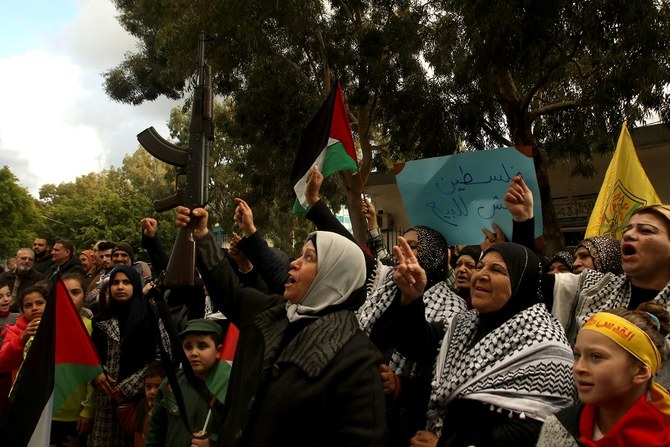
Refugees in Lebanese camps and towns took to the streets to voice their opposition to the so-called “deal of the century." (File/AFP)
Short Url
Updated 30 January 2020
Follow

Peace deal ‘will not pass,’ Palestinian exiles vow

  • Aoun calls Abbas in solidarity, while Iran foreign minister urges ‘united Arab response’

BEIRUT: Angry Palestinian refugees in Lebanon set fire to American and Israeli flags in response to US President Donald Trump’s Middle East peace offer, vowing the deal “will not pass.”

Refugees in Lebanese camps and towns took to the streets to voice their opposition to the so-called “deal of the century,” burning pictures of Trump and Israeli Prime Minister Benjamin Netanyahu, and calling on the Arab League to reject the offer.

The plan envisages a Palestinian state and the recognition of Israeli sovereignty over West Bank settlements.

The US leader said Jerusalem would remain Israel’s “undivided” capital, but the Palestinian capital would “include areas of East Jerusalem.”

Reacting to Tuesday’s announcement, Palestinian President Mahmoud Abbas said Jerusalem was “not for sale.”

“All our rights are not for sale and are not for bargain,” he added.

Lebanese President Michel Aoun called Abbas on Wednesday to affirm “Lebanon’s solidarity with the Palestinian people in facing the deal of the century,” according to his media office.

Aoun stressed “the importance of a unified Arab response,” saying Lebanon believes Palestinians have a right to an independent state with Jerusalem as its capital.

The Lebanese leader held talks with Foreign Minister Nassif Hitti ahead of a meeting of Arab foreign ministers in Cairo next Saturday.

“Any attempt to achieve a partial peace that does not guarantee the establishment of a Palestinian state with East Jerusalem as its capital will not succeed,” Hitti said.

“No one will give up their national identity in exchange for material temptations.”

Parliamentary Speaker Nabih Berri received a call from his Iranian counterpart Ali Larijani, who urged “Arab and Islamic peoples to reject the deal of the century.”

Berri said later that “Lebanon will not be a false witness at the new execution party for the Palestinian people.”

Palestinian rights will not be “bartered for money,” he added.

Prime Minister Hassan Diab tweeted: “Jerusalem will remain the compass and Palestine will remain the issue.”

Hezbollah also rejected the offer, describing it as “a very dangerous step that will have very bad repercussions for the future of the region and its peoples.”

The party warned that “the settlement project aims to create social, demographic and transitional tensions that serve only the interests of the enemy and its expansionist goals.”

Riad Tabbarah, former Lebanese ambassador to Washington, told Arab News the international community is unlikely to recognize the deal since the “disregard of the issue of refugees changes nothing on the ground.”

Speaking on the Arab League’s position, Tabbarah said: “I do not think any Arab country would dare take an anti-Palestinian stance. The presence of three Arab countries at the Trump and Netanyahu press conference does not necessarily mean they support the peace plan.”

Former Lebanese prime minister Salim Al-Hoss described the Trump deal as a “heinous crime that destroys the right of a people and abolishes an Arab homeland called Palestine.”

Another former leader, Fouad Siniora, said the deal ignored previous international agreements.

“It is a plan for the continuation of the Arab-Israeli conflict,” he added.


Spain highlights importance of Gaza reconstruction

Palestinian prime minister, Mohammed Mustafa, and the Spanish foreign minister, Jose Manuel Albares. (AP)
Updated 02 January 2026
Follow

Spain highlights importance of Gaza reconstruction

  • Spain officially recognized Palestine as a state in May 2024, in a coordinated move alongside Ireland and Norway

RAMALLAH: The Palestinian prime minister, Mohammed Mustafa, and the Spanish foreign minister, Jose Manuel Albares, on Friday discussed the latest developments in the West Bank and Gaza Strip.
During their telephone conversation they emphasized the need to intensify international efforts to end the Israeli occupation and halt attacks and settler violence, and to secure the release of Palestinian funds held by Israeli authorities.
They affirmed the importance of ongoing efforts relating to plans for the reconstruction of Gaza, and Europe’s significant role in this process. Mustafa and Albares highlighted the need to unify Palestinian institutions in Gaza with those in the West Bank, with the aim of establishing a Palestinian state in line with international resolutions, including last year’s New York Declaration.
They also discussed coordination between their countries, and the strengthening of Spain’s political, diplomatic and financial support for Palestine, and Mustafa thanked Spain for its ongoing support.
Spain officially recognized Palestine as a state in May 2024, in a coordinated move alongside Ireland and Norway. Estephan Salameh, the Palestinian finance and planning minister, is set to visit Spain this month to discuss enhanced cooperation, particularly in the areas of development and reconstruction. Meanwhile, Israel continues operating in the occupied West Bank.
The Palestinian Prisoners media office said on Friday that Israel carried out numerous raids across the territory, including the major cities of Ramallah and Hebron, according to The Associated Press.
Nearly 50 people were detained, following the arrest of at least 50 other Palestinians on Thursday, most of those in the Ramallah area.
As 2026 begins, the shaky 12-week-old ceasefire between Israel and Hamas has largely ended large-scale Israeli bombardment of Gaza. 
But Palestinians are still being killed by Israeli fire, especially along the so-called Yellow Line that delineates areas under Israeli control, and the humanitarian crisis is compounded by frequent winter rains and colder temperatures.
On Friday, American actor and film producer Angelina Jolie visited the Rafah border crossing between Egypt and the Gaza Strip. 
The only crossing between the territory and a country other than Israel, it remains closed despite Palestinian requests to reopen it to people and aid.
Jolie met with members of the Red Crescent on the Egyptian side of the Rafah border crossing and then visited a hospital in the nearby city of Arish to speak with Palestinian patients on Friday, according to Egyptian officials.
Aid groups say not enough shelter materials are getting into Gaza during the truce.