

French navy identifies Turkish vessel accompanying cargo ship carrying armored vehicles to Tripoli

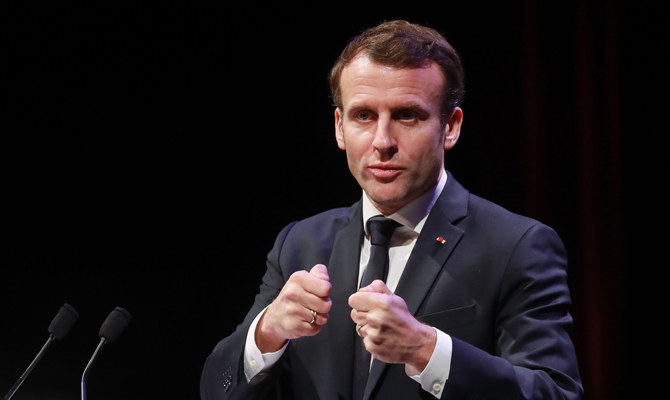
French President Emmanuel Macron. (AFP)
Short Url
Updated 01 February 2020
Follow

French navy identifies Turkish vessel accompanying cargo ship carrying armored vehicles to Tripoli

  • UN special representative warns of "dangerous conflagration” that could be precipitated by the the intervention of foreign actors in Libya’s conflict

JEDDAH: A row between France and Turkey over a pledge by world leaders not to interfere in Libya has escalated after a French aircraft carrier reportedly spotted a Turkish frigate operating in breach of a UN arms embargo on the country.

Hours after French President Emmanuel Macron had accused Ankara of breaking its promise to stay out of the Libyan civil conflict, the French Navy’s flagship Charles de Gaulle identified a Turkish vessel which appeared to be accompanying a cargo ship carrying armored vehicles to Libya’s capital Tripoli, AFP reported a French military source as saying.

Macron claimed that Turkish ships had been seen in recent days escorting boats loaded with Syrian mercenaries heading to Libyan battlegrounds in defiance of a UN arms embargo that has been in effect since February 2011.

Under the ruling, all supplies of arms and military equipment to and from Libya are banned.

Speaking before Thursday’s UN Security Council meeting, UN special representative for Libya Ghassan Salame warned that the intervention of foreign actors in Libya’s conflict by resupplying warring factions threatened “to precipitate a new and much more dangerous conflagration.”

During the UN discussions on Libya, Salame urged “the parties and their foreign sponsors to desist from reckless actions and instead renew their expressed commitment to work toward a cease-fire.”

Turkey supports the Tripoli-based Government of National Accord against fighters aligned with eastern commander Gen. Khalifa Haftar ,who currently controls almost three quarters of Libyan territory.

Aydin Sezer, a Turkish political analyst, said Turkey could well be condemned by the UN if the French claim is proven.

However, the Turkish Foreign Ministry put the blame on France for Libya’s instability, claiming that Paris gave “unconditional support” to Haftar for grasping the country’s energy reserves.

Although the Turkish Parliament approved in January a motion to give the green light to military deployment to Libya, Ankara claims that it has only dispatched a small number of Turkish troops to help with the training of local forces.

Experts do not expect an immediate sanctions against Turkey. 

Dr. Willem Theo Oosterveld, a senior fellow at the Hague Centre for Strategic Studies, said it is not very likely that the EU will impose sanctions on Turkey as a result of Turkey’s arms embargo violation due to the disagreement between the EU members on Libya issue. 

“And they would not want to further escalate tension with Turkey as there is already an ongoing dispute in the Eastern Med over gas drillings, for which the EU already adopted a sanctions framework back in 2019. Also, there is little appetite to see Turkey put pressure on the EU-Turkey deal as a new migration pact is to be discussed among EU member states in the coming months,” he told Arab News.


Lebanon PM says IMF wants rescue plan changes as crisis deepens

Updated 4 sec ago
Follow

Lebanon PM says IMF wants rescue plan changes as crisis deepens

  • “We want to engage with the IMF. We want to improve. This is a draft law,” Salam said
  • “They wanted the hierarchy of claims to be clearer. The talks are all positive”

DAVOS, Switzerland: The International Monetary Fund has demanded amendments to a draft rescue law aimed at hauling Lebanon out of its worst financial crisis on record and giving depositors access to savings frozen for six years, Prime Minister Nawaf Salam said.
The “financial gap” law is part of a series of reform measures required by the IMF in order to access its funding and aims to allocate the losses from Lebanon’s 2019 crash between the state, the central bank, commercial banks and depositors.
Salam told Reuters the IMF wants clearer provisions in the hierarchy of claims, which is a core element of the draft legislation designed to determine how losses are allocated.
“We want to engage with the IMF. We want to improve. This is a draft law,” Salam said in an interview at the World Economic Forum annual meeting in ⁠the Swiss mountain resort of Davos.
“They wanted the hierarchy of claims to be clearer. The talks are all positive,” Salam added.
In 2022, the government put losses from the financial crisis at about $70 billion, a figure that analysts and economists forecast is now likely to be higher.
Salam stressed that Lebanon is still pushing for a long-delayed IMF program, but warned the clock is ticking as the country has already been placed on a financial ‘grey list’ and risks falling onto the ‘blacklist’ if reforms stall further.
“We want an IMF program and we want to continue our discussions until we get there,” he said, adding: “International pressure is real ... The longer we delay, the more people’s money will evaporate.”
The draft law, which was passed by Salam’s government in December, is under parliamentary review. It aims to give depositors a guaranteed path to recovering their funds, restart bank lending, and end a financial crisis that has left nearly a million accounts frozen and confidence in the system shattered.
The roadmap would repay depositors up to $100,000 over four years, starting with smaller accounts, while launching forensic audits to determine losses and responsibility.
Lebanon’s Finance Minister Yassine Jaber, who is driving the reform push with Salam, told Reuters it was ⁠essential to salvage a hollowed-out banking system, and to stop the country from sliding deeper into its cash-only, paralyzed economy.
The aim, Jaber said, is to give depositors clarity after years of uncertainty and to end a system that has crippled Lebanon’s international standing.
He framed the law as part of a broader reckoning: the first time a Lebanese government has confronted a combined collapse of the banking sector, the central bank and the state treasury.
Financial reforms have been repeatedly derailed by political and private vested interests over the last six years and Jaber said the responsibility now lies with lawmakers.
Failure to act, he said, would leave Lebanon trapped in “a deep, dark tunnel” with no way back to a functioning system.
“Lebanon has become a cash economy, and the real question is whether we want to stay on the grey list, or sleepwalk into a blacklist,” Jaber added.