Chinese family diagnosed with coronavirus were in UAE for a week

1 / 6
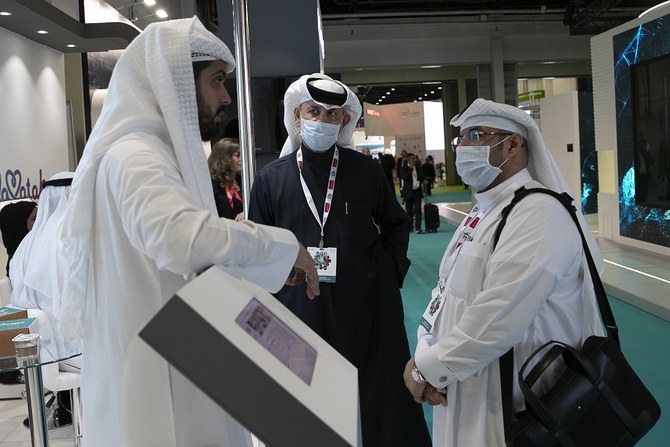
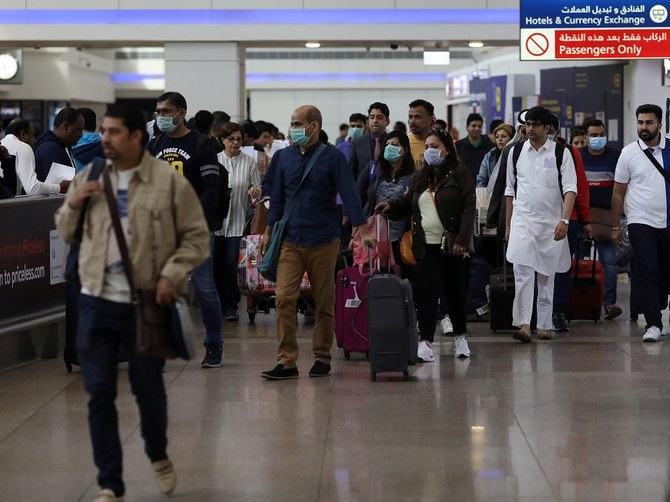
Visitors and exhibitors wear masks at the Arab Health Exhibition in Dubai, United Arab Emirates, Wednesday, Jan. 29, 2020. (AP)
2 / 6
Visitors and exhibitors wear masks at the Arab Health Exhibition in Dubai, United Arab Emirates, Wednesday, Jan. 29, 2020. (AP)
3 / 6
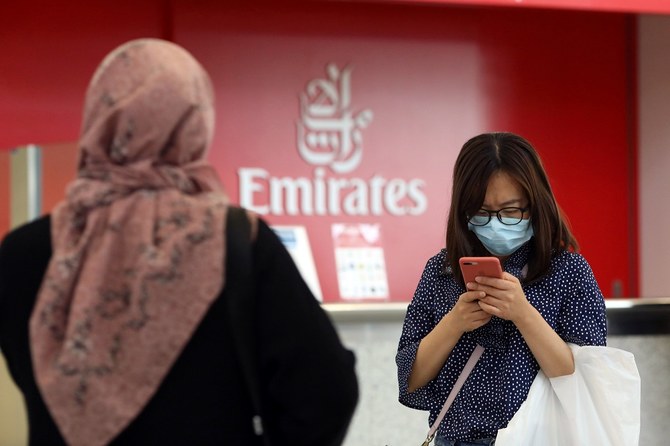
A traveller wears a mask at the Dubai International Airport on Wednesday, Janaury 29, 2020. (Reuters)
4 / 6
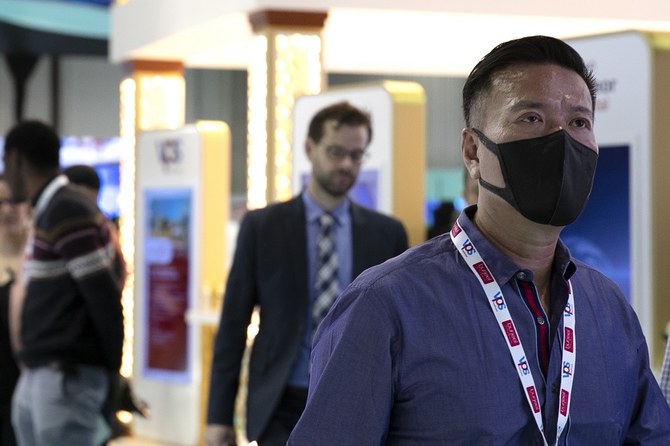
A man wears a mask as he visits the UAE Ministry stand during the Arab Health Exhibition in Dubai on Wednesday, Jan. 29, 2020. (AP)
5 / 6
Travellers wear masks as they arrive at the Dubai International Airport. (Reuters)
6 / 6
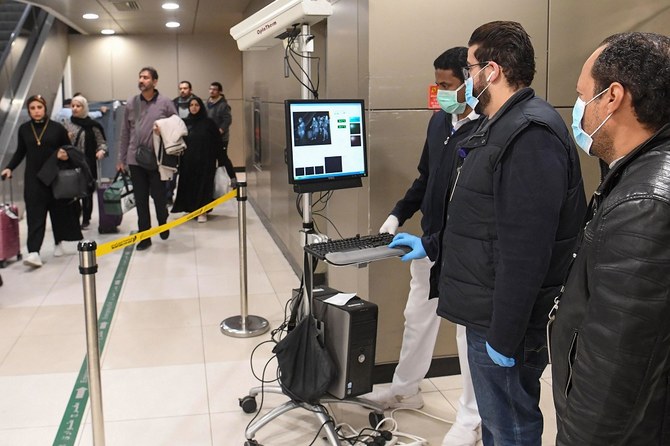
Temperature scanners are used to screen passengers for fever with upon their arrival at Kuwait international airport in Kuwait City on Wednesday, January 29, 2020. (AFP)
Short Url
Updated 29 January 2020
Follow

Chinese family diagnosed with coronavirus were in UAE for a week

  • Patients’ health stable and under medical observation
  • General health situation not a cause for concern, ministry says

DUBAI: The UAE Ministry of Health and Prevention confirmed Wednesday that four members of the same Chinese family in the Gulf state have been infected with coronavirus, and with an Emirati doctor saying the first to fall ill only showed symptoms after over a week on vacation.

Dr. Hussein al-Rand, an assistant undersecretary at the UAE's Ministry of Health and Prevention, said there was no reason to panic over virus. However, he acknowledged Emirati officials now were tracing the family's steps since landing in this federation of seven sheikhdoms that includes Dubai and Abu Dhabi.

“Their condition is stable, they are awake, they are all receiving all the measures,” al-Rand said. “I would say to the public: Please, don't be panicked. The health condition within the United Arab Emirates is safe.”
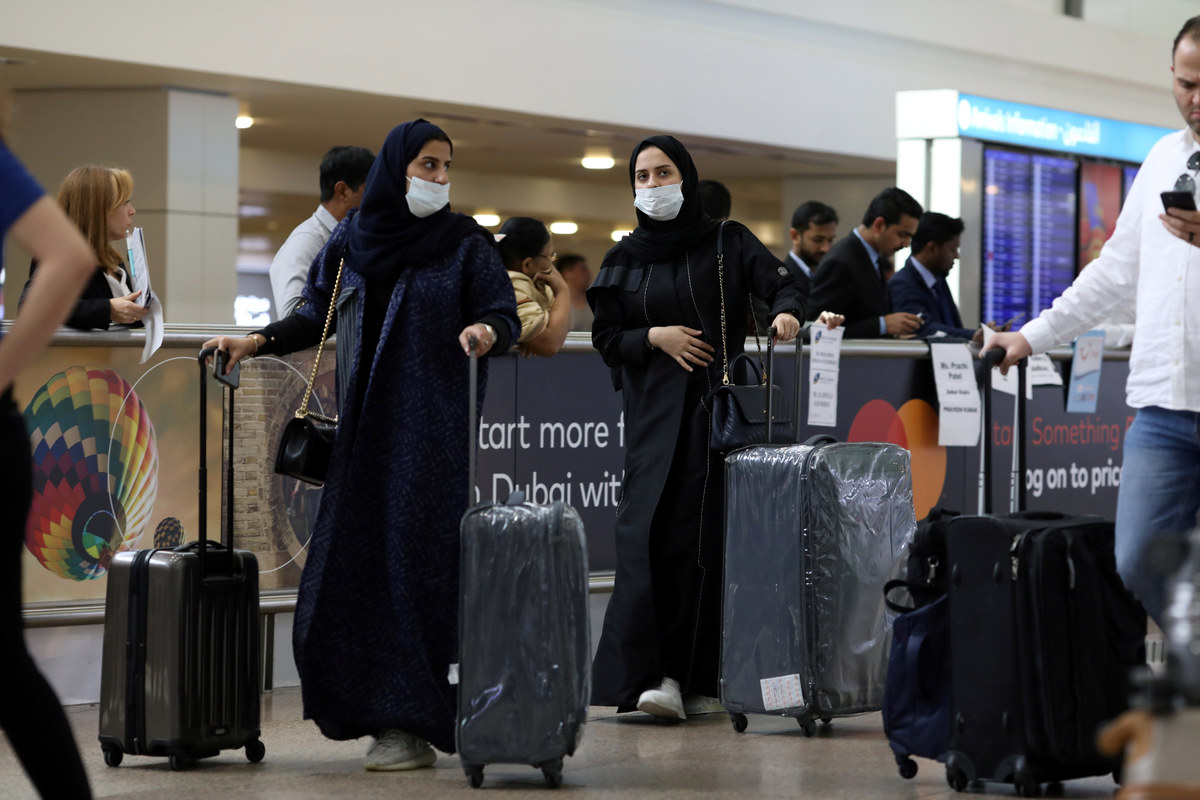


Travellers wear masks as they arrive at the Dubai International Airport in Dubai. (Reuters)

Among those sick in the family are a grandmother, her daughter, the daughter's husband and the couple's 9-year-old daughter, al-Rand said.

The family from Wuhan, the epicenter of the viral outbreak, entered the UAE on Jan. 16, al-Rand said.

Al-Rand declined to name the airline the family flew on and the airport at which they arrived.

Al-Rand also declined to say which cities they visited during their vacation.

Authorities at Abu Dhabi's airport and Dubai International Airport, the world's busiest for international travel, began screening passengers and crew from incoming China flights on Jan. 23.

That same day, Jan. 23, the grandmother among the family fell ill and sought medical care, Al-Rand said.

Public awareness about the virus had spread widely and doctors tested the grandmother for the new coronavirus and got a positive result. Authorities admitted the other three shortly after and they too tested positive.

By Wednesday the number of infected reached 5,974 cases in China alone, surpassing the number of infections during the Severe Acute Respiratory Syndrome (SARS) outbreak in 2003, at 5,327.


But some experts believed the Wuhan virus figures could still be under-reported, making it far more contagious that SARS.

It is not clear when the family arrived in the UAE, or what airline or airport they came through.

Meanwhile Kuwait asked its nationals not to travel to Shanghai, according to the state news agency KUNA.


In a statement Emirates confirmed that all its passengers arriving from China, including flights from Beijing, Shanghai and Guangzhou, were being screened by the Dubai health authorities.

“We are in close contact with all relevant UAE and Chinese regulatory authorities, and are complying with their directives and guidance. We are also closely monitoring and implementing the guidance of the World Health Organisation, which currently does not advise any restrictions on travel.

“Our crew members are highly trained and will follow standard operating procedures to manage any suspected cases on board. For more information on passenger screening, please contact the Ministry of Health.”
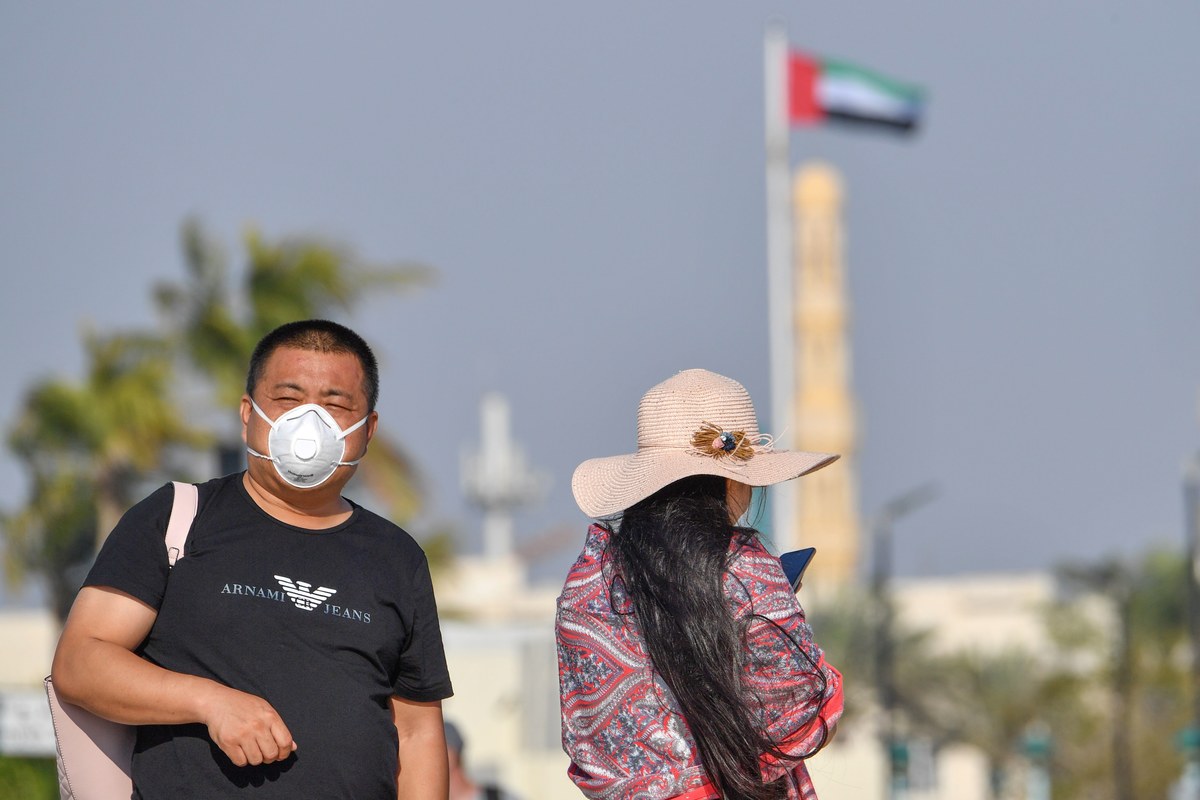


A visitor wears a surgical mask while touring Dubai on Wednesday, January 29 2020. (AFP)

Meanwhile local press reports suggest that the sale of face masks has risen significantly, with some pharmacists currently out of stock.

NOW READ: Coronavirus - who is at risk?


Hundreds flee to government-held areas in north Syria ahead of possible offensive

Updated 56 min 18 sec ago
Follow

Hundreds flee to government-held areas in north Syria ahead of possible offensive

  • Many of the civilians who fled used side roads to reach government-held areas
  • Men, women and children arrived in cars and pickup trucks that were packed with bags of clothes

DEIR HAFER, Syria: Scores of people carrying their belongings arrived in government-held areas in northern Syria on Friday ahead a possible attack by Syrian troops on territory held by Kurdish-led fighters east of the city of Aleppo.
Many of the civilians who fled used side roads to reach government-held areas because the main highway was blocked with barriers at a checkpoint that previously was controlled by the Kurdish-led and US-backed Syrian Democratic Forces, Associated Press journalists observed.
The Syrian army said late Wednesday that civilians would be able to evacuate through the “humanitarian corridor” from 9 a.m. to 5 p.m. Thursday. The announcement appeared to signal plans for an offensive against the SDF in the area east of Aleppo.
There were limited exchanges of fire between the two sides.
Men, women and children arrived in cars and pickup trucks that were packed with bags of clothes, mattresses and other belongings. They were met by local officials who directed them to shelters.
In other areas, people crossed canals on small boats and crossed a heavily damaged pedestrian bridge to reach the side held by government forces.
The SDF closed the main highway but about 4,000 people were still able to reach government-held areas on other roads, Syrian state TV reported.
A US military convoy arrived in Deir Hafer in the early afternoon but it was not immediately clear whether those personnel will remain. The US has good relations with both sides and has urged calm.
Inside Deir Hafer, many shops were closed and people stayed home.
“When I saw people leaving I came here,” said Umm Talal, who arrived in the government-held area with her husband and children. She added that the road appeared safe and her husband plans to return to their home.
Abu Mohammed said he came from the town of Maskana after hearing the government had opened a safe corridor, “only to be surprised when we arrived at Deir Hafer and found it closed.”
SDF fighters were preventing people from crossing through Syria’s main east-west highway and forcing them to take a side road, he said.
The tensions in the Deir Hafer area come after several days of intense clashes last week in Aleppo, previously Syria’s largest city and commercial center, that ended with the evacuation of Kurdish fighters from three neighborhoods north of the city that were then taken over by government forces.
The fighting broke out as negotiations stalled between Damascus and the SDF over an agreement reached in March to integrate their forces and for the central government to take control of institutions including border crossings and oil fields in the northeast.
The US special envoy to Syria, Tom Barrack, posted on X Friday that Washington remains in close contact with all parties in Syria, “working around the clock to lower the temperature, prevent escalation, and return to integration talks between the Syrian government and the SDF.”
The SDF for years has been the main US partner in Syria in fighting against the Daesh group, but Turkiye considers the SDF a terrorist organization because of its association with Kurdish separatist insurgents in Turkiye.