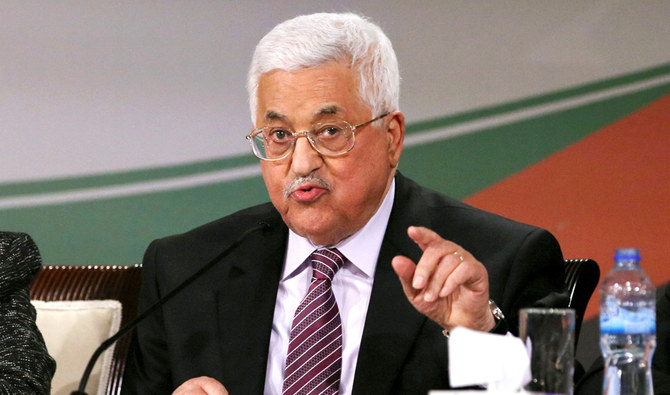

RAMALLAH: The Palestinians on Monday urged world powers to reject Donald Trump’s peace plan, which they said President Mahmud Abbas had refused to discuss with his US counterpart despite several outreaches.
Trump is due to unveil his proposal for Middle East peace this week in Washington, where he is scheduled to meet Israeli Prime Minister Benjamin Netanyahu and opposition leader Benny Gantz.
Palestinian leaders, who have not been invited to the White House, have already rejected the US initiative and insist that Trump’s administration has forfeited its role as an honest broker in the conflict due to what they say is the president’s pro-Israel bias.
“We call on the international community to not be partners in this (plan) because it contravenes international law,” Palestinian Prime Minister Mohammed Shtayyeh told journalists ahead of a weekly cabinet meeting.
The details of Trump’s initiative, which has been in the works since 2017, are not yet public.
But his administration has already recognized Israeli sovereignty over the Golan Heights, which the Jewish state captured from Syria in the Six-Day War of 1967 and stopped referring to the West Bank as “occupied” territory.
It also no longer considers Israeli settlements there as inconsistent with international law and most analysts expect his proposal to reaffirm his administration’s positions.
Trump also broke with decades of international consensus that the fate of Jerusalem should be negotiated between the parties when he recognized the disputed city as Israel’s capital in December 2017.
He is releasing the plan as he faces impeachment hearings over abuse of office and while Netanyahu battles serious corruption charges during a neck-and-neck election against Gantz.
“This a plan to protect Trump from impeachment and protect Netanyahu from prison. It is not a Middle East peace plan,” Shtayyeh told a Cabinet meeting.
Previously released parts of the Trump initiative purport to offer the Palestinians substantial economic incentives.
FASTFACT
US President Donald Trump is due to unveil his proposal for Middle East peace this week in Washington, where he is scheduled to meet Israeli Prime Minister Benjamin Netanyahu and opposition leader Benny Gantz.
“The rights of the Palestinian people are not for sale,” Shtayyeh said. “This plan gives Israel sovereignty over Palestinian territory.”
Three Palestinian officials, speaking on condition of anonymity, told AFP on Monday that Trump had made several attempts to discuss the plan with Abbas in recent weeks, but the Palestinian president had rejected those outreaches.
“There will be no discussion with the Americans until they recognize the two-state solution,” one senior official said.
A spokesperson for the American Embassy in Jerusalem was not immediately available for comment.
Some have speculated that the US proposal could pull back from supporting the creation of a Palestinian state with its capital in East Jerusalem, the common definition of the two-state solution.
The US proposal may also seek to give Israel the green light to annex the Jordan Valley, a key territory that constitutes around 30 percent of the West Bank.
Israeli Interior Minister Aryeh Deri toured the Jordan Valley Monday, saying they were taking steps toward the move — a central election promise of right winger Netanyahu.
“As interior minister I’d like to tell you, we’ve started to prepare for an annexation — we are getting the paper-work ready,” Deri said in a statement.
In Gaza on Monday a few hundred Palestinians protested against the Trump plan, which Palestinians ironically call the “Deal of the Century.”
Further protests were expected on Wednesday, when the plan is expected to be public.