

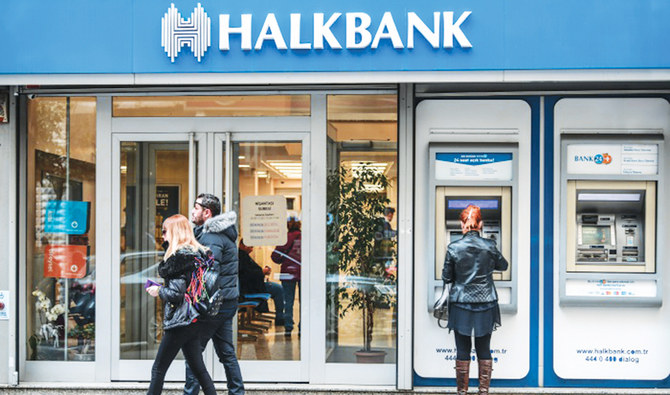

JEDDAH: Turkey’s state-owned Halkbank has failed to defend itself in court in New York amid charges related to Iranian sanctions.
The non-appearances have increased the penalties the bank could pay for violating US sanctions against Iran between 2012 to 2016.
The suggested fine is $1 million for each day of absence during the first week of noncompliance, increasing to $2 million per day in the following week, with fines reaching $105 million after a month and $1.8 billion after two months.
Halkbank — one of Turkey’s largest lenders — is accused of being involved in a gold-for-oil scheme and transferring $20 billion of restricted Iranian funds through the intermediaries of several senior ministers in the ruling Justice and Development Party.
A court in New York, which last year rejected the bank’s appeal for the case to be dropped, is set to begin hearings about the case on Feb. 25.
Halkbank may also be restricted from acceding to the US financial system and dollar transactions if found guilty of violating sanctions.
The case has been contentious due to the tense relationship between Ankara and Washington.
The bank’s senior executive, Hakan Atilla, was sentenced to 32 months in jail two years ago.
In October 2019, Atilla, former jailed banker and former executive of the bank, was selected to become the CEO of the Istanbul stock exchange.
The European Bank for Reconstruction and Development, the second-biggest shareholder, sold its 10 percent stake in the stock exchange allegedly because of Atilla’s selection.
He was sentenced to prison in the US for helping Iran in evade sanctions in a multibillion-dollar scheme. He was then released and returned to Turkey in July 2019 after serving 28 months behind bars.
FASTFACT
A court in New York, which last year rejected the bank’s appeal for the case to be dropped, is set to begin hearings about the case on Feb. 25.
His appointment came a week after US prosecutors in New York filed fraud and money laundering charges against Halkbank.
Ibrahim Kahveci, a Turkish economist, said the Halkbank case became political because it was used as a stick by Washington during a period of difficult relations.
“If Halkbank faces huge penalties, then the bank can cancel all its SWIFT operations. Foreign investors would avoid the bank and Turkey-based operators would not conduct operations through it. It would lead to short-term fluctuations in the economy,” he told Arab News.
Timothy Ash, an analyst at BlueBay Asset Management, told Arab News that the “US reaction seems to reflect the personal relationship between US President Donald Trump and Turkish President Recep Tayyip Erdogan. For some reason there is a ‘connection’ between the two leaders and Trump keeps blocking any sanctions on Turkey.”
He added: “Perhaps this case might be a little different in that the fine will be levied by the Southern District of New York (SDNY), which might be beyond the control of Trump.”


