Turkey’s Erdogan takes on former ally with foundation takeover

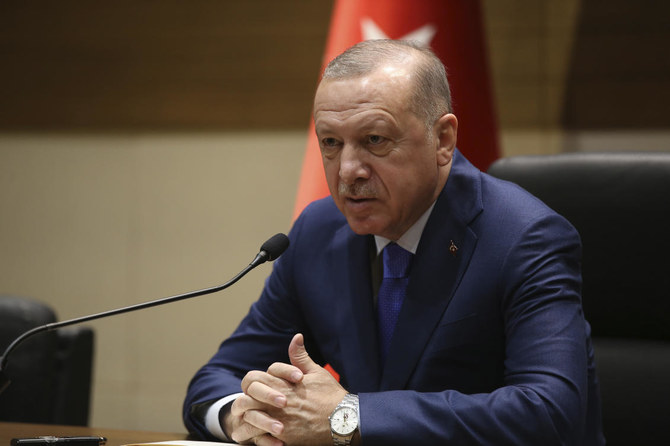
The Turkish government has taken over the management of a foundation set up by a former ally of President Recep Tayyip Erdogan, as hostility between the two men heats up. (AP)
Short Url
Updated 24 May 2023
Follow

Turkey’s Erdogan takes on former ally with foundation takeover

ANKARA: The Turkish government has taken over the management of a foundation set up by a former ally of President Recep Tayyip Erdogan, as hostility between the two men heats up.
Erdogan is punishing Ahmet Davutoglu, who is also former prime minister, for breaking away from the ruling Justice and Development Party (AKP) and launching a new rival party to appeal to  disillusioned voters.
Davutoglu co-founded the Foundation for Sciences and Arts (BSV) in 1986, but on Tuesday it was taken over by a government ministry-affiliated body.
The BSV said the decision was “arbitrary” and a “dangerous initiative.”
The government recently appointed a government official to the privately-owned Istanbul Sehir University, which is also affiliated with Davutoglu, after it failed to pay back loans to state-run Halkbank.
But Davutoglu has come out swinging despite the setbacks to his legacy. This week he criticized the government’s handling of the economy, alleging that Erdogan's team was manipulating inflation figures to paint a rosy picture.
“Think about a doctor who tells his patient that he is fine by changing his test results. The patient says ‘I'm dying,’ but the doctor says, ‘Look at the figures, your test results are fine.’ The economic administration in Turkey is doing precisely the same,” the former prime minister said.


Iraq: Ankara agrees to take back Turkish citizens among Daesh detainees transferred from Syria

Updated 4 sec ago
Follow

Iraq: Ankara agrees to take back Turkish citizens among Daesh detainees transferred from Syria

Iraq’s foreign minister said on Monday Turkiye had agreed to take back Turkish citizens from among thousands of ​Islamic State detainees transferred to Iraq from Syria when camps and prisons there were shut in recent weeks.
Iraq took in the detainees in an operation arranged with the United States after Kurdish forces retreated and shut down camps and prisons which had housed Islamic ‌State suspects ‌for nearly a decade.
Baghdad has ​said ‌it ⁠will ​try suspects ⁠on terrorism charges in its own legal system, but it has also repeatedly called on other countries to take back their citizens from among the detainees.
Foreign Minister Fuad Hussein told US envoy Tom Barrack in a meeting that Iraq ⁠was in talks with other countries on ‌the repatriation of ‌their nationals, and had reached ​an agreement with Turkiye.
In ‌a separate statement to the UN Human ‌Rights Council, Hussein said: “We would call the states across the world to recover their citizens who’ve been involved in terrorist acts so that they be tried ‌in their countries of origin.”
The fate of the suspected Islamic State fighters, ⁠as well ⁠as thousands of women and children associated with the group, has become an urgent issue since the Kurdish force guarding them collapsed in the face of a Syrian government offensive.
At the height of its power from 2014-2017, Islamic State held swathes of Syria and Iraq in a self-proclaimed caliphate, ruling over millions of people and attracting fighters from other countries. ​Its rule collapsed ​after military campaigns by regional governments and a US-led coalition.