


MANILA: Philippine authorities are bracing for an eruption of Taal volcano, south of the capital Manila, after it began to spew lava on Monday.
The Philippine Institute of Volcanology and Seismology (Phivolcs) said a lava fountain from the volcano was recorded less than 24 hours after it entered a period of intense unrest, blasting ash and steam up to 15,000 meters into the air on Sunday.
The Philippine Seismic Network has recorded 144 volcanic earthquakes in the Taal region since 1 p.m. on Sunday.
Alert level 4 remains in effect over the volcano, which means that a hazardous explosive eruption “is possible within hours to days.”
Phivolcs said the total evacuation of Volcano Island, and high-risk areas within a 14-km radius of the main crater, must be enforced.
Motorists are advised to drive with extreme caution as poor to zero visibility due to ash has been reported in some affected areas. Civil aviation authorities have advised aircraft to avoid the airspace around Taal volcano.
Department of National Defense Secretary Delfin Lorenzana said the worst-case scenario is that it will erupt at a scale similar to the June 1991 eruption of Mount Pinatubo that killed 800 people and rendered 200,000 homeless.
“The entire mountain collapsed during the (Pinatubo) eruption,” he added. “That’s what we’re fearing, that the eruption would cause the entire island to rise and scatter debris on the nearby areas. Hopefully this won’t happen. We can never predict the actions of this volcano.”
Lorenzana, who also heads the National Disaster Risk Reduction and Management Council (NDRRMC), said he had talked to Phivolcs chief Renato Solidum, who said there is no danger of a tsunami as Taal Lake is too small.
The NDRRMC said at least 5,458 families, or 24,508 individuals, in the provinces of Batangas and Cavite have been evacuated.
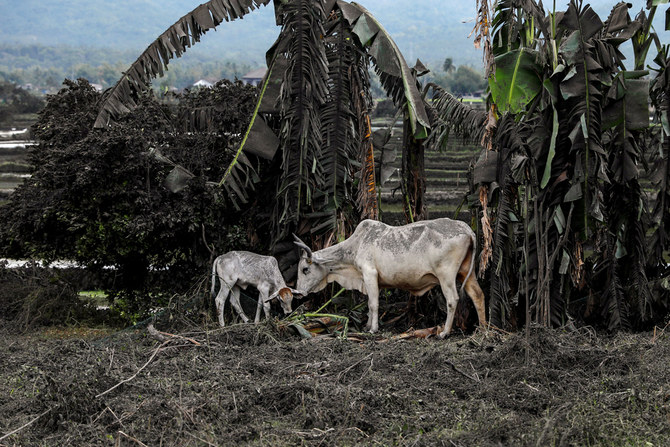
There are reports of areas in the immediate vicinity of the volcano being deserted and covered in ash, and of several houses having been destroyed.
Meanwhile, thousands of passengers remain stranded at Ninoy Aquino International Airport even as it resumed partial operations from 10 a.m. on Monday.
President Rodrigo Duterte’s office said the ash had prevented him from flying back to Manila from Davao City on Sunday.


