

Taal Volcano forces evacuation of thousands in Philippines

1 / 2
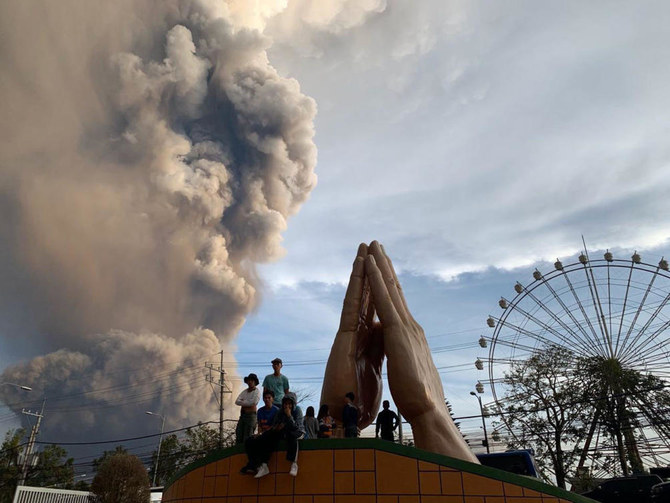
People watch as Taal Volcano erupts Sunday Jan. 12, 2020, in Tagaytay, Cavite province, outside Manila, Philippines. (AP)
2 / 2
People watch as the Taal volcano spews ash and smoke during an eruption in Tagaytay, Cavite province south of Manila, Philippines on Sunday. Jan. 12, 2020. (AP)
Short Url
Updated 13 January 2020
Follow

Taal Volcano forces evacuation of thousands in Philippines

  • Eruption possible within weeks as alert level raised

MANILA: Thousands of people are being evacuated from a southwestern province in the Philippines after a volcano began spewing ash plumes as high as 100 meters.

As of Sunday afternoon Taal Volcano had escalated its eruptive activity generating an eruption plume one-kilometer high accompanied by volcanic tremor and felt earthquakes in Volcano Island and villages of Agoncillo, Batangas, according to the Philippine Institute of Volcanology and Seismology (Phivolcs), which raised the alert level to three, indicating a high level of volcanic unrest. 

The maximum alert level is five, which is a hazardous eruption in progress. 

The institute said ashfall was being showered on the southwest sector of Taal and that the volcano had shown increased steaming activity in at least five spots inside the main crater.

The largest activity was a steam-driven eruption that generated a plume approximately 100 meters high.

The institute recommended that residents and tourists should be evacuated from Taal Island, Agoncillo and Laurel due to the possible threat of searing hot flows of ash, gas and rocks that whoosh down the sides of a volcano during an eruption, and a volcanic tsunami.

National Disaster Risk Reduction and Management Council spokesman Mark Timbal said residents from nine towns near the volcano were being moved to safer grounds.

Parts of the province are already experiencing a power outage, but no casualties have been reported so far.

Taal is the second most active volcano in the Philippines, with 33 recorded eruptions. The last major eruption happened on Oct. 3, 1977.

It is also considered one of the most dangerous in the world. In 1911, Taal caused one of the worst volcano disasters in history when it erupted and killed 1,334 people.

FAST FACTS

• The largest activity was a steam-driven eruption that generated a plume approximately 100 meters high.

• Residents from nine towns near the volcano were being moved to safer grounds.

Phivolcs Officer-in-charge Renato Soldium said that Taal was inside a bigger crater or basin or bowl, which is why people would have to evacuate horizontally and away from the crater.

“There is water that would be hindering the rapid evacuation and that is why people need to get out of the island as soon as possible,” he added.

Communities around the shore of Taal Lake have been advised to take precautionary measures and be vigilant of possible lakewater disturbances related to the ongoing seismic unrest.

Phivolcs said that the volcano had maintained a moderate to high level of seismic activity since last March. Some of these earthquakes were felt with intensity levels ranging from one, scarcely perceptible, to three, weak shaking, in the surrounding villages.

These earthquakes were often accompanied by rumbling sounds, it added. Three earthquakes were recorded on Sunday and a seismic swarm was ongoing. 

Phivolcs said that raising the alert level from two to three meant there was a “magmatic intrusion”  that was likely driving the current activity. Alert level three also meant that eruption was possible within weeks.

It reminded the public that the entire island was a permanent danger zone and that entry onto the island, as well as nearby villages, was prohibited.


Species behavior drives Red Sea conservation plans

Updated 4 sec ago
Follow

Species behavior drives Red Sea conservation plans

  • Behavioral insights from sharks and rays are driving targeted marine protection strategy

JEDDAH: The Red Sea hosts over 40 shark species, making it one of the region’s most biologically diverse marine environments. Their presence is a key indicator of healthy waters and balanced ecosystems, according to the Red Sea Authority.

Silky sharks, a large pelagic species common around offshore reefs and drop-offs, occupy a critical space between reef and open-ocean ecosystems. Among the most heavily harvested sharks in the region and globally, they are a growing conservation concern.

Though often solitary, silky sharks form seasonal aggregations of 20 or more at a few Red Sea sites, including locations in Sudan, Yemen, and Jeddah, Saudi Arabia. Surveys at the Jeddah site, dating to the 1990s, show significant population declines.

FASTFACT

Did you know?

  • Only a small fraction of critical shark habitats are protected.
  • Sharks do not always leave when it gets hotter, they swim deeper.
  • Silky sharks can stay surprisingly local.
  • The Red Sea is a hotspot for threatened species.

Recent research led by Collin Williams, a research scientist at Neom, shows that rather than migrating from warming waters, Red Sea silky sharks adapt by moving to deeper depths in response to rising surface temperatures.

Williams told Arab News: “Silky sharks are among the most prolific sharks in the Red Sea.” 

He noted that Saudi Arabia hosts the best-documented aggregation of the species.

Halavi Guitarfish

Evidence suggests silky sharks reproduce in the Red Sea, supported by sightings of juveniles and pregnant females in scientific literature. However, the recent study focused on movement patterns and depth use rather than pinpointing breeding or nursery habitats. Ongoing research, including ultrasound scanning, aims to better define key reproductive areas.

Jesse Cochran, a research scientist at King Abdullah University for Science and Technology, said: “The Red Sea’s high temperatures let us observe what sharks do when they are pushed toward thermal extremes. In this case, the sharks didn’t simply disappear, they shifted deeper.”

KAUST scientists are using Important Shark and Ray Areas and tracking studies to strengthen conservation in the Red Sea. ISRAs identify critical habitats, revealing many fall outside current marine protected zones. Tagging research, including on silky sharks (Carcharhinus falciformis), shows sharks adjust depth rather than leaving the area as temperatures rise.

Together, these approaches close knowledge gaps on habitat use, human pressures, and climate impacts, supporting science-based conservation and marine planning aligned with Saudi Vision 2030.

Tawny Nurse Shark. (SUPPLIED)

“ISRAs are a practical bridge between science and decision-making,” Cochran said. “By identifying and mapping known critical habitats with the best available evidence, they provide key information that managers can actually act on.”

Seasonal shifts in the Red Sea often manifest not as absence, but as changes in vertical habitat use. Silky sharks, for example, spend the hottest months at greater depths, reducing visibility in surface or shallow-reef surveys. Similar patterns are observed in whale shark research, which shows seasonal aggregation near Al-Lith followed by widespread foraging across the central and southern Red Sea.

Cochran added: “The Red Sea gives us a window into how sharks may behave near their upper thermal limits, letting us study climate responses with real conservation relevance.”

The Red Sea and Western Indian Ocean host highly diverse shark and ray communities, including whale sharks, scalloped hammerheads, reef manta rays, and reef sharks. This diversity reflects the wide range of habitats and life histories marine planning must consider. Yet conservation concerns remain acute for range-restricted species, which face limited data and high vulnerability. The ISRA assessment warns of potential extinctions among species such as the Red Sea torpedo ray.

Climate change compounds these risks. Research on silky sharks shows rising surface temperatures compress habitat use into narrower depth ranges, potentially increasing fishing exposure. Williams noted that, contrary to prior assumptions, these sharks do not migrate elsewhere in summer but instead retreat to deeper waters.

Redticulated Whipray. (SUPPLIED)

“Sharks are vulnerable when concentrated, because they are easier to catch. If hot temperatures in the Red Sea are concentrating sharks into narrower depths seasonally, this could potentially indicate increased fisheries vulnerability for sharks associated with climate change.”

A recent KAUST study tagged 10 silky sharks with smart position and temperature tags, as well as pop-up satellite archival tags. The sharks showed regional residency of up to 267 days, mostly within 50 km of tagging sites. The study found that above 29.1°C at the surface, sharks sharply reduced upper-water-column use, spending most time at 70-100 meters — a thermal refuge.

This behavior suggests reduced sightings in hot months reflect depth shifts, not departures — a finding with key conservation implications. Williams said: “Satellite tagging provides extremely valuable data for protecting sharks and better understanding their ecology.” He added: “Understanding the unique ecology Red Sea sharks may help us to better conserve sharks in a warming climate.”

The Red Sea records 31 shark and 29 ray species, over half of which are threatened on the IUCN Red List. Rays, closely tied to the seafloor, benefit from area-based management tools such as MPAs informed by ISRAs.

Cochran noted: “A lot of rays and some deepwater taxa are still under-documented, not because they are unimportant, but because they are harder to study. That is exactly where targeted surveys and new tools can transform what we know.”

The ISRA analysis highlights two priorities: accounting for rays’ ecological breadth and expanding deepwater surveys via ROVs, deep BRUVS, and submersibles to enhance protection. The Red Sea offers a natural laboratory, combining high temperatures, elevated salinity, and strong latitudinal gradients, to study how sharks and rays adapt to extremes.

Protections exist, such as a royal decree banning elasmobranch fishing in Saudi Arabia. Yet prior Reef Ecology Lab work showed enforcement gaps, and shared populations across neighboring countries remain legally fished. More recent market surveys, conducted with the National Center for Wildlife, show declining shark and ray sales, indicating potential behavioral changes in response to stricter enforcement.

Tracking complements ISRAs by providing behavioral evidence of regular presence and habitat use. Red Sea Reef Ecology Lab studies informed ISRA designations for endangered whale sharks, guitarfish, and manta rays.

Cochran said: “The ISRAs show us the overlap between where the sharks regularly occur and where we have the data to show it. Tracking studies can help generate that data while also telling us how animals move through those habitats and when they may be most exposed to threats like fishing.”

Satellite tracking of Red Sea silky sharks revealed new insights into connectivity, including a shark moving from Jeddah into a Sudanese ISRA — the first documented trans-Red Sea movement. Williams said: “Tracking provides valuable data on shark connectivity, enabling ISRAs to be defined more accurately and protected more effectively.”

The Reef Ecology Lab prioritizes sharks and rays due to their ecological roles and vulnerability. Research combining ecology with oceanography, fisheries science, technology, sociology, and spatial planning is most effective.

The silky shark study demonstrates this: understanding the water column’s temperature structure was essential to interpreting movement patterns and assessing fisheries risk. Michael Berumen, KAUST marine science professor, said: “Saudi Arabia is investing heavily in the Red Sea. Our job is to make sure decisions about protection and use are informed by the best possible science, so sustainability is real, not just a slogan.”

Andrew Temple, research scientist, concluded: “Protecting sharks and rays is not anti-development. It is risk management for the ecosystem services that support fisheries, biodiversity, and long-term tourism value.”