

Study reveals Saudis’ admiration for Japanese traditions, customs

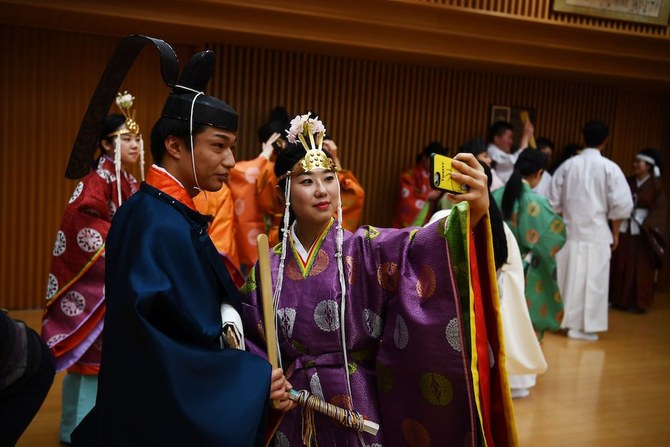
Students clad in kimono at a coming-of-age ceremony in the Kokugakuin university in Tokyo on Saturday. Arab perceptions of Japan are influenced by its traditions, the survey found. (AFP)
Short Url
Updated 12 January 2020
Follow

Study reveals Saudis’ admiration for Japanese traditions, customs

  • Saudis’ first impressions of the Japanese is that they are organized, hardworking and technical
  • Karate was ranked as Saudi’s favorite type of martial arts followed by judo and sumo, says poll

DUBAI: Contemporary Japan may be a paragon of sophisticated, cosmopolitan values, but Arabs’ impression of the Asian power appears to be more influenced by its traditions, customs and national character.

A YouGov poll conducted by Arab News across 18 countries in the Middle East showed that Saudis’ first impressions of the Japanese was that they were organized (51 percent,) hardworking (50 percent) and technical (42 percent).

Other words used to describe the Japanese culture were punctual, respectful and creative.

Such perceptions appear to be significantly shaped by Japanese fictional characters, mainstream media, martial arts and the country’s export industries.

Out of 3,033 survey respondents in the Arab world, more than 50 percent picked samurai, car manufacturing and sushi as aspects they most associated with Japan.

The findings were similar among Saudis questioned for the poll, with anime (Japan-style film and television animation) being one of the main attractions of Japanese culture.

This was also reflected in other findings of the study, which showed that 65 percent of Saudis associated the fictional character, Hello Kitty, with Japanese people. The cartoon was produced by Japanese company Sanrio under the gijinka concept, which creates human-like characters based on non-human subjects.

Fascinated by Japanese history, Rania Al-Mutairi, a pharmacist from Saudi Arabia, described the country’s culture as one with “many wonders,” reflected in the writings and poems of its literary masters.

She said Japanese people were “kind, polite and educated,” adding that Saudi Arabia and Japan had great respect for each other and shared cultural similarities.

In the same way, the warrior traditions of the samurai are to be found in different forms of martial arts, which date back to times of war in Japanese history.

Jiu-jitsu, for instance, originated in the 16th century and was taught to warriors as a method of fighting both with and without weapons. However, Japanese martial arts go far beyond matters of self-defense, and focus on building values such as discipline and mental strength.

A growing interest in martial arts has also been witnessed in Saudi Arabia, where 32 percent of respondents selected karate as their favorite type of martial arts, followed by judo and sumo wrestling (both 17 percent).

The survey also suggested that Saudis were widely familiar with products made by the technologically advanced nation, with many correctly identifying Sony, Sega and Muji as Japanese brands.

Al-Mutairi, a fan of some of Japan’s most popular brands, listed Hitachi, Sony and Toyota as her favorite products, citing the latter’s use of the kaizen technique, an approach that works on continuous improvements through small, ongoing positive changes.

Saudis quizzed for the survey were also well-informed about Japanese brands in the automotive industry, with 40 percent selecting Toyota as their favorite make of car, followed by Lexus (30 percent) and Honda (7 percent.)


Saudi Arabia, Estonia strengthen cyber defense cooperation

Updated 09 February 2026
Follow

Saudi Arabia, Estonia strengthen cyber defense cooperation

  • Renowned for its leadership in digital governance, Estonia sees cybersecurity as central to its partnership potential with Saudi Arabia, building on years of regional engagement through its technology firms

RIYADH: Estonia aims to deepen defense, cybersecurity, and artificial intelligence cooperation with Saudi Arabia as both nations look to advance technology‑driven defense and cybersecurity capabilities.

Hanno Pevkur, Estonia’s minister of defense, told Arab News at the World Defense Show in Riyadh on Monday that Estonia’s defense industry is eager to contribute to the Kingdom’s fast‑growing defense ecosystem.

“In the modern world, cooperation built on trust and technology is the best defense,” he said. “It is important for us to be here because we clearly see there is a possibility to increase cooperation, not only bilaterally between Saudi Arabia and Estonia, but across the region.”

At Estonia’s pavilion, a cooperation agreement was signed between an Estonian company and a Saudi firm during the show, he noted.

Pevkur also said Estonia’s defense sector has expanded rapidly in recent years, driven by technological innovation and partnership.

“Our defense industry is growing very rapidly, and we continue to see strong momentum,” he said.

He said Estonia’s strengths lie in digital and smart‑system integration rather than large‑scale weapons production.

“We will not build airplanes or tanks, but what we can do is integrate robotics, automation and drones to make existing systems smarter,” he said.

The minister said effective defense collaboration must link businesses and governments to achieve meaningful results.

“When we want to have real cooperation, we need it on all levels,” he said. “The biggest client for any defense company is the government, so we must treat this as one ecosystem where the public and private sectors work hand in hand.”

Renowned for its leadership in digital governance, Estonia sees cybersecurity as central to its partnership potential with Saudi Arabia, building on years of regional engagement through its technology firms.

Pevkur said several Estonian companies, including Nortal, have already assisted Gulf governments in developing open IT and digital‑service systems.

“As the most digitalized nation in the world, almost every service in Estonia can be done online, except getting married,” he said. “But with such digitalization, we also need strong cyberdefense.”

He said data protection and digital resilience are treated as matters of national sovereignty in Tallinn, the capital of Estonia.

“Data is what we own. When someone steals that data, it becomes a serious threat,” he added. “That is why cyberdefense is not just about technology, it is about trust, sovereignty and protection.”

Pevkur said Saudi Arabia’s advances in AI offer promising opportunities for collaboration.

“I know that Saudi Arabia is doing great work when it comes to AI,” he said. “For us, as a small country with limited human resources, AI is essential not just for defense but for everyday life.”

Pevkur added that Estonia has launched a national AI strategy to promote responsible development and closer coordination between government and industry. One Estonian company, he said, has developed a system that allows a single operator to control hundreds of drones through AI.

“It is quite easy to put a weapon into the hands of a robot, but we also need to define who is accountable for its actions,” he said.

“The big question for the future is whether we can allow a war to be fought entirely by AI, or if humans must always make the final ethical decisions.”

He said in his conclusion that governments must reach a common understanding on how AI will be used and regulated on the battlefield.