

India’s new citizenship law takes toll on Muslims in Assam

Evicted people show their land ownership documents at the Mukua Shapori camp, Sonitpur district, Assam. (AN Photo)
Short Url
Updated 08 January 2020
Follow

India’s new citizenship law takes toll on Muslims in Assam

  • BJP administration evicted hundreds of Muslim households in Assam following the enactment of CAA
  • Members of the Muslim minority in Sonitpur district have become refugees in their own homeland

TEZPUR, ASSAM: The moment Akkas Ali saw his destroyed home, he burst in tears. The 65-year-old farmer from Bhuttamari Vairabi, Sonitpur district in India’s northeastern Assam state, has spent all his life savings on building the three-bedroom house in the village.

Last month, the district’s administration and a local legislator entered 10 villages in the area with bulldozers and paramilitary personnel. They razed 450 houses and displaced more than 3,000 people.

Ali is now a refugee in his own village and stays at a nearby makeshift camp, without any clue what the future holds for him. 
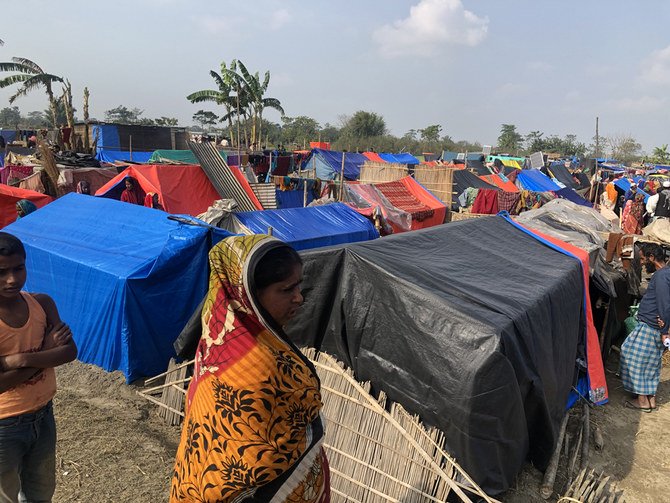


Evicted people show their land ownership documents at the Mukua Shapori camp, Sonitpur district, Assam. (AN Photo)

“My fault is that I am not registered as a voter in the Sootea Assembly constituency where my village falls. I have my vote in the neighboring constituency. Local Bhartiya Janata Party (BJP) legislator Padma Hazarika, with support from the administration, threw me and more than 450 families out from the area just because we don’t vote for him,” he said.

“I am a genuine citizen of Assam and my name figures in the NRC. I am a registered voter of the neighboring Tezpur constituency and I've been living here for more than 15 years, after moving from my native village which was washed away by a flood,” Ali told Arab News, referring to the National Register of Citizens, a citizenship list issued by the Assam government in August last year.

“The government says we are encroachers and Bangladeshis, and they evicted us from our own land despite having all the documents. The larger goal, I feel, is that the BJP wants to settle down Hindu Bengalis in this area who will act as a permanent vote bank for the party,” Ali said.

Ever since New Delhi passed the Citizenship Amendment Act (CAA) in mid-December, tensions have been running high in Assam with the Assamese fearing to lose their ethnic identity if immigrant Hindu Bengalis are allowed to become Indian citizens. 

Under the CAA, Hindu, Sikh, Jain, Parsi and Christian minorities from neighboring Bangladesh, Pakistan and Afghanistan are eligible to become citizens, if they have come to India before Dec. 31, 2014. Muslims are not included.

Meanwhile, Assam’s NRC has provisions for declaring all migrants – regardless of their religion – as stateless if they have entered Assam after March 24, 1971. More than 1.9 million people, mostly Hindus, could not find their place on the NRC list. The CAA  will now accommodate Hindus, leaving out Muslims.

Members of the Muslim minority in the state fear they would be the real target of the BJP’s majoritarian politics.
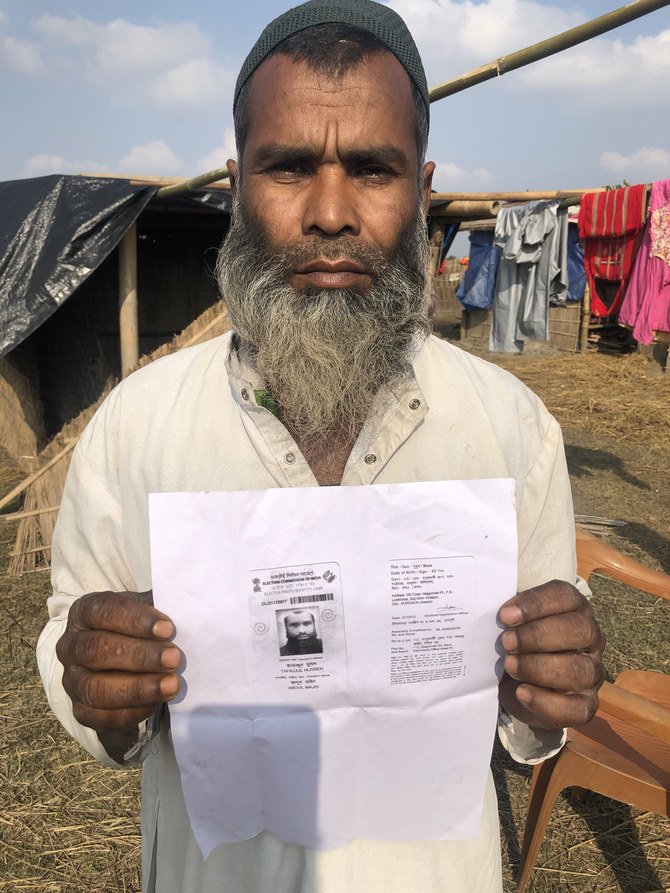


A man shows his documents at the Shirwani camp, Sonitpur district, Assam. (AN Photo)

Abdul Quddus faces a similar fate as Ali.

“First they evicted us saying we are not their voters, and soon they are going to throw out the remaining Muslim families,” said the teacher who has been living in at the Mukua Chapori camp, some two kilometers from his house, also as a refugee.

Arab News asked Hazrika, the local BJP legislator behind the evictions, about their grounds.

“They are encroachers, that’s why they have been evicted,” was his reply.

“I don’t care whether they are Hindu or Muslims, they are encroachers and they have been thrown out of the government land,” Hazrika said, adding that the evictions followed a court order.

He denied, however, the presence of refugee camps in the area.

Manvendra Pratap Singh, deputy commissioner of Sonitpur district and a man at the forefront of the evictions, also defended the move by citing encroachment.

“We have a plan to evict more people from that area, as the whole land belongs to the government and those who claim they are owners of the land bought the land from encroachers,” he said, adding that an industrial park and Tezpur University facilities were going to be built in the area.

He also denied the existence of camps and said that eligible to own land would be resettled. “There exists no refugee camp in the area,” he claimed.

But people in the camps say that no one from the government side has visited them.
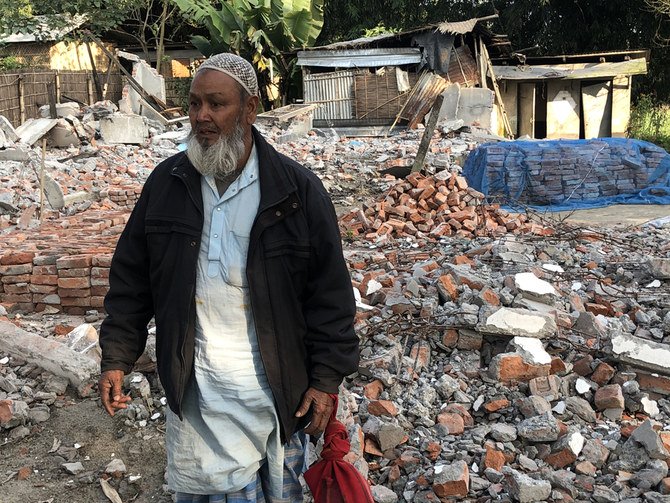


Akkas Ali stands in the ruins of his house in Bhuttamari Vairobi village, Sonitpur district, Assam. (AN Photo)

“We are being treated as foreigners in our own land. The situation is so bad that local schools are refusing (our) kids entry to school premises. The future of hundreds of students is bleak,” said Ali. 

According to local social worker Isfaqul Hussain, “there is a larger game at play in Assam now. Wherever Muslim communities are vulnerable, there is an attempt to displace them internally and make them refugees in their own homeland.”

Tezpur-based political analyst Abdul Qadir explained that following the enactment of CAA, the BJP seeks to settle Hindu Bengalis in Muslim-dominated areas.

“The situation was very sad in the beginning when more than 10,000 people suddenly became homeless. Some of them spent nights in the open in this severe winter. Concerned citizens mobilized funds and erected tents,” he said.

“We are living in a difficult time, when human suffering is measured by the parameters of religion.”


Teenage preacher to alleged mass killer: Bondi attack suspect’s background emerges

Updated 5 sec ago
Follow

Teenage preacher to alleged mass killer: Bondi attack suspect’s background emerges

SYDNEY/MANILA: Standing in the rain outside a suburban Sydney train station, seventeen-year-old Naveed Akram stares into the camera and urges those watching to spread the word of Islam.
“Spread the message that Allah is One wherever you can ... whether it be raining, hailing or clear sky,” he said.
Another since-deleted video posted in 2019 by Street Dawah Movement, a Sydney-based Islamic community group, shows him urging two young boys to pray more frequently.
Authorities are now trying to piece together what happened in the intervening six years that led a teenager volunteering to hand out pamphlets for a non-violent community group to allegedly carry out Australia’s worst mass shooting in decades.
Akram, who remains under heavy guard in hospital after being shot by police, was briefly investigated by Australia’s domestic intelligence agency in 2019 for links to individuals connected to Islamic State, but authorities found he did not have extremist tendencies at the time.
“In the years that followed, that changed,” Home Affairs Minister Tony Burke said on Tuesday.
Police have not formally identified Naveed Akram, 24, as one of the alleged gunmen who killed 15 people at a Jewish event on a Sydney beach on Sunday. His father Sajid Akram, 50, is the other gunman who was shot and killed by police, local media reported.
Officials have said the second gunman is the deceased man’s son and is in a critical condition in hospital.

MOTIVATED BY DAESH
Prime Minister Anthony Albanese said on Tuesday the attack was likely motivated by the ideology of Daesh, but that the two men appeared to have acted alone.
Homemade Daesh flags were found in the suspects’ car after Sunday’s attack, and police said on Tuesday the pair had last month visited the Philippines, where offshoots of the militant group have a presence.
A spokesperson for the Philippines Bureau of Immigration said Akram, an Australian national, arrived in the country on November 1 with his father, who was traveling on an Indian passport.
Both reported Davao as their final destination, the main city on Mindanao island, which has a history of Islamist insurgency. A months-long conflict on the island in 2017 between armed forces and two militant groups linked to IS left over a thousand dead and a million displaced, though the country’s military says these groups are now fragmented and weakened.
The pair left the Philippines on November 28, two weeks before Sunday’s attack using high-powered shotguns and rifles.

’NEVER DID ANYTHING UNUSUAL’
Local media reported that Akram, an unemployed bricklayer, attended high school in Cabramatta, a suburb around 30 kilometers by road from Sydney’s central business district and close to the family’s current home in Bonnyrigg, which was raided by police after the attacks.
“I could have never imagined in 100 years that this could be his doing,” former classmate Steven Luong told The Daily Mail.
“He was a very nice person. He never did anything unusual. He never even interrupted in class.”
After leaving school, Akram showed a keen interest in Islam, seeking tutoring and attending several Street Dawah Movement events. The group confirmed he appeared in the videos.
“We at Street Dawah Movement are horrified by his actions and we are appalled by his criminal behavior,” the group said in a statement, adding Akram had attended several events in 2019 but was not a member of the organization.
Months after the videos were posted, Akram approached tutor Adam Ismail seeking tuition in Arabic and the Qur'an, studying with him for a combined period of one year.
Ismail’s language institute posted a photo in 2022, since deleted, showing Akram smiling while holding a certificate in Qur'anic recitation.
“Not everyone who recites the Qur'an understands it or lives by its teachings, and sadly, this appears to be the case here,” Ismail said in a video statement late on Monday.
“I condemn this act of violence without hesitation.”

EARLIER TIES TO DAESH NOT PROVEN
Two of the people he was associated with in 2019 were charged and went to jail but Akram was not seen at that time to be a person of interest, Albanese said.
However he was radicalized, Akram’s journey from a teenager interested in Islam to one of Australia’s worst alleged killers has taken not just the public, but also law enforcement by surprise.
“We are very much working through the background of both persons,” New South Wales Police Commissioner Mal Lanyon told reporters on Monday.
“At this stage, we know very little about them.”