Iraq protesters lock down Nasiriyah oilfield, production and exports not affected

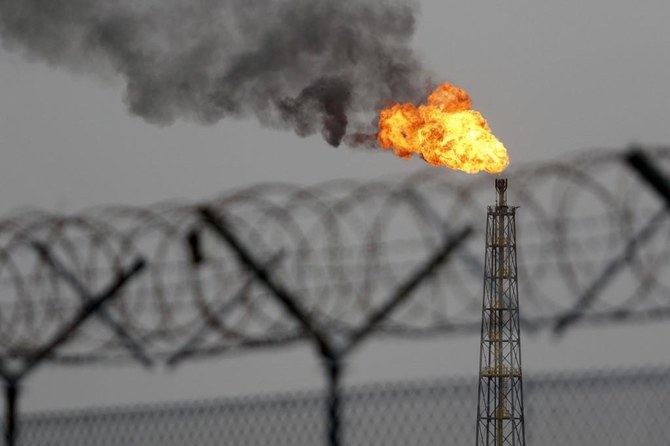
Iraq will use additional output from southern oilfields in Basra to make up for the missing shipments from Nasiriyah field, the country’s oil ministry said in a statement. (AFP file photo)
Short Url
Updated 29 December 2019
Follow

Iraq protesters lock down Nasiriyah oilfield, production and exports not affected

  • Several hundred people demanding jobs shut off access to the Nasiriyah field
  • Demonstrators have vented their fury at what they consider inept politicians who have mismanaged the economy

NASIRIYAH, Iraq: Iraqi anti-government protesters blockaded an oil field and rallied in southern cities Sunday while political factions remained paralyzed in their attempts to form a new government.
Several hundred people demanding jobs shut off access to the Nasiriyah field, 300 kilometers (190 miles) south of Baghdad, which produces 82,000 barrels of oil per day, executives said.
The two-day-old blockade is the first to disrupt operations in OPEC’s second largest producer since the start of the popular revolt set to enter its fourth month in early January.
Halting production from Iraq’s southern Nasiriyah oilfield on Saturday by protesters will not affect the country’s exports and production operations, the oil ministry said on Sunday.
Iraq will use additional output from southern oilfields in Basra to make up for the missing shipments from Nasiriyah field, the ministry said in a statement.
The youth-led protests demand the ouster of the entire political class that has run the country in the aftermath of the 2003 US-led invasion that toppled dictator Saddam Hussein.
Demonstrators have vented their fury at what they consider inept politicians who have mismanaged the economy, enriched themselves and are beholden to powerful neighbor Iran.
Sit-in protests have shut down state offices and schools across the Shiite-majority south for weeks, and demonstrators again declared a “general strike” in Diwaniya on Sunday, the first day of the working week.
Mass rallies and picket lines also paralyzed Kout, Al-Hilla, Amara and the shrine city of Najaf, AFP correspondents said.
The protests have continued despite being met with batons, tear gas and, at times, live rounds in violence that has claimed nearly 460 lives and left some 25,000 people wounded.
The activists scored a partial success in November with the resignation of prime minister Adel Abdel Mahdi, who however remains in charge in a caretaker role.
Pro-Iranian and other political factions have since wrangled over finding a successor — so far without success.
And although parliament has just voted for an electoral reform package, there has been no indication that the early polls many citizens are calling for will be held anytime soon.
Heightening the turmoil, President Barham Saleh last week threatened to resign rather than put forward the name of a pro-Iran candidate to form the next government.
Nasiriyah student demonstrator Osama Ali praised the head of state, saying he had “foiled the attempts by parties and militiamen to kill off the revolution to protect their own interests.”
“This gives us hope to continue our peaceful movement until we obtain all our demands,” he said.
Those demands include an end to a system that doles out state jobs according to ethnicity and religion, and a stop to the endemic corruption estimated to have swallowed up twice Iraq’s GDP in 16 years.


Closing Bell: Saudi benchmark index closes lower at 10,540 

Updated 24 December 2025
Follow

Closing Bell: Saudi benchmark index closes lower at 10,540 

RIYADH: Saudi equities ended Wednesday’s session lower, with the Tadawul All Share Index falling 55.13 points, or 0.52 percent, to close at 10,540.72. 

The sell-off was mirrored across other indices, with the MSCI Tadawul 30 Index retreating 5.79 points, or 0.41 percent, to close at 1,393.32, while the parallel market Nomu slipped 74.56 points, or 0.32 percent, to 23,193.21.  

Market breadth remained firmly negative, as decliners outpaced advancers, with 207 stocks ending the session lower against just 51 gainers on the main market. 

Trading activity moderated compared to recent sessions, with volumes reaching 123.5 million shares, while total traded value stood at SR2.72 billion ($725.2 million). 

On the sectoral and stock level, Al Moammar Information Systems Co. led the gainers after surging 9.96 percent to close at SR172.30, extending its rally following a series of contract announcements tied to data center and IT infrastructure projects.  

Al Masar Al Shamil Education Co. climbed 4.89 percent to SR27.48, while Naqi Water Co. advanced 3.36 percent to SR58.50. Al Yamamah Steel Industries Co. and Al-Jouf Agricultural Development Co. also posted solid gains, rising 3 percent and 2.86 percent, respectively. 

Losses, however, were concentrated in industrial names. Saudi Kayan Petrochemical Co. fell 3.67 percent to SR4.73, while Makkah Construction and Development Co. slid 3.44 percent to SR80.  

Saudi Tadawul Group Holding Co. retreated 3.28 percent to SR147.50, weighed down by broader market weakness, and Saudi Cable Co. declined 3.18 percent to SR143.  

Alkhaleej Training and Education Co. rounded out the top losers, shedding just over 3 percent. 

On the announcement front, BinDawood Holding announced the signing of a share purchase agreement to acquire 51 percent of Wonder Bakery LLC in the UAE for 96.9 million dirhams, marking a strategic expansion of its food manufacturing footprint beyond Saudi Arabia.   

The acquisition, which remains subject to regulatory approvals, is expected to support the group’s regional growth ambitions and strengthen supply chain integration.  

BinDawood shares closed at SR4.68, up 0.43 percent, reflecting a positive market reaction to the overseas expansion move.  

Meanwhile, Al Moammar Information Systems disclosed the contract sign-off for the renewal of IT systems support licenses with the Saudi Central Bank, valued at SR114.4 million, inclusive of VAT.   

The 36-month contract is expected to have a positive financial impact starting from fourth quarter of 2025, reinforcing MIS’s position as a key technology partner for critical government institutions. The stock surged to the session’s limit making it the top gainer. 

In a separate disclosure, Maharah Human Resources confirmed the completion of the sale of its entire stake in Care Shield Holding Co. through its subsidiary, Growth Avenue Investments, for a total consideration of SR434.3 million.  

The transaction involved the transfer of 41.36 percent of Care Shield’s share capital to Dallah Healthcare, with Maharah receiving the full cash proceeds.  

Despite the strategic divestment, Maharah shares closed lower, ending the session at SR6.12, down 1.29 percent.