Iraqi oil-reserve potential ‘could exceed’ Saudi Arabia’s

1 / 5
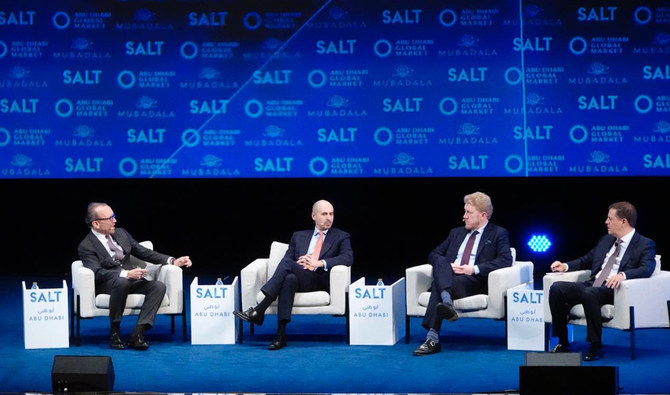
Taking part in a panel discussion on the second day of the SALT conference in Abu Dhabi (second from left to right): Majid Jafar, Crescent Petroleum’s CEO, R. J. Johnston, executive adviser and managing director for global energy and natural resources at Eurasia Group, Francisco Blanch, global head of commodities research at Bank of America Merrill Lynch. (AN Photo/Huda Bashatah)
2 / 5
The discussion took place on the second day of the SALT conference in Abu Dhabi. (AN Photo/Huda Bashatah)
3 / 5
The discussion took place on the second day of the SALT conference in Abu Dhabi. (AN Photo/Huda Bashatah)
4 / 5
The discussion took place on the second day of the SALT conference in Abu Dhabi. (AN Photo/Huda Bashatah)
5 / 5
The discussion took place on the second day of the SALT conference in Abu Dhabi. (AN Photo/Huda Bashatah)
Short Url
Updated 12 December 2019
Follow

Iraqi oil-reserve potential ‘could exceed’ Saudi Arabia’s

  • Crescent Petroleum’s CEO Majid Jafar told SALT conference Iraq's production has risen despite obstacles
  • 'Improving investment climate for private sector essential' to utilize Iraq's full energy-sector potential

ABU DHABI: Iraq’s oil reserves had the potential to exceed those of Saudi Arabia, a top Middle East energy company chief has told the region’s first SALT conference.

In spite of years of corruption, a lack of infrastructure, and the five-year war on Daesh in Iraq, the country had managed to increase its production of oil from 1.5 million barrels per day (bpd) to 5 million, Crescent Petroleum’s CEO Majid Jafar revealed.

Speaking in Abu Dhabi on a panel session discussing power dynamics in the energy sector, he addressed Iraq’s position on oil production and the US’ recent move toward energy “independence.”

Referring to the rate of Iraq’s oil production today, he said: “This gives you some indication of the reserve potential in Iraq, which I believe can exceed Saudi Arabia’s.” And he added that parts of the country still remained “unexplored.”

To utilize the country’s full potential in the energy sector, he believed that improving the investment climate for the private sector was essential.

Jafar said this could be achieved by addressing the demands voiced in recent protests lead by Iraq’s youth, adding that “young people have had enough.”

Among their demands were the need for better services, electricity, employment opportunities and a governing system free of corruption and sectarian politics.

Yet, despite the instability, Crescent Petroleum was still optimistic. “As a group, we have invested $3 billion (SR11.25 billion) over the last 10 years, and the rate of investment is increasing going forward.”

Jafar pointed to the Middle East and North Africa region’s steep oil wealth, implying that more could be done to raise competition in the global energy market. He cited new reforms, such as Saudi Aramco’s partnership with the private sector, as a step in the right direction, considering that the region was home to five of the top 10 oil-producing countries.

However, he highlighted that in recent times the Middle East oil and gas industry had given up a significant amount of its market share to its American counterparts.

While the US moved toward “self-sufficiency,” Jafar believed the country’s “inter-dependence” would grow.

“Being an exporter of oil, you start to worry about the markets,” he said, making a projection on the impact of recent changes on the US economy. “With the US becoming one of the biggest producers in the world, its economy in terms of overall GDP does better if the oil prices are higher, and that changes all the calculations.”

Dr. Francisco Blanch, global head of commodities research at Bank of America Merrill Lynch, highlighted that while the US had become “energy independent,” investors had lost a significant amount of funds to “supply the capital to make it happen.”

Blanch’s forecast was that the US would not continue to grow at the pace it had been doing in recent years. “I think investors are waking up to realize that Shell is a marginal-cost business.”

Supporting Jafar’s observations, he agreed that the US had become more interdependent on exports and imports. He pointed out that today, the US imported 6.5 million barrels of oil, and exported 2.5 million bpd.

“I think the capital market has become more skeptical about capital being allocated to the energy sector,” said Blanch, adding that the next five to 10 years would witness a focus on technology and healthcare.

Examining the geopolitical situation in the Arab region, panelist R. J. Johnston, executive adviser and managing director for global energy and natural resources at Eurasia Group, described the energy sector as a “geopolitical-driven story.”

He cited the drone and missile attacks earlier this year on two Saudi Aramco oil sites in the Eastern Province, pointing out the disruptions in supply did not generate an expected response and impact on oil prices.

“This maybe suggests something about how the geopolitics of the region are changing. Even with sanctions on Iran and the attack against the Aramco facilities, the world is more focused on a different kind of geopolitics; more on the demand side,” said Johnston.

He also referenced the upcoming US elections as well as other problematic structural trends in the region and around the world, such as the protests seen in the Middle East, Western Europe, and Hong Kong, as factors that created uncertainty for the growth of the global market.

He added that in the age of US President Donald Trump, America was “less committed to the region” than it had been in the past, a situation that would create a new set of realities.


MPs, parties welcome Lebanon’s decision to ban Hezbollah’s military wing

Updated 43 min 43 sec ago
Follow

MPs, parties welcome Lebanon’s decision to ban Hezbollah’s military wing

  • Lebanese judiciary issues arrest warrants to pursue those who fired rockets at Haifa
  • Bilal Al-Houshaymi: It (Lebanon) is either a fully sovereign state with a single decision-making authority, or it will continue its downward slide into greater danger and collapse

BEIRUT: Lebanon’s Cabinet decisions were described by political parties and parliamentarians as the boldest measures taken against Hezbollah to date, with ministers from the Amal Movement, the group’s key ally, joining in a show of government solidarity.

In an unprecedented move, Lebanon’s Cabinet on Monday declared Hezbollah’s military activities illegal and demanded the immediate handover of its weapons, following Israeli strikes that killed more than 40 people and wounded dozens across Beirut’s southern suburbs, southern Lebanon and the Bekaa Valley.

The Israeli strikes came after rockets and drones were fired from Lebanese territory toward northern Israel — an assault Hezbollah said was carried out in retaliation for the killing of Iran’s Supreme Leader Ayatollah Ali Khamenei. Among those killed were several Hezbollah officials.

Independent MP Ibrahim Mneimneh affirmed his support for the government’s decisions “at this sensitive stage” as he said they consolidate the sovereignty of the state and the confinement of security and military decision-making to its legitimate institutions.

“The protection of Lebanon requires the firm application of the law, without making any exceptions, and providing support for the army and security forces in carrying out their duties in order to safeguard stability and civil peace,” he added.

Beqaa MP Bilal Al-Houshaymi said Lebanon cannot withstand new experiments or further adventures. “It is either a fully sovereign state with a single decision-making authority, or it will continue its downward slide into greater danger and collapse.”

Lebanese Forces party leader Samir Geagea said in a statement that the cabinet had taken an additional step toward the establishment of a functioning state.

“The ball is now in the court of the Lebanese Armed Forces, the Internal Security Forces, General Security, State Security and the competent judicial authorities. It is their chance to begin implementing the government’s decision seriously and decisively as of this moment,” he added.

The party’s two ministers remained alone in their defense of what they called the “resistance.” This stance was articulated by Health Minister Rakan Nassereddine, whom Hezbollah named to represent it in the government, as he said after the session that “no one holds their resistance accountable as we have held ours accountable.” He questioned whether “the Israelis can be trusted.”

Lebanese President Joseph Aoun held those who launched the rockets responsible for their actions, noting that the Lebanese people should not bear responsibility “for a reckless operation.”

Aoun said Hezbollah’s morning strike was “not a defense of Lebanon nor a protection of the Lebanese; it is not acceptable in any way whatsoever, and it gives Israel a pretext to destroy what is left.”

The cabinet asked the Lebanese Army Command to immediately and firmly begin implementing the plan to restrict weapons north of the Litani River, announcing that Lebanon is ready to resume negotiations with Israel.

The cabinet decisions, read out by Prime Minister Nawaf Salam in an address, announced that the government had formally rejected any military or security operations carried out from Lebanese territory outside the authority of the state, reaffirming that the decision of war and peace rests solely with the government.

The measures include an immediate ban on all Hezbollah military and security activities deemed unlawful, a requirement that the group hand over its weapons to the state, and a restriction of its role to political activity within constitutional and legal frameworks — a step aimed at ensuring the monopoly of arms remains exclusively with the state and reinforcing full sovereignty over Lebanese territory.

Salam said that the government does not seek confrontation with Hezbollah. “But we cannot in any way accept the launching of rockets from Lebanon nor the threat of civil war.”

In parallel with the political move, the Lebanese judiciary moved to pursue those who fired rockets at Haifa from Lebanese territory. The military judiciary issued warrants to arrest all those responsible for launching rockets at the Israeli city.

Government Commissioner to the Military Court Claude Ghanem requested that the security agencies identify those who took part in directing the rockets, arrest them immediately and refer them to the military public prosecution.

A judicial source confirmed that the security agencies verified that the rocket-launching operation took place from an area of valleys and forests located north of the Litani River.

A statement bearing the signature of Hezbollah’s Military Media had been issued at dawn claiming responsibility for the operation of bombarding the Mishmar site south of the city of Haifa with a salvo of rockets and drones, as “revenge for the blood of the Iranian Supreme Leader Ali Khamenei.”

While Hezbollah has not issued any official statement tallying its human losses as a result of direct Israeli strikes, Lebanese and Israeli field reports cited the assassination of Mohammad Raad, head of Hezbollah’s parliamentary bloc, who in recent months had coordinated between the state and the party on the issue of restricting weapons; Sheikh Ali Daamoush, the head of Hezbollah’s Executive Council; and Hussein Moukalled, the head of Hezbollah’s intelligence services in the southern suburb.

The reports also mentioned the killing of Mohammad Rida Fadlallah, brother of the late scholar Sayyed Mohammad Hussein Fadlallah, along with his wife; and Sheikh Abdullah Shaito, a Ja‘fari Sharia judge, with his son and daughter.

Amid the strikes, citizens evacuated Beirut’s southern suburb, more than 53 southern villages and dozens of villages in the Beqaa region.

Many fled at night, remaining in their cars or along the roadsides in Beirut, amid successive warnings issued by the Israeli army urging civilians to leave their villages and homes ahead of strikes on Hezbollah targets, according to its claims.

As hotels reached full capacity, many turned to furnished apartments. Although the state opened a number of public schools to shelter the displaced, the hastily opened and prepared facilities were insufficient to accommodate tens of thousands of people.

Meanwhile, a military source suggested that the evacuation of the villages could be a prelude to a ground invasion.

Israel announced the mobilization of about 100,000 reservists along the border with Lebanon in preparation for expanding the war. Israeli army spokesperson Avichay Adraee posted on social media that “all options are on the table,” adding that “Hezbollah chose to launch this campaign, and will pay a heavy price for it.”

Israeli Chief of Staff Eyal Zamir warned of “many days of fighting ahead,” while Israeli Defense Minister Israel Katz said that “Hezbollah chief Naim Qassem is now a ‘target for elimination,’ and Hezbollah will pay a heavy price for launching missiles toward Israel.”