SoftBank’s $3bn WeWork financing talks stall with Japan banks

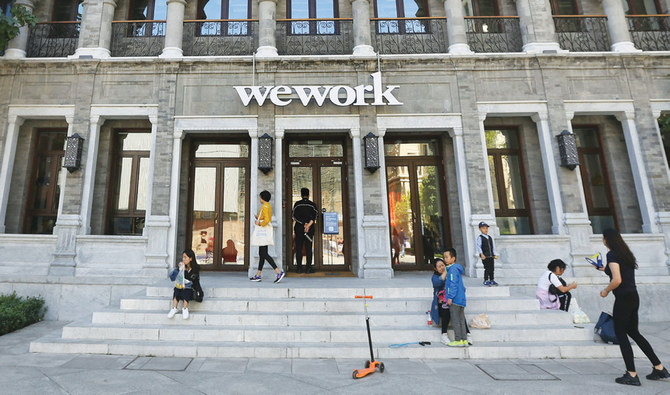
People are seen outside the building of WeWork office in Beijing. (File/Reuters)
Short Url
Updated 24 December 2019
Follow

SoftBank’s $3bn WeWork financing talks stall with Japan banks

TOKYO: SoftBank Group Corp’s talks to secure $3 billion from Japan’s three biggest banks have stalled as the lenders have hit internal lending limits to the firm, two people said, complicating a $9.5 billion rescue package for WeWork.

The Japanese technology conglomerate is now likely to enter the new year without the WeWork financing in place, the people said, adding the banks are also concerned about the risks involved in rescuing the US office-sharing startup.

Mizuho Financial Group Inc., Mitsubishi UFJ Financial Group Inc. (MUFG) and Sumitomo Mitsui Financial Group Inc. (SMFG) are seeking ways to provide the financing while offsetting exposure, the people said, declining to be identified because the information is not public. SoftBank did not respond to a request for comment. Mizuho, MUFG and SMFG declined to comment.

One option is to use some of SoftBank’s 26 percent stake in Chinese e-commerce major Alibaba Group Holding Ltd. as collateral, the people said.

“SoftBank is an important client so we want to do everything we can to help, but we have to consider our credit risk,” said a senior banker.

FASTFACTS

• The Japanese technology conglomerate is now likely to enter the new year without the WeWork financing in place.

• The banks are also concerned about the risks involved in rescuing the US office-sharing startup. •SoftBank has 5.5 trillion yen in outstanding bonds and another 4 trillion yen in bank loans, Refinitiv data shows.

The talks illustrate the difficulty SoftBank poses for Japan’s banks. Founder Masayoshi Son’s tech juggernaut has long been a lucrative source of corporate lending in the world’s third-largest economy, where banks typically have to lend at ultra-low interest rates given years of deflation.

But SoftBank’s growing debt and turmoil at major bet WeWork earlier this year also highlight the firm’s higher risk profile.

“Banks cannot loosen their credit criteria only for SoftBank,” said S&P Global Ratings senior director Ryoji Yoshizawa.

Another option to spread the risk is a syndicated loan, Yoshizawa said, adding this would be time-consuming — potentially delaying financing.

SoftBank in October said it would launch a $9.5 billion bailout of WeWork after the cancelation of the startup’s initial public offering due to investor concerns over its corporate governance and co-founder Adam Neumann’s hard-partying ways.



Saudi POS spending jumps 28% in final week of Jan: SAMA

Updated 06 February 2026
Follow

Saudi POS spending jumps 28% in final week of Jan: SAMA

RIYADH: Saudi Arabia’s point-of-sale spending climbed sharply in the final week of January, rising nearly 28 percent from the previous week as consumer outlays increased across almost all sectors. 

POS transactions reached SR16 billion ($4.27 billion) in the week ending Jan. 31, up 27.8 percent week on week, according to the Saudi Central Bank. Transaction volumes rose 16.5 percent to 248.8 million, reflecting stronger retail and service activity. 

Spending on jewelry saw the biggest uptick at 55.5 percent to SR613.69 million, followed by laundry services which saw a 44.4 percent increase to SR62.83 million. 

Expenditure on personal care rose 29.1 percent, while outlays on books and stationery increased 5.1 percent. Hotel spending climbed 7.4 percent to SR377.1 million. 

Further gains were recorded across other categories. Spending in pharmacies and medical supplies rose 33.4 percent to SR259.19 million, while medical services increased 13.7 percent to SR515.44 million. 

Food and beverage spending surged 38.6 percent to SR2.6 billion, accounting for the largest share of total POS value. Restaurants and cafes followed with a 20.4 percent increase to SR1.81 billion. Apparel and clothing spending rose 35.4 percent to SR1.33 billion, representing the third-largest share during the week. 

The Kingdom’s key urban centers mirrored the national surge. Riyadh, which accounted for the largest share of total POS spending, saw a 22 percent rise to SR5.44 billion from SR4.46 billion the previous week. The number of transactions in the capital reached 78.6 million, up 13.8 percent week on week. 

In Jeddah, transaction values increased 23.7 percent to SR2.16 billion, while Dammam reported a 22.2 percent rise to SR783.06 million. 

POS data, tracked weekly by SAMA, provides an indicator of consumer spending trends and the ongoing growth of digital payments in Saudi Arabia.  

The data also highlights the expanding reach of POS infrastructure, extending beyond major retail hubs to smaller cities and service sectors, supporting broader digital inclusion initiatives.  

The growth of digital payment technologies aligns with Saudi Arabia’s Vision 2030 objectives, promoting electronic transactions and contributing to the Kingdom’s broader digital economy.