
Vision Fund, the biggest startup investor in the world, is to toughen up governance procedures and slow the pace of initial public offerings (IPOs) in the wake of the WeWork debacle and the disappointing market performance of Uber, Arab News can reveal.
The fund is also determined to push on with its commitment to job creation and company startups in Saudi Arabia, where it is in partnership with the Kingdom’s Public Investment Fund (PIF).
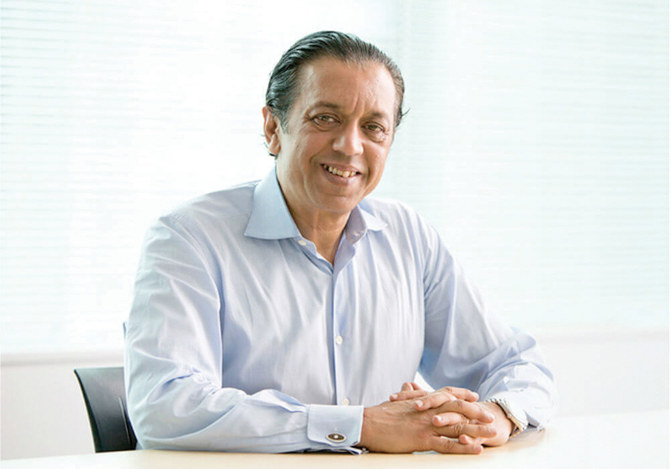
In an exclusive interview in Riyadh ahead of the Future Investment Initiative gathering this week, Rajeev Misra, chief executive of SoftBank Investment Advisers, which manages the $100 billion fund, said that it learned lessons from the abortive IPO of the US-based work space group, and the departure of its founder Adam Neumann.
“We believe that the founder’s integrity is critical. WeWork was not ready to be IPOd. Sometimes portfolio companies need to incubate for longer,” Misra said.
Neumann stepped down as chairman of the company and gave up his high voting shares after SoftBank, the Japanese financial giant headed by Masayoshi Son, organized a multibillion-dollar rescue of WeWork.
Neumann, who came under fire for personal eccentricities as well as governance lapses at the company he founded nine years ago, could receive as much as $1.7bn for ceding control of WeWork.
SoftBank is proposing to pay him $185m for a four year consulting contract and non-compete agreement, make available a $500m repayable loan, and buy out his shares in the loss-making company.
The WeWork problems will lead to an overhaul of governance procedures at all the companies held in the Vision Fund portfolio. “We are enhancing governance structures across all portfolio investments. We are serious about implementing policies and procedures, without exception,” Misra said.
Despite the problems at WeWork, Vision Fund is convinced of the long-term potential of the business, which it regards as a unique global company disrupting the real estate market and the way people work, and that it will thrive under new leadership.
The demise of the WeWork IPO has meant a financial hit for Vision Fund and for SoftBank.
Once valued at $47 billion in an earlier round of valuation, WeWork is now valued at just $8 billion.
Once the share transactions are completed, it will end up 80 percent owned by SoftBank and Vision Fund, with a multibillion-dollar capital injection in lieu of proceeds from the aborted IPO.
In Tokyo next month, SoftBank will report third quarter figures, and analysts are expecting write-downs in the value of its Vision Fund investments. But the overall value of the investments is still expected to be ahead, having shown a $20 billion increase at the last financial reporting period at the end of June.
SoftBank has to find cash to pay interest on the preference shares held by some of the Vision Fund investors, notably the two big contributors from the Middle East, the PIF and Mubadala of the UAE. Misra was confident that Vision Fund has the resources to meet these commitments.
“Out of our commitments of $100 billion in the first Vision Fund, we have only invested around $80 billion. There is uncalled capital capacity. The balance is here to be used primarily for ‘follow-on’ investment in existing portfolio companies, and to meet other liabilities including the interest payment on the preference shares held by limited partners (investors),” he told Arab News.
The pace of IPO offerings by Vision Fund is expected to slow, in light of a more difficult market for public share offerings, which led to a difficult market debut for Uber. SoftBank’s Rajeev Misra was confident that further share flotations — “realizations” in investment terminology — would be forthcoming.
“We are still in a very early stage of the investment cycle. Of course, realizations generate growth, and those will come in time,” he said. Guardant Health, the US oncology company that listed last year, is seen as a model for successful long-term performance.
HIGHLIGHTS
- Vision Fund has returned $6.4 billion to investors in its first two years of operations.
- SoftBank has $108 billion of commitments from a group of investors to the second fund
- It is in the process of raising Vision Fund 2.
- SoftBank has around 14 portfolio companies that are considering opening or expanding in Saudi Arabia.
He pointed to another company in the Vision Fund stable — the drugs manufacturer Roivant — as a well-run and cash generative company that could be an appropriate IPO vehicle sometime in the future. US-based Roivant recently signed a $3 billion deal with Sumitomo Pharma of Japan.
Vision Fund has returned $6.4 billion to investors in its first two years of operations, including a $2.9 billion gross gain on US technology group Nvidia and a $1.3 billion profit on Indian e-commerce company Flipkart.
SoftBank is in the process of raising Vision Fund 2, potentially with an even bigger budget than the first.
SoftBank has $108 billion of commitments from a group of investors to the second fund, but so far neither the PIF nor Mubadala have committed to the second fund.
“The partnership with PIF transcends the Vision Fund, WeWork or Uber. Conversations with PIF and Mubadala are constructive and ongoing,” Misra said.
SoftBank has around 14 portfolio companies that are considering opening or expanding in Saudi Arabia, including construction group Katerra and hotels business Oyo.
“The investment objective of Vision Fund for the Kingdom of Saudi Arabia is beyond financial performance. We have a focused program of portfolio company expansion in the Kingdom, and we are already seeing evidence of that in terms of company establishment which is in turn leading to economic development and job creation,” Misra added.