

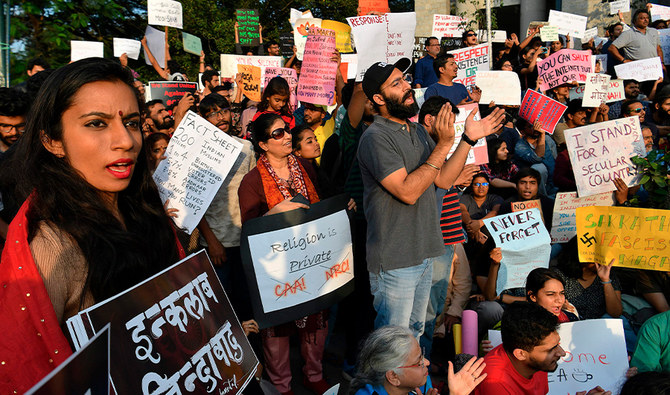

NEW DELHI: Reacting for the first time to the week-long protest against the Citizenship Amendment Act (CAA), Indian Prime Minister Narendra Modi said the law was “not discriminatory” and that the opposition was seeking to gain political mileage from the situation.
The opposition was “misleading people and stoking their emotions against the citizenship law,” said Modi, speaking during a rally on Sunday for his Hindu nationalist party in the capital.
New Delhi’s state election early next year will be the first major electoral test for Modi’s Bharatiya Janata Party (BJP) in the wake of the mass demonstrations seen after parliament cleared the Citizenship Amendment Act on Dec. 11.
Several thousand people took part in Modi’s rally where he accused the opposition of distorting facts to trigger protests.
“The law does not impact 1.3 billion Indians, and I must assure Muslim citizens of India that this law will not change anything for them,” said Modi, adding that his government introduces reforms without any religious bias.
“We have never asked anyone if they go to a temple or a mosque when it comes to implementing welfare schemes,” he said.
Modi said that the CAA was not directed at Muslims and the idea that the government had brought the law to usurp people’s rights was a “lie.”
“The law is not discriminatory,” said Modi while addressing a political rally in Delhi.
“My rivals should burn my effigy if they hate me but they should not target the poor. Target me but don’t set the public property on fire.”
However, Modi’s words failed to assure protesters in Delhi who gathered in the capital to demand the scrapping of the law.
“You cannot trust this regime, which has been acting on the sly and whose intentions are always suspect,” Ovais Sultan Khan, a social activist who has been at the forefront of the protests, told Arab News. “If the CAA is not discriminatory then why did you bring this law?”
“If the government’s intention was pure then it should have allowed peaceful protest. It should not have killed so many people in indiscriminate firing. It should not have excluded Muslims from the citizenship law,” Khan said.
The northern state of Uttar Pradesh has seen intense protest against the law and according to media reports 18 people have died in the past three days in police shootings.
“The situation in the western UP is tense today but no violence has taken place on Sunday. But it has been mayhem for the last three days,” said Durgesh, a Kanpur-based journalist.
“The administration imposed a prohibitory order, and when the protesters came out police used harsh measures and in the ensuing violence several people lost their lives in different parts of the state,” Durgesh said.
Under the new citizenship law, persecuted minorities — Hindu, Sikh, Jain, Parsi and Buddhist — from Bangladesh, Pakistan and Afghanistan would gain Indian citizenship, but not Muslims.
For many, this religious marking for the consideration of citizenship is an attack on the spirit of the constitution and violates the secular preamble of the republic.
The anxiety in the Muslim community has been further compounded by the government’s plan to bring in a National Register of Citizens (NRC), an exercise to identify genuine citizens of India. If a non-Muslim is left off the NRC he or she has the protection of the CAA but a Muslim does not, so protesters see the CAA as an instrument of “otherization of Muslims” in India.
This is the first serious resistance against the Modi regime since 2014 when he came to power. People from all communities are taking to the street to protest.
The BJP-ruled southern state of Karnataka also witnessed large-scale violence against the police crackdown with the government claiming the loss of four lives in Mangalore city. The coastal town has been put under curfew for three days.
Political analyst Pranjay Guha Thakurta said that the ruling Bhartiya Janata Party (BJP) is “trying hard to contain the protest and resorting to arrests and violence to discredit a genuine political uprising.”
He told Arab News that “the unrest is not sectarian and it’s not only Muslims but India which is speaking against the policy of a regime that is hellbent on turning the nation into a majoritarian state and trying to kill its secularism.”


