Hong Kong extradition bill turmoil damaged whole society: Chinese premier

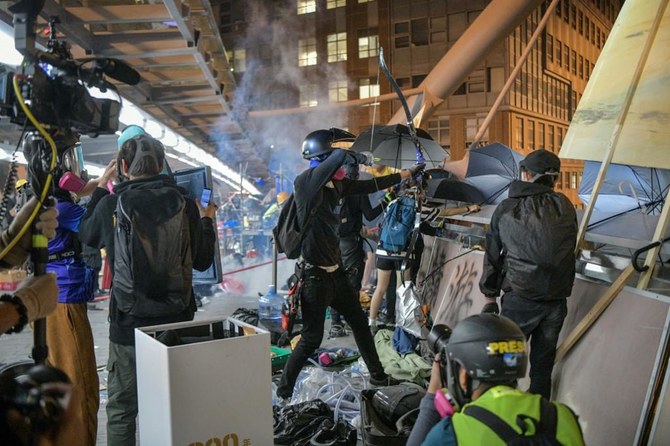
Some protesters in Hong Kong have increasingly resorted to violence since mass demonstrations began in June. (AFP)
Short Url
Updated 16 December 2019
Follow

Hong Kong extradition bill turmoil damaged whole society: Chinese premier

  • Chinese Premier Li Keqiang meets Hong Kong leader Carrie Lam in Beijing
  • Some protesters in territory have increasingly resorted to violence

BEIJING: Turmoil over amendments to extradition legislation has damaged Hong Kong society on all fronts, Chinese Premier Li Keqiang said Monday during a meeting with the territory’s leader, Carrie Lam.
Lam is in Beijing for talks with Li and Chinese President Xi Jinping. It’s her first visit to Beijing since pro-democracy candidates swept local Hong Kong elections last month in a rebuke of how Lam has handled months of fiery anti-government protests.
“In the past year, our politics, economy and society have really faced big problems,” Lam said at her meeting with Li, who reiterated the central government’s support for her administration.
The mass demonstrations began in June in response to proposed legislation that would have allowed Hong Kong residents to be tried for crimes in mainland China. While Lam has since withdrawn the bill, protesters have continued calling for broader democratic reforms and an independent inquiry into alleged police brutality.
Some protesters have increasingly resorted to violence. A lull in clashes ended Sunday evening when protesters threw bricks at police officers, who in turn fired tear gas. According to the authorities, the rioters also set fires, blocked roads and smashed traffic lights with hammers.
Video footage showed truncheon-wielding riot officers squirting pepper spray at a man in a group of journalists and ganging up to beat and manhandle him.
The violence and scattered confrontations in shopping malls earlier Sunday, where police also squirted pepper spray and made several arrests, ended what had been a break of a couple of weeks in conflicts between police and protesters.
It has snowballed into a full-blown challenge to the government and Communist leaders in Beijing, with an array of demands, including that Hong Kong’s leader and legislators all be fully elected. A former British colony, Hong Kong was returned to China in 1997 under a framework that promised the city more democratic freedoms than are allowed on the mainland.


Carney says Canada has no plans to pursue free trade agreement with China as Trump threatens tariffs

Updated 26 January 2026
Follow

Carney says Canada has no plans to pursue free trade agreement with China as Trump threatens tariffs

TORONTO: Canadian Prime Minister Mark Carney said Sunday his country has no intention of pursuing a free trade deal with China. He was responding to US President Donald Trump’s threat to impose a 100 percent tariff on goods imported from Canada if America’s northern neighbor went ahead with a trade deal with Beijing.
Carney said his recent agreement with China merely cuts tariffs on a few sectors that were recently hit with tariffs.
Trump claims otherwise, posting that “China is successfully and completely taking over the once Great Country of Canada. So sad to see it happen. I only hope they leave Ice Hockey alone! President DJT”
The prime minister said under the free trade agreement with the US and Mexico there are commitments not to pursue free trade agreements with nonmarket economies without prior notification.
“We have no intention of doing that with China or any other nonmarket economy,” Carney said. “What we have done with China is to rectify some issues that developed in the last couple of years.”
In 2024, Canada mirrored the United States by putting a 100 percent tariff on electric vehicles from Beijing and a 25 percent tariff on steel and aluminum. China had responded by imposing 100 percent import taxes on Canadian canola oil and meal and 25 percent on pork and seafood.
Breaking with the United States this month during a visit to China, Carney cut its 100 percent tariff on Chinese electric cars in return for lower tariffs on those Canadian products.
Carney has said there would be an initial annual cap of 49,000 vehicles on Chinese EV exports coming into Canada at a tariff rate of 6.1 percent, growing to about 70,000 over five years. He noted there was no cap before 2024. He also has said the initial cap on Chinese EV imports was about 3 percent of the 1.8 million vehicles sold in Canada annually and that, in exchange, China is expected to begin investing in the Canadian auto industry within three years.
Trump posted a video Sunday in which the chief executive of the Canadian Vehicle Manufacturers’ Association warns there will be no Canadian auto industry without US access, while noting the Canadian market alone is too small to justify large scale manufacturing from China.
“A MUST WATCH. Canada is systematically destroying itself. The China deal is a disaster for them. Will go down as one of the worst deals, of any kind, in history. All their businesses are moving to the USA. I want to see Canada SURVIVE AND THRIVE! President DJT,” Trump posted on social media.
Trump’s post on Saturday said that if Carney “thinks he is going to make Canada a ‘Drop Off Port’ for China to send goods and products into the United States, he is sorely mistaken.”
“We can’t let Canada become an opening that the Chinese pour their cheap goods into the U.S,” US Treasury Secretary Scott Bessent said on ABC’s “This Week.”
“We have a , but based off — based on that, which is going to be renegotiated this summer, and I’m not sure what Prime Minister Carney is doing here, other than trying to virtue-signal to his globalist friends at Davos.”
Trump’s threat came amid an escalating war of words with Carney as the Republican president’s push to acquire Greenland strained the NATO alliance.
Carney has emerged as a leader of a movement for countries to find ways to link up and counter the US under Trump. Speaking in Davos before Trump, Carney said, “Middle powers must act together because if you are not at the table, you are on the menu” and he warned about coercion by great powers — without mentioning Trump’s name. The prime minister received widespread praise and attention for his remarks, upstaging Trump at the World Economic Forum.
Trump’s push to acquire Greenland has come after he has repeatedly needled Canada over its sovereignty and suggested it also be absorbed into the United States as a 51st state. He posted an altered image on social media this week showing a map of the United States that included Canada, Venezuela, Greenland and Cuba as part of its territory.