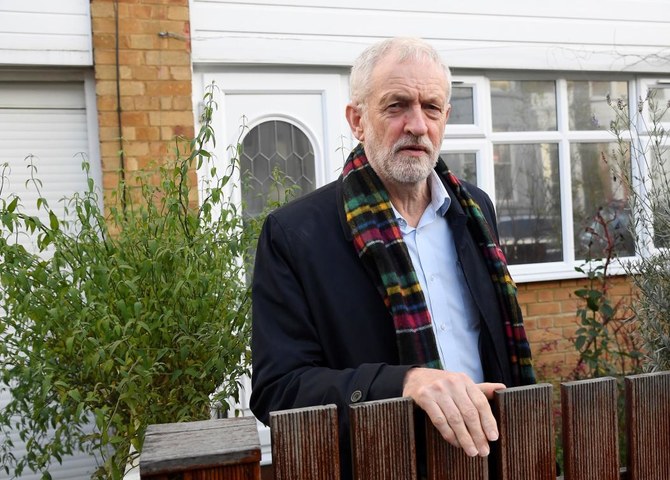
LONDON: Britain’s main opposition leader Jeremy Corbyn apologized to supporters on Sunday for overseeing his Labour party’s worst election defeat since before World War II.
But the veteran socialist defended his far-left campaign platform and gave no clear indication of when he might step down.
“I will make no bones about it. The election result on Thursday was a body blow for everyone who so desperately needs real change in our country,” Corbyn wrote in the Sunday Mirror newspaper.
“I wanted to unite the country that I love but I’m sorry that we came up short and I take my responsibility for it.”
Thursday’s snap general election handed Prime Minister Boris Johnson’s Conservatives a mandate to take Britain out of the European Union at the end of next month.
Corbyn said on Friday that he would step down at some point early next year.
But the century-old party has no clear successor and is being riven by infighting within its senior ranks.
Labour’s campaign was dogged by voter doubts about its vague position on Brexit and allegations of anti-Semitism within the party’s senior ranks.
Corbyn tried to shift the campaign’s focus on bread-and-butter social issues traditionally important to Labour voters.
“But despite our best efforts, this election was ultimately about Brexit,” Corbyn admitted in his letter.
“The Tory campaign, amplified by most of the media, managed to persuade many that only Boris Johnson could ‘get Brexit done’,” he said in reference to Johnson’s campaign slogan.
“We will learn the lessons of this defeat, above all by listening to those lifelong Labour voters who we’ve lost in working class communities.”

UK opposition chief Corbyn apologizes for Labour’s worst election debacle
Short Url
https://arab.news/93ymn
UK opposition chief Corbyn apologizes for Labour’s worst election debacle
- But veteran socialist defended his far-left campaign platform and gave no clear indication of when he might step down
- Labour’s campaign was dogged by voter doubts about its vague position on Brexit
Minnesota gears up for anti-immigration enforcement protest Friday despite dangerous cold
MINNEAPOLIS: A vast network of labor unions, progressive organizations and clergy has been urging Minnesotans to stay away from work, school and stores Friday to protest against immigration enforcement in the state.
“We really, really want I.C.E. to leave Minnesota, and they’re not going to leave Minnesota unless there’s a ton of pressure on them,” said Kate Havelin of Indivisible Twin Cities, one of the more than 100 groups that is mobilizing. “They shouldn’t be roaming any streets in our country just the way they are now.”
The Twin Cities of Minneapolis and St. Paul have seen daily protests since Renee Good was fatally shot by a US Immigration and Customs Enforcement officer during an operation on Jan. 7. Federal law enforcement officers have surged in the area for weeks and have repeatedly squared off with community members and activists who track their movements online and in streets.
On Thursday, a prominent civil rights attorney and at least two other people involved in an anti-immigration enforcement protest that disrupted a Sunday service at a Minnesota church were arrested.
Vice President JD Vance visited Minneapolis to meet with ICE officials. He said repeatedly that he believed the fraught situation in Minneapolis would improve upon better cooperation from state and local officials, and he encouraged protests to remain peaceful.
Friday’s mobilization was planned as the largest coordinated protest action to date, including a march in downtown Minneapolis despite dangerously cold temperatures that the National Weather Service forecast in the single to double digits below zero (-20 to -30 degrees Celsius).
While organizations have asked participants to prepare for the cold, Havelin compared the presence of immigration enforcement to just such winter weather warnings.
“Minnesotans understand that when we’re in a snow emergency … we all have to respond and it makes us do things differently,” she said. “And what’s happening with ICE in our community, in our state, means that we can’t respond as business as usual.”
More than a hundred small businesses in the Twin Cities, largely coffee shops and restaurants, said they would close in solidarity or donate part of their profits, organizers said.
Ethnic businesses especially have lost sales during enforcement surges as both workers and customers stay away fearing they would be detained.
But some are deciding to close anyway, preferring to take a stance in solidarity rather than the “unscheduled interruption” of having agents apprehend staff, said Luis Argueta of Unidos MN, a civil rights group.
Many schools were planning to be closed for a variety of reasons. The University of Minnesota, which has about 50,000 students enrolled, said there would be no in-person classes because of the extreme cold warning, and the St. Paul public school district said there would no classes for the same reason. Minneapolis Public Schools were also scheduled to be closed Friday “for a teacher record keeping day.”
Clergy planned to join the march as well as hold prayer services and fasting, according to a delegation of representatives of faith traditions ranging from Buddhist to Jewish, Lutheran to Muslim.
Bishop Dwayne Royster, leader of the progressive organization Faith in Action, arrived in Minnesota on Wednesday from Washington, D.C.
“We want ICE out of Minnesota,” he said. “We want them out of all the cities around the country where they’re exercising extreme overreach.”
Royster said at least 50 of his network’s faith-based organizers from around the US were joining in the protest.
About 10 faith leaders were planning to travel to Minnesota from Los Angeles while others from the same group planned a solidarity rally in California, said one of the organizers there.
“It was a very harrowing experience,” said the Rev. Jennifer Gutierrez of the large enforcement operation in Los Angeles last year. “We believe God is on the side of migrants.”
“We really, really want I.C.E. to leave Minnesota, and they’re not going to leave Minnesota unless there’s a ton of pressure on them,” said Kate Havelin of Indivisible Twin Cities, one of the more than 100 groups that is mobilizing. “They shouldn’t be roaming any streets in our country just the way they are now.”
The Twin Cities of Minneapolis and St. Paul have seen daily protests since Renee Good was fatally shot by a US Immigration and Customs Enforcement officer during an operation on Jan. 7. Federal law enforcement officers have surged in the area for weeks and have repeatedly squared off with community members and activists who track their movements online and in streets.
On Thursday, a prominent civil rights attorney and at least two other people involved in an anti-immigration enforcement protest that disrupted a Sunday service at a Minnesota church were arrested.
Vice President JD Vance visited Minneapolis to meet with ICE officials. He said repeatedly that he believed the fraught situation in Minneapolis would improve upon better cooperation from state and local officials, and he encouraged protests to remain peaceful.
Friday’s mobilization was planned as the largest coordinated protest action to date, including a march in downtown Minneapolis despite dangerously cold temperatures that the National Weather Service forecast in the single to double digits below zero (-20 to -30 degrees Celsius).
While organizations have asked participants to prepare for the cold, Havelin compared the presence of immigration enforcement to just such winter weather warnings.
“Minnesotans understand that when we’re in a snow emergency … we all have to respond and it makes us do things differently,” she said. “And what’s happening with ICE in our community, in our state, means that we can’t respond as business as usual.”
More than a hundred small businesses in the Twin Cities, largely coffee shops and restaurants, said they would close in solidarity or donate part of their profits, organizers said.
Ethnic businesses especially have lost sales during enforcement surges as both workers and customers stay away fearing they would be detained.
But some are deciding to close anyway, preferring to take a stance in solidarity rather than the “unscheduled interruption” of having agents apprehend staff, said Luis Argueta of Unidos MN, a civil rights group.
Many schools were planning to be closed for a variety of reasons. The University of Minnesota, which has about 50,000 students enrolled, said there would be no in-person classes because of the extreme cold warning, and the St. Paul public school district said there would no classes for the same reason. Minneapolis Public Schools were also scheduled to be closed Friday “for a teacher record keeping day.”
Clergy planned to join the march as well as hold prayer services and fasting, according to a delegation of representatives of faith traditions ranging from Buddhist to Jewish, Lutheran to Muslim.
Bishop Dwayne Royster, leader of the progressive organization Faith in Action, arrived in Minnesota on Wednesday from Washington, D.C.
“We want ICE out of Minnesota,” he said. “We want them out of all the cities around the country where they’re exercising extreme overreach.”
Royster said at least 50 of his network’s faith-based organizers from around the US were joining in the protest.
About 10 faith leaders were planning to travel to Minnesota from Los Angeles while others from the same group planned a solidarity rally in California, said one of the organizers there.
“It was a very harrowing experience,” said the Rev. Jennifer Gutierrez of the large enforcement operation in Los Angeles last year. “We believe God is on the side of migrants.”
© 2026 SAUDI RESEARCH & PUBLISHING COMPANY, All Rights Reserved And subject to Terms of Use Agreement.


