

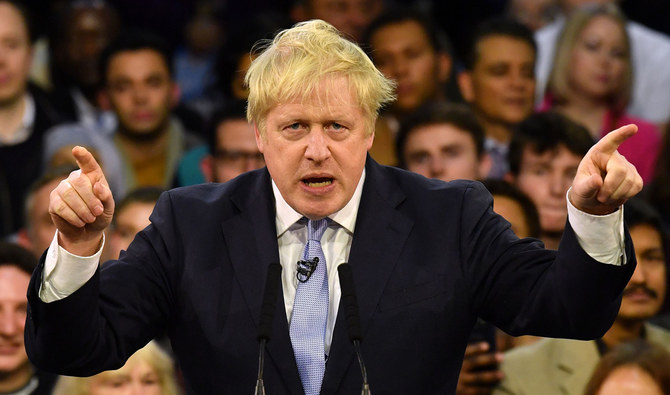

LONDON: Prime Minister Boris Johnson won a resounding election victory on Friday that will allow him to end three years of political paralysis and take Britain out of the European Union by Jan. 31.
Brexit represents the country's biggest political and economic gamble since World War Two, cutting the world's fifth largest economy adrift from the vast trading bloc and threatening the integrity of the United Kingdom.
For Johnson, who campaigned on a vow to "Get Brexit Done", victory was a vindication after anti-Brexit opponents tried one manoeuvre after another to thwart him during his first chaotic months in office.
"We will get Brexit done on time by the 31st of January, no ifs, no buts, no maybes," a triumphant Johnson told supporters at a rally in London.
"Leaving the European Union as one United Kingdom, taking back control of our laws, borders, money, our trade, immigration system, delivering on the democratic mandate of the people," he said, reprising the refrains of his successful Brexit referendum campaign of 2016.
Sterling soared, on course for one of its biggest one-day gains in the past two decades
Nearly half a century after Britain joined the EU, Johnson must now strike new international trade deals, preserving London's position as a top global financial capital and keeping the United Kingdom together.
That last goal looks more challenging, with Scotland voting for a nationalist party that wants an independence referendum, and Irish nationalists performing strongly in Northern Ireland.
"Boris Johnson may have a mandate to take England out of the European Union. He emphatically does not have a mandate to take Scotland out of the European Union," said Scotland's first minister, Nicola Sturgeon.
Her Scottish National Party (SNP) won 48 of Scotland's 59 seats in the national parliament.
RED WALL CRUMBLES
In England, the Conservatives won large numbers of seats in the opposition Labour Party's so-called Red Wall, declining industrial heartlands once hostile to Johnson's party.
Brexit, which has shattered old party loyalties and divided Britain along new fault lines, was the cause of the shift. In the Red Wall, a majority of voters favoured leaving the European Union and rejected Labour leader Jeremy Corbyn's ambiguous stance on the issue.
In a symbolic win, the Conservatives took Sedgefield, once held by former Prime Minister Tony Blair, Labour's most successful leader.
Educated at Eton, the country's most elite private school, and known for his bombastic rhetoric, Johnson seemed to critics to be an unlikely candidate to win over working class communities, but Brexit helped him redraw the electoral map.
In his victory speech, he struck a rare note of humility as he addressed voters who had deserted Labour in his favour.
"Your hand may have quivered over the ballot paper before you put your cross in the Conservative box, and you may hope to return to Labour next time round, and if that is the case, I am humbled that you have put your trust in me," he said.
U.S. President Donald Trump was quick to congratulate Johnson.
"Britain and the United States will now be free to strike a massive new Trade Deal after BREXIT. This deal has the potential to be far bigger and more lucrative than any deal that could be made with the E.U.," Trump wrote on Twitter "Celebrate Boris!"
European politicians were less enthusiastic.
German lawmaker Norbert Roettgen of Chancellor Angela Merkel's party said "the British people have decided and we have to accept their choice. With Johnson's victory Brexit has become inevitable".
NO MORE DELAYS
Johnson, 55, will now be able to lead Britain out of the EU by Jan. 31, 10 months after the original deadline of March 29, which was repeatedly pushed back as a gridlocked parliament failed to take any clear decisions on Brexit.
However, with the complex task of negotiating his country's future relationship with the bloc still ahead of him, he may struggle to reunite a divided nation.
Many voters regard him as a populist charlatan who played fast and loose with the facts and made unrealistic promises.
But his landslide win marks the ultimate failure of the anti-Brexit camp, who tried to thwart the 2016 referendum vote through complex legislative manoeuvres and could not convert huge anti-Brexit street protests into a coherent political strategy.
With Labour split and unclear on Brexit, the strongly anti-Brexit Liberal Democrats had hoped to do well but they won only 11 seats, a crushing result. Party leader Jo Swinson lost her seat in Scotland to the SNP and resigned.
With results in from all but one of the 650 parliamentary seats, the Conservatives had won 364, their biggest election win since Margaret Thatcher's 1987 triumph.
Labour, led since 2015 by the veteran socialist Corbyn, had won just 203 seats, the party's worst result since 1935.
Corbyn's offer of nationalisations and big state spending failed to win over voters, while his equivocal position on Brexit left many angry and confused, especially in Red Wall areas where large majorities had voted for Brexit in 2016.
Corbyn said he would quit as Labour leader after a "process of reflection".
The party now faces a brutal battle between Corbyn's socialist followers and his centrist critics.
A SOFTER BREXIT?
After Jan. 31, Britain will enter a transition period during which it will negotiate a new relationship with the EU.
This can run until the end of 2022, but the Conservatives have pledged not to extend the transition beyond 2020.
A big majority may allow Johnson to extend trade talks beyond 2020 because he could overrule the Brexit hardline European Research Group (ERG) faction in the party.
"The bigger the Tory majority of course the less influence over this the ERG and Eurosceptics will have," said hardline Brexiteer Nigel Farage, whose anti-EU campaigning played a major part in persuading former Conservative Prime Minister David Cameron to call the 2016 referendum.
"It will be called Brexit but it won't really be," Farage said.
Johnson was helped by Farage's Brexit Party, which stood down hundreds of candidates to prevent the pro-Brexit vote from being split. The insurgent party poached a significant number of voters from Labour.
In his victory speech, Johnson gave no details of how he would handle Brexit after Jan. 31. Instead, he made a typically light-hearted offer to his supporters.
"Let's get Brexit done but first, my friends, let's get breakfast done."


