Exiled actress Farahani decries ‘massacre’ in Iran

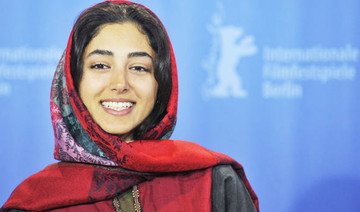
Iranian actress and singer Golshifteh Farahani attends the 18th edition of the Marrakech International Film Festival. (AFP)
Updated 06 December 2019
Follow

Exiled actress Farahani decries ‘massacre’ in Iran

  • Golshifteh Farahani: ‘It’s a massacre, with hundreds of people dead’
  • Farahani upset the Iranian authorities when she appeared in Ridley Scott’s spy thriller ‘Body of Lies’

MARRAKESH, Morocco: Exiled Iranian actress Golshifteh Farahani has condemned what she called a “massacre” in her homeland, which has been rocked by a wave of deadly protests.
Farahani, Iran’s first actress to star in a Hollywood film since the 1979 revolution, told AFP in an interview that the Iranian people were “suffering economically, politically and democratically.”
The United States said Thursday that Iranian authorities may have killed more than 1,000 people in a crackdown on demonstrations, after the government abruptly hiked fuel prices.
According to London-based human rights group Amnesty International, at least 208 people died in the protests that erupted on November 15.
“It’s a massacre, with hundreds of people dead,” Farahani said on the sidelines of the Marrakesh International Film Festival.
“I’ve learned not to dream when it comes to Iran. We cannot guess what will happen tomorrow.
“I didn’t expect the price of petrol to triple overnight. At the same time, I know that the people are suffering economically, politically and democratically. And when people suffer, it can explode quickly,” she said.
Iran has dismissed the high death tolls reported by foreign sources as “utter lies” and has so far confirmed only five dead — four security force personnel killed by “rioters” and one civilian.
Farahani — daughter of the acclaimed director Behzad Farahani — upset the Iranian authorities when she appeared in Ridley Scott’s spy thriller “Body of Lies” in 2008 alongside Leonardo DiCaprio.
She went into exile, first in the United States and then in France where she now lives.
“I realized that I preferred being in Europe, in the middle of the world,” she said.
“Being in exile is like being in an ocean. Your only choice is to swim or you’ll die.”
Farahani said she cannot return to Iran.
“Because of my films, because I’m a woman, for not wearing the veil,” she said.
“Everything I did when I left Iran became like a political act, when it was not the case,” she added.
“I wasn’t a politician or an activist. I was just an actress. A female actress. If I were a man I would have taken a different path.”


Abu Dhabi’s 421 Arts Campus celebrates 10 years with new show

Updated 24 December 2025
Follow

Abu Dhabi’s 421 Arts Campus celebrates 10 years with new show

  • ‘Rays, Ripples, Residue’ triple exhibition runs until April 16
  • Focus on UAE art, director Faisal Al-Hassan tells Arab News

ABU DHABI: Abu Dhabi’s 421 Arts Campus has just turned 10 and is marking the milestone with an exhibition “Rays, Ripples, Residue,” running until April 16, 2026.

The exhibition comprises three sections, each curated independently but with a cohesive thread.


A post shared by @421.online

The curators, Emirati Munira Al-Sayegh, Lebanese transplant Nadine Khalil, and Sharjah-born Indian writer, Murtaza Vali, explore how artistic practices and exhibition-making in the UAE has evolved over the past decade.

Faisal Al-Hassan, director of the arts hub and commissioning institution, spoke to Arab News about the showcase.

“‘Rays, Ripples, Residue’ is a landmark exhibition that celebrates this 10-year milestone and reflects on artistic practices over the past decade or so. The exhibition unfolds in three separate chapters, each curated from a distinct point of view,” he said.

‘Rays, Ripples, Residue,’ 2025. Installation view. Photography by Ismail Noor, ‘Seeing Things.’ (Courtesy of 421 Arts Campus, Abu Dhabi)

Al-Sayegh’s chapter, titled “Leading to the Middle,” is perhaps the most personal and rooted, because of her deep connection to the land and its people. She looked at how seemingly minute moments have a rippling effect.

In her space, she examines the practices of established artists including Emirati Mohammed Ahmed Ibrahim and the late Kuwaiti creative Tarek Al-Ghoussein.

In the adjacent space, Khalil presents “Ghosts of Arrival,” described by Al-Hassan as “an intimate look at what it feels like to arrive after the moment has passed.” This serves as the residue part of the exhibition.

Al-Hassan said: “She (Khalil) brings to the fore the practices of artists from the past 10 years who were influenced by work that was created a decade prior. It is both an analysis of artmaking in the UAE and a personal reflection of her own arrival in the country in 2017.”

Hashed Al Lamki’s ‘Space is Holy’ (ongoing sculptural series), 2016 - present. Found objects and sawdust. (Courtesy of 421 Arts Campus, Abu Dhabi)

Artists featured in the section include Hashel Al-Lamki, Mona Ayyash, and Nadine Ghandour.

Vali’s “SUN” presents the rays part of the show, highlighting a sunny — and shady — survey of the last 10 years and the preoccupation of local artists with the flaming ball in the sky.

According to Al-Hassan, Vali selected “works made between 2015 and today that are focused on the sun as both a symbolic and physical presence in our everyday lives — presented visually and metaphorically — to convey and investigate environmental degradation, hyper-commodification, and urban development.”

The three chapters feature new commissions, as well as previously presented works, or new iterations of existing works.

It also spans a wide range of disciplines, including photography, video, performance, installations and multimedia works.

“When we started our journey 10 years ago, the mission was clear: we wanted to provide a nurturing space for emerging artists to experiment and grow,” Al-Hassan told Arab News.

Hashel Al Lamki’s ‘Space is Holy’ (ongoing sculptural series), 2016 - present. (Courtesy of 421 Arts Campus, Abu Dhabi)

In the last decade, 421 has supported over 1,500 emerging creative practitioners, presented over 50 exhibitions, including solo, group and traveling shows, and commissioned hundreds of new works across visual art, design, performance and writing.

During that time, it also delivered around 2,000 impactful programs across residencies, grants and exhibitions. This was alongside various public programs including talks, workshops, film screenings and special events, while training and mentoring more than 60 interns and creative facilitators.

“We see our work as complementary to the wider ecosystem,” he said.

“It took some time for the creative community to understand why it was so important for us to include such an extensive set of access points in the exhibitions,” he added.

“To us, these materials, like the tactile books, family labels, glossaries, and wall text annotations for example, are just as important as the artwork itself.”

Mays Albaik, who is 421’s “wall whisperer,” walked Arab News through the overall space and explained how the organization gets it done.

“So from the get-go, 421’s mission has always been about breaking down the wall that makes people say, oh, it’s art, I don’t get it, it’s not for me. And so in everything that we do, we’re constantly thinking, how do we tell people: no, actually, it is for you,” Albaik told Arab News.

“Art spaces should be fun,” she added with a laugh.

Text on the walls are written in English and Arabic and the wording used is aimed to be simple but not simplistic, being mindful of the extensive expatriate community in the UAE who may not be fluent in either language.

“What we actually do is, the version of the wall text that you see — or an earlier version of this wall text — goes to a few different members of our community. We go to our operations team, for example, our housekeeping staff and our security guards,” she said.

Arab News spoke with Rajesh Maurati, 28, who has been a security officer at 421 for the past four years, to find out more.

“Initially, we did not have a lot of context, there was some description about the artist, the curators and about the artist point of view,“ Maurati, who is from Nepal, said.

During his 12-hour shift, he would spend a lot of time walking past the walls. Now those walls are a part of the show for him.

“Initially, it was a little bit hard for me to understand the text. Before, I said nothing. Now, before the exhibition, they give us the text to read and if we don’t understand something, we just underline it. And they listen.”


A post shared by @421.online

With this simple shift, he now takes pride in not only responding to questions from visitors, but being able to make the space even more immersive and welcoming. And much more human.

“It is really helpful for me personally, too, to create more knowledge about art. Even English, my communication is better — it was not really good before.”

“When I came here (to 421), I learned a lot of things; how to communicate with our clients, our colleagues—we are a mixed nationality. So every time we communicate with each other it gets better. It is better,” he said.