

Saudi Arabia’s Al-Jubeir warns of intolerable Iranian threat

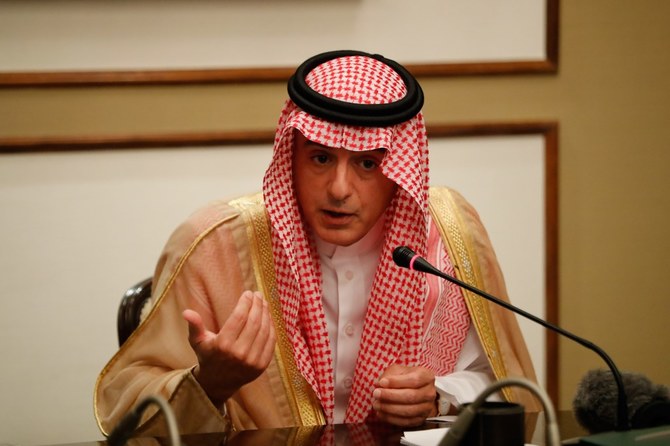
Iran threatens the entire region and its aggression can no longer be tolerated, Saudi Minister of State for Foreign Affairs Adel Al-Jubeir said on Friday. (File/AFP)
Updated 07 December 2019
Follow

Saudi Arabia’s Al-Jubeir warns of intolerable Iranian threat

  • Al-Jubeir stressed that Iran must be deprived of the tools that threaten the region
  • He also said the only solution to Yemen is political

JEDDAH: Iran continues to pose a serious threat to the entire region and its aggression can no longer be tolerated, Saudi Minister of State for Foreign Affairs Adel Al-Jubeir said on Friday.

He told the Mediterranean Dialogue Conference in Rome that the regime in Tehran must be deprived of the tools it uses to endanger the region and the world.

“Iran believes in the principle of exporting its revolution and does not respect the sovereignty of states,” said Al-Jubeir. The regime is spending millions of dollars to build nuclear weapons but does not take care of its people, he said.

Nobody is suggesting a regime change, the minister said; the solution instead lies in more effective negotiations to agree an improved Joint Comprehensive Plan of Action (the so-called Iran nuclear deal), and halt Tehran’s interference in other countries and its support of terrorism.

Turning to the crisis in Yemen, Al-Jubeir said only a political solution will be effective. “The Houthis are the ones who started the war, not us,” he added, but stressed that they will not be excluded from the peace and recovery process.

“All Yemenis, including the Houthis, have a role in the future of Yemen,” he said. “We support the legitimate government and the creation of new institutions that can be representative of all Yemenis.”

In a series of tweets on the Saudi Foreign Ministry’s Twitter account, Al-Jubeir addressed a number of other issues, including the regional dispute with Qatar.


Italian Foreign Minister Luigi Di Maio meets with Saudi Arabia’s Foreign Minister Adel Al-Jubeir, left, at the Rome Med 2019 – Mediterranean Dialogues summit, in Rome. (AP)

“We have a common history with Qatar and we have a common destiny, but there are necessary steps that need to be taken,” he wrote.

Regarding the decision by the Trump administration to withdraw US forces from a number of countries in the region, Al-Jubeir noted: “While they redeploy from Iraq they’re sending more troops to Saudi Arabia. Their presence is welcome, because they’re our allies.”

Al-Jubeir’s strong criticism of Iran was echoed on Friday by UN human rights chief Michelle Bachelet.

She said that Iranian security forces used “severe violence” to quell anti-government unrest last month, shooting at protesters from helicopters and a rooftop. They aimed for people’s heads and also fired at protesters as they ran away, she added, citing verified video footage.

Bachelet said the UN Human Rights Office has received information indicating that at least 208 people were killed, including 13 women and 12 children, during the demonstrations and at least 7,000 people arrested. 

Iranian authorities this week confirmed for the first time that security forces killed demonstrators during what human rights groups have described as the deadliest anti-government unrest since 1979.

“All in all, the picture now emerging from Iran is extremely disturbing,” Bachelet said.


School materials enter Gaza after being blocked for two years, UN agency says

Updated 58 min 55 sec ago
Follow

School materials enter Gaza after being blocked for two years, UN agency says

  • Thousands of kits, including pencils, exercise books and wooden cubes to play with, have now entered the enclave, UNICEF said

GENEVA: The UN children’s agency said on Tuesday it had for the first time in two-and-a-half years been able to deliver school kits with learning materials into Gaza after they were previously ​blocked by Israeli authorities.
Thousands of kits, including pencils, exercise books and wooden cubes to play with, have now entered the enclave, UNICEF said.
“We have now, in the last days, got in thousands of recreational kits, hundreds of school-in-a-carton kits. We’re looking at getting 2,500 more school kits in, in the next week, because they’ve been approved,” UNICEF spokesperson James Elder said.
COGAT, the arm of the Israeli military that oversees aid flows into ‌the Gaza ‌Strip, did not immediately respond to a request ‌for ⁠comment.
Children ​in ‌Gaza have faced an unprecedented assault on the education system, as well as restrictions on the entry of some aid materials, including school books and pencils, meaning teachers had to make do with limited resources, while children tried to study at night in tents without lights, Elder said. During the conflict some children missed out on education altogether, facing basic challenges like finding water, ⁠as well as widespread malnutrition, amid a major humanitarian crisis.
“It’s been a long two years ‌for children and for organizations like UNICEF to ‍try and do that education without those ‍materials. It looks like we’re finally seeing a real change,” Elder ‍stated. UNICEF is scaling up its education to support half of children of school age — around 336,000 — with learning support. Teaching will mainly happen in tents, Elder said, due to widespread devastation of school buildings in the enclave during the war which ​was triggered by Hamas’ assault on Israel on October 2023.
At least 97 percent of schools sustained some level of ⁠damage, according to the most recent satellite assessment by the UN in July.
Israel has previously accused Hamas and other militant groups of systematically embedding in civilian areas and structures, including schools, and using civilians as human shields. The bulk of the learning spaces supported by UNICEF will be in central and southern areas of the enclave, as it remains difficult to operate in the north, parts of which were badly destroyed in the final months of the conflict, Elder said.
The Hamas-led attack in October 2023 killed 1,200 people, according to Israeli tallies. Israel’s assault has killed 71,000 Palestinians, Gaza’s health authorities say. ‌More than 20,000 children were reported killed, including 110 since the October 10 ceasefire last year, UNICEF said, citing official data.