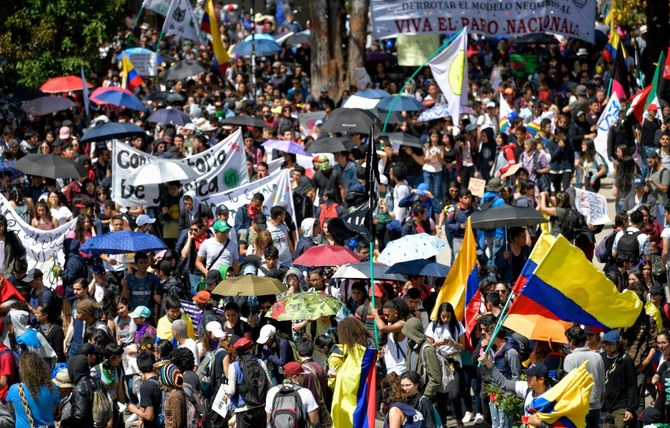
Third general strike keeps pressure on Colombia’s Duque

Indigenous people and students take part in a protest against the government of Colombian President Ivan Duque in Bogota, on December 4, 2019. (AFP)
Updated 05 December 2019
Follow

Third general strike keeps pressure on Colombia’s Duque

  • Some roads were blocked in the capital and in the northeastern city of Cali, but many businesses remained open
  • Crowds were smaller than previous demonstrations as protests took place for a 14th consecutive day

BOGOTA: Thousands of protesters took part in anti-government demonstrations in Colombia’s capital Bogota and other cities Wednesday during the country’s third general strike in two weeks.

Strike leaders say they intend to maintain pressure on right-wing President Ivan Duque’s government, after brushing aside his appeals to cancel the strike on the grounds its effects were crippling the economy.

But crowds were smaller than previous demonstrations as protests took place for a 14th consecutive day.

Some roads were blocked in the capital and in the northeastern city of Cali, but many businesses remained open.

Around 250,000 people took part in the first demonstration against Duque’s 15-month-old government on November 21, when the initial general strike brought the country to a standstill.

Interior Minister Nancy Patricia Gutierrez estimated that 40,000 people took part in demonstrations across the country on Wednesday, but organizers said the number of participants was much higher.

“The Colombian people have woken up!” shouted Paola Jiminez, a 41-year-old lawyer taking part in a pot-banging “cacerolazo” demonstration in Bogota.

“Colombians are finding it more and more difficult financially,” she said.

A student taking part in one of several peaceful protests in Bogota, who gave his name as Nicolas, held up a banner saying: “The state lies more than my ex.”

Police were deployed in nearby streets, but there were no confrontations of the kind that have marred some protests over the last two weeks, during which four people died. Some 500 have been injured.

On Tuesday, the Colombian National Strike Committee — comprising unions, students and teacher organizations, indigenous groups and the opposition — met directly with Duque’s advisers for the first time, but reached no agreement.

Another meeting was scheduled for Thursday. Under fire for his economic policies and corruption in the country, Duque launched a national dialogue with mayors and other officials 10 days ago.

The strike committee has presented Duque with a list of 13 demands, including the withdrawal of his proposed tax reforms, and full compliance with the 2016 peace deal with FARC guerrillas.

Among them is a call to dismantle the feared ESMAD riot police, widely criticized for its heavy handed response to protesters.

Duque has yielded to some of the demands on tax reform, announcing the return of Value Added Tax to the poorest 20 percent of the population and benefits for companies that hire young people.


India, Arab League target $500bn in trade by 2030

Updated 54 min ago
Follow

India, Arab League target $500bn in trade by 2030

  • It was the first such gathering of India–Arab FMs since the forum’s inauguration in 2016
  • India and Arab states agree to link their startup ecosystems, cooperate in the space sector

NEW DELHI: India and the Arab League have committed to doubling bilateral trade to $500 billion by 2030, as their top diplomats met in New Delhi for the India–Arab Foreign Ministers’ Meeting. 

The foreign ministers’ forum is the highest mechanism guiding India’s partnership with the Arab world. It was established in March 2002, with an agreement to institutionalize dialogue between India and the League of Arab States, a regional bloc of 22 Arab countries from the Middle East and North Africa.

The New Delhi meeting on Saturday was the first gathering in a decade, following the inaugural forum in Bahrain in 2016.

India’s Foreign Minister S. Jaishankar said in his opening remarks that the forum was taking place amid a transformation in the global order.

“Nowhere is this more apparent than in West Asia or the Middle East, where the landscape itself has undergone a dramatic change in the last year,” he said. “This obviously impacts all of us, and India as a proximate region. To a considerable degree, its implications are relevant for India’s relationship with Arab nations as well.”

Jaishankar and his UAE counterpart co-chaired the talks, which aimed at producing a cooperation agenda for 2026-28.

“It currently covers energy, environment, agriculture, tourism, human resource development, culture and education, amongst others,” Jaishankar said.

“India looks forward to more contemporary dimensions of cooperation being included, such as digital, space, start-ups, innovation, etc.”

According to the “executive program” released by India’s Ministry of External Affairs, the roadmap agreed by India and the League outlined their planned collaboration, which included the target “to double trade between India and LAS to US$500 billion by 2030, from the current trade of US$240 billion.”

Under the roadmap, they also agreed to link their startup ecosystems by facilitating market access, joint projects, and investment opportunities — especially health tech, fintech, agritech, and green technologies — and strengthen cooperation in space with the establishment of an India–Arab Space Cooperation Working Group, of which the first meeting is scheduled for next year.

Over the past few years, there has been a growing momentum in Indo-Arab relations focused on economic, business, trade and investment ties between the regions that have some of the world’s youngest demographics, resulting in a “commonality of circumstances, visions and goals,” according to Muddassir Quamar, associate professor at the School of International Studies, Jawaharlal Nehru University.

“The focus of the summit meeting was on capitalizing on the economic opportunities … including in the field of energy security, sustainability, renewables, food and water security, environmental security, trade, investments, entrepreneurship, start-ups, technological innovations, educational cooperation, cultural cooperation, youth engagement, etc.,” Quamar told Arab News.

“A number of critical decisions have been taken for furthering future cooperation in this regard. In terms of opportunities, there is immense potential.”