

Malawi tobacco pressured as US butts in over labor abuses

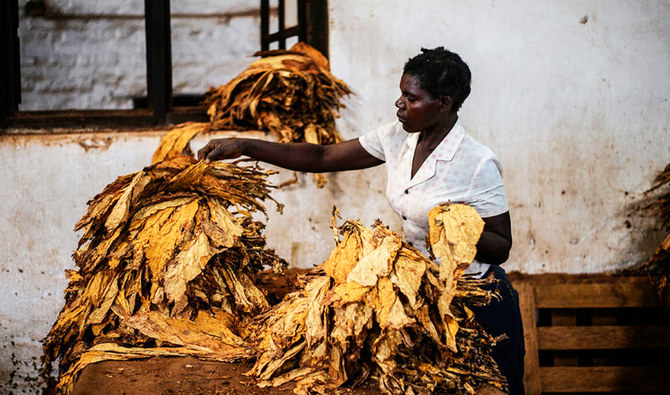
As tobacco, known locally as ‘green gold,’ is Malawi’s top crop in terms of employment, foreign exchange earnings and tax revenue, any trouble the sector runs into could quickly reverberate throughout the economy. (AFP/File)
Updated 01 December 2019
Follow

Malawi tobacco pressured as US butts in over labor abuses

  • As tobacco, known locally as “green gold,” is Malawi’s top crop in terms of employment

BLANTYRE: Malawi is being forced to confront child and forced labor practices after the US restricted tobacco imports from the impoverished southeastern African nation over allegations workers including children were being exploited.

Although exports to the US make up only a small part of Malawi’s total, the US move could make it harder selling its tobacco elsewhere and has sparked anxiety among farmers who fear they will be forced to accept lower prices.

As tobacco, known locally as “green gold,” is Malawi’s top crop in terms of employment, foreign exchange earnings (60 percent) and tax revenue (25 percent), any trouble the sector runs into could quickly reverberate throughout the economy.

The US decision piles even more pressure on the tobacco sector, already confronted with global anti-tobacco campaigns.

The trouble began in late October. British law firm Leigh Day announced it was preparing a landmark class action case against British American Tobacco (BAT) on behalf of 2,000 Malawian farmers, including hundreds of children, for forced labor and poverty wages.

BAT, which says it “takes the issue of child labor extremely seriously,” has denied any wrongdoing and noted that it buys tobacco from Malawi via international dealers who are required adhere to a code of conduct that does not tolerate child and forced labor.

The US suspended imports of tobacco from Malawi, saying it had information that reasonably indicated it was being produced using forced labor and forced child labor.

According to a survey conducted in 2017 by the country’s statistics agency the use of child labor in Malawi is extensive. It found that 38 percent of the country’s children aged between 5 and 17 were working.

Although the survey did not provide specific information about the tobacco sector, it is widely acknowledged that child labor is a problem.

Betty Chinyamunyamu, who heads an association of smallholder farmers, said incidents of child labor occur despite efforts to eliminate the practice.

BYD Americas CEO hails Middle East as ‘homeland for innovation’

Updated 7 sec ago
Follow

BYD Americas CEO hails Middle East as ‘homeland for innovation’

  • In an interview on the sidelines of Davos, Stella Li highlighted the region’s openness to new technologies and opportunities for growth

DAVOS: BYD Americas CEO Stella Li described the Middle East as a “homeland for innovation” during an interview with Arab News on the sidelines of the World Economic Forum.

The executive of the Chinese electric vehicle giant highlighted the region’s openness to new technologies and opportunities for growth.

“The people (are) very open. And then from the government, from everybody there, they are open to enjoy the technology,” she said.

BYD has accelerated its expansion of battery electric vehicles and plug-in hybrids across the Middle East and North Africa region, with a strong focus on Gulf Cooperation Council countries like the UAE and Saudi Arabia.

GCC EV markets, led by the UAE and Saudi Arabia, rank among the world’s fastest-growing. Saudi Arabia’s Public Investment Fund has been aggressively investing in the EV sector, backing Lucid Motors, launching its brand Ceer, and supporting charging infrastructure development.

However, EVs still account for just over 1 percent of total car sales, as high costs, limited charging infrastructure, and extreme weather remain challenges.

In summer 2025, BYD announced it was aiming to triple its Saudi footprint following Tesla’s entry, targeting 5,000 EV sales and 10 showrooms by late 2026.

“We commit a lot of investment there (in the region),” Li noted, adding that the company is building a robust dealer network and introducing cutting-edge technology.

Discussing growth plans, she envisioned Saudi Arabia and the wider Middle East as a potential “dreamland” for innovation — what she described as a regional “Silicon Valley.” 

Talking about the EV ambitions of the Saudi government, she said: “If they set up (a) target, they will make (it) happen. Then they need a technology company like us to support their … 2030 Vision.”