

Trump accuses impeachment witness of lying, defends use of Giuliani

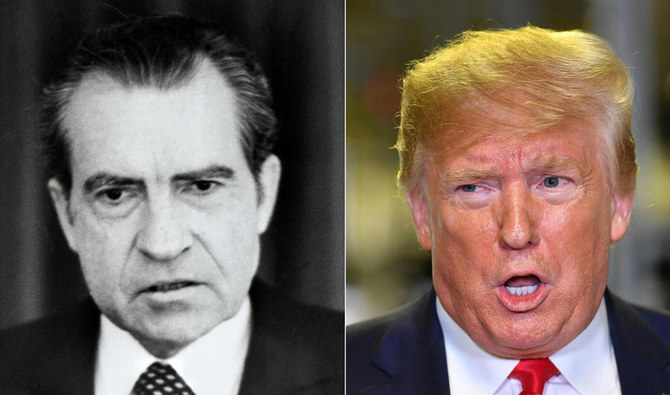
This combination of file pictures created on Nov. 22, 2019 shows US President Richard Nixon on April 30, 1973, in Washington, DC, and US President Donald Trump on Nov. 20, 2019 in Austin, Texas. On August 7, 1974, a trio of top Republican Party leaders visited the White House and told president Richard Nixon that impeachment was inevitable. He resigned the next day. Fast forward 45 years, and another US president, Donald Trump, is facing impeachment by the House of Representatives and a potential trial in the Senate. Unlike Nixon, however, Trump appears to enjoy — for the time being at least — the support of Republican lawmakers and has given no hint of stepping aside. (AFP / Mandel Ngan and AFP files)
Updated 23 November 2019
Follow

Trump accuses impeachment witness of lying, defends use of Giuliani

  • Trump took issue with the testimony by David Holmes, a US embassy official in Ukraine, pinning him to charges that he pressed the Ukraine government to investigate potential presidential rival Joe Biden
  • A focus of the inquiry is a July 25 telephone call in which Trump asked Ukrainian President Volodymyr Zelenskiy to open two investigations

WASHINGTON: President Donald Trump on Friday accused a witness in the Democratic-led impeachment inquiry of lying and offered an explanation for his controversial use of his personal lawyer Rudy Giuliani on Ukraine policy, saying Giuliani’s crime-fighting abilities were needed to deal with a corrupt country.
Trump made his remarks the day after the fifth and final scheduled day of public hearings in the US House of Representatives inquiry, which threatens his presidency even as he seeks re-election in November 2020.
The Republican president took issue with testimony on Thursday by David Holmes, a US embassy official in Ukraine. Holmes said under oath that at a Kiev restaurant he overheard a July 26 cellphone conversation in which Trump loudly pressed Gordon Sondland, the US ambassador to the European Union, for details on whether Ukraine would carry out politically motivated investigations the president was seeking.
“I guarantee you that never took place,” Trump told Fox News Channel’s “Fox & Friends” program.
“That was a total phony deal,” he added.
Trump appointed Sondland to the envoy post after the wealthy Oregon hotelier donated $1 million to his inaugural committee. While Sondland in testimony described an easygoing relationship between the two, Trump said on Friday he had spoken with him “a few times,” adding, “I hardly know him, OK?“
In another development, Trump’s former national security adviser John Bolton said that Twitter Inc. had returned control to him of his personal account. He accused the White House of blocking his access to it after he left his post in September.
In a post on the account, Bolton asked whether the White House had done so “out of fear of what I may say?” A person close to Bolton told Reuters there were numerous requests made to the White House on Bolton’s behalf to stop blocking his access before going to the company to regain control.
Bolton so far has declined to cooperate in the impeachment inquiry.
Later on Friday, Bolton told reporters at the Union Station in Washington: “We have regained control of the Twitter account. Twitter detached the White House.”
Asked if he was prepared to testify at the impeachment hearings, Bolton said: “I have no comment.”
Trump, a prolific Twitter user, denied in the Fox interview that Bolton’s access had been blocked by the White House.
Twitter did not immediately respond to a request for comment.
Testimony at the hearings put a spotlight on Trump’s decision to give Giuliani, a private citizen with no formal job in his administration, an outsized role to shape American policy toward Ukraine rather than using the US government’s usual diplomatic and national security channels.
Bolton is among the various US officials described as being alarmed at Giuliani’s actions, including pushing Ukraine to conduct two investigations that could harm Trump’s political adversaries. Former White House Russia expert Fiona Hill recalled how Bolton called Giuliani “a hand grenade who’s going to blow everybody up.”
During the hearings, current and former White House officials and diplomats voiced alarm at Giuliani’s activities.
Trump said Giuliani was the right person for the job.
“He’s like an iconic figure in this country for two reasons. He was the greatest mayor in the history of New York and he was the greatest crime fighter probably in the last 50 years,” Trump said of Giuliani, who previously served as the mayor of the largest US city and as a federal prosecutor.
“He’s also a friend of mine. He’s a great person,” Trump added. ” ... When you’re dealing with a corrupt country — if Rudy Giuliani — he’s got credentials because of his reputation... When Rudy Giuliani goes there and you hear it’s a corrupt country, I mean, it means a lot.”
Trump did not address what he actually told Giuliani to do.

Trump call
A focus of the inquiry is a July 25 telephone call in which Trump asked Ukrainian President Volodymyr Zelenskiy to open two investigations.
One involved Joe Biden, a top contender for the Democratic nomination to face Trump in the 2020 presidential election, and his son Hunter Biden, who had worked for Ukrainian energy company Burisma. Trump has accused Biden of corruption, but has not provided evidence. Biden has denied wrongdoing.
The other investigation involved a debunked conspiracy theory promoted by Trump and his allies that Ukraine meddled in the 2016 US presidential election to hurt his candidacy and boost Democratic rival Hillary Clinton. Trump touted that theory again on Friday.
US intelligence agencies and former Special Counsel Robert Mueller determined that Russia used a campaign of propaganda and hacking to interfere in the election to try to help Trump win.
Testimony in the impeachment inquiry has shown that Trump in May instructed top US officials to work with Giuliani on Ukraine policy. This came after the president removed Marie Yovanovitch as US ambassador to Ukraine at Giuliani’s urging even as the former mayor was pressing officials in Kiev to conduct the two investigations.
Democrats also are looking into whether Trump abused his power by withholding $391 million in security aid to Ukraine as leverage to pressure Kiev into digging up dirt on his political adversaries. The money — approved by the US Congress to help Ukraine combat Russia-backed separatists in the eastern part of the country — was provided to Ukraine in September only after the controversy spilled into public view.
Trump said Ukraine is “known as being the third most corrupt country in the world.”
“Are we going to be sending massive amounts of money to a country and they’re corrupt and they steal the money and it goes into everybody’s bank account?” Trump told Fox News.
Ukraine ranked 120 out of the 180 countries assessed in Transparency International’s Corruption Perceptions Index in 2018. Its score of 32 out of 100 on the index, which is widely used by companies when deciding where to do business, indicates Ukraine has serious corruption issues.
If the Democratic-led House approved articles of impeachment — formal charges — against Trump, the Senate would then hold a trial on whether to convict Trump and remove him from office. Trump’s fellow Republicans control the Senate and have shown little support for removing him.
“I want a trial,” Trump told Fox News.



House Republicans barely defeat Venezuela war powers resolution to check Trump’s military actions

Updated 5 sec ago
Follow

House Republicans barely defeat Venezuela war powers resolution to check Trump’s military actions

WASHINGTON: The House rejected a Democratic-backed resolution Thursday that would have prevented President Donald Trump from sending US military forces to Venezuela after a tied vote on the legislation fell just short of the majority needed for passage.
The tied vote was the latest sign of Republican House Speaker Mike Johnson’s tenuous hold on the majority, as well as some of the growing pushback in the GOP-controlled Congress to Trump’s aggressions in the Western Hemisphere. A Senate vote on a similar resolution was also tied last week until Vice President JD Vance broke the deadlock.
To defeat the resolution Thursday, Republican leaders had to hold the vote open for more than 20 minutes while Republican Rep. Wesley Hunt, who had been out of Washington all week campaigning for a Senate seat in Texas, rushed back to Capitol Hill to cast the decisive vote.
On the House floor, Democrats responded with shouts that Republican leaders were violating the chamber’s procedural rules. Two Republicans — Reps. Don Bacon of Nebraska and Thomas Massie of Kentucky — voted with all Democrats for the legislation.
The war powers resolution would have directed Trump to remove US troops from Venezuela. The Trump administration told senators last week that there are no US troops on the ground in the South American nation and committed to getting congressional approval before launching major military operations there.
But Democrats argued that the resolution is necessary after the US raid to capture Venezuelan leader Nicolás Maduro and since Trump has stated plans to control the country’s oil industry for years to come.
The response to Trump’s foreign policy
Thursday’s vote was the latest test in Congress of how much leeway Republicans will give a president who campaigned on removing the US from foreign entanglements but has increasingly reached for military options to impose his will in the Western Hemisphere. So far, almost all Republicans have declined to put checks on Trump through the war powers votes.
Rep. Brian Mast, the Republican chair of the House Armed Services Committee, accused Democrats of bringing the war powers resolution to a vote out of “spite” for Trump.
“It’s about the fact that you don’t want President Trump to arrest Maduro, and you will condemn him no matter what he does, even though he brought Maduro to justice with possibly the most successful law enforcement operation in history,” Mast added.
Still, Democrats stridently argued that Congress needs to assert its role in determining when the president can use wartime powers. They have been able to force a series of votes in both the House and Senate as Trump, in recent months, ramped up his campaign against Maduro and set his sights on other conflicts overseas.
“Donald Trump is reducing the United States to a regional bully with fewer allies and more enemies,” Rep. Gregory Meeks, the top Democrat on the House Foreign Affairs Committee, said during a floor debate. “This isn’t making America great again. It’s making us isolated and weak.”
Last week, Senate Republicans were only able to narrowly dismiss the Venezuela war powers resolution after the Trump administration persuaded two Republicans to back away from their earlier support. As part of that effort, Secretary of State Marco Rubio committed to a briefing next week before the Senate Foreign Relations Committee.
Yet Trump’s insistence that the US will possess Greenland over the objections of Denmark, a NATO ally, has alarmed some Republicans on Capitol Hill. They have mounted some of the most outspoken objections to almost anything the president has done since taking office.
Trump this week backed away from military and tariff threats against European allies as he announced that his administration was working with NATO on a “framework of a future deal” on Arctic security.
But Bacon still expressed frustration with Trump’s aggressive foreign policy and voted for the war powers resolution even though it only applies to Venezuela.
“I’m tired of all the threats,” he said.
Trump’s recent military actions — and threats to do more — have reignited a decades-old debate in Congress over the War Powers Act, a law passed in the early 1970s by lawmakers looking to claw back their authority over military actions.
The war powers debate
The War Powers Resolution was passed in the Vietnam War era as the US sent troops to conflicts throughout Asia. It attempted to force presidents to work with Congress to deploy troops if there hasn’t already been a formal declaration of war.
Under the legislation, lawmakers can also force votes on legislation that directs the president to remove US forces from hostilities.
Presidents have long tested the limits of those parameters, and Democrats argue that Trump in his second term has pushed those limits farther than ever.
The Trump administration left Congress in the dark ahead of the surprise raid to capture Maduro. It has also used an evolving set of legal justifications to blow up alleged drug boats and seize sanctioned oil tankers near Venezuela.
Democrats question who gets to benefit from Venezuelan oil licenses
As the Trump administration oversees the sale of Venezuela’s petroleum worldwide, Senate Democrats are also questioning who is benefiting from the contracts.
In one of the first transactions, the US granted Vitol, the world’s largest independent oil broker, a license worth roughly $250 million. A senior partner at Vitol, John Addison, gave roughly $6 million to Trump-aligned political action committees during the presidential election, according to donation records compiled by OpenSecrets.
“Congress and the American people deserve full transparency regarding any financial commitments, promises, deals, or other arrangements related to Venezuela that could favor donors to the President’s campaign and political operation,” 13 Democratic senators wrote to White House Chief of Staff Susie Wiles Thursday in a letter led by Democratic Sen. Adam Schiff of California.
The White House has said it is safeguarding the South American country’s oil for the benefit of both the people of Venezuela and the US