RIYADH: Khalid Al-Salem, director general of the Saudi Authority for Industrial Cities and Technology Zones (MODON), told Arab News on Monday during the Future Factory Show Conference that they did a preliminary survey and they have found that they have “about 17,000 female workers inside MODON's factories.”
Al-Salem, who is a speaker at the conference, said that they didn’t expect this number, and they will do another survey to make sure that number of female workers in factories is correct.
“I remember when I first came to MODON we reported only 7,500,” he said.
Al-Salem said: “We have ‘ready-built factories’ we created it for male and female investors. Even foreign companies are now taking these ready-built factories because they don’t want to waste time in building them — they have them ready and they just need to bring their hardware and production lines to get going.”
He said that they are training women to enable them to work in the industry sector. One way they are helping women work in Riyadh is opening a daycare for employees which costs around SR200 a month.
The Future Factory Show conference was organized by MODON, in the presence of the Minister of Industry and Mineral Resources, Bandar Al-Khorayef, and the Minister of Communications and Information Technology Eng. Abdullah Al-Swaha, and with the participation of more than 350 bodies from inside and outside the Kingdom. More than 280 factories, 17 exhibitors and 21 speakers from technical leaders, local and international empowerment entities and a number of executives and experts are taking part to discuss their views on the impact of the Fourth Industrial Revolution on the future of the industrial sector in Saudi Arabia.
Al-Khorayef said: “Jobs will be available for our male and female youth, and creativity will be the real role of factories. Traditional labor will be limited, which is commensurate with the vision of the country in different sectors and specifically the industrial sector.”
Al-Khorayef also stressed the role of information technology, pointing out that the Ministry of Communications and Information Technology is setting up the infrastructure through which the industrial sector can launch in the next phase of future industries.
In his opening speech to the conference, Al-Khorayef confirmed that Saudi industry is seeking to follow the changes taking place in manufacturing processes worldwide, where manufacturers are raising productivity by employing advanced technology such as the Internet, robots, augmented reality, virtual reality, 3D printing and artificial intelligence,
He said: “These changes are at the heart of the Fourth Industrial Revolution and intelligent manufacturing, which is pushing for increased investment in digital technologies that allow for self-management of factories and improve the ability to make better decisions, representing an opportunity to achieve an added economic value of about $4.5 trillion to the global manufacturing sector annually.”
Al-Khorayef said that the Future Factory Show aims to review international experiences, improve the level of knowledge, and share best practices and global trends to stimulate the industrial sector to transform digitally and adopt the applications of the Fourth Industrial Revolution, as well as “to bring together the key players in the manufacturing sector in one platform."


![]()
![]()

MODON minister Khalid Al Salem: “We have about 1,700 female workers in factories”
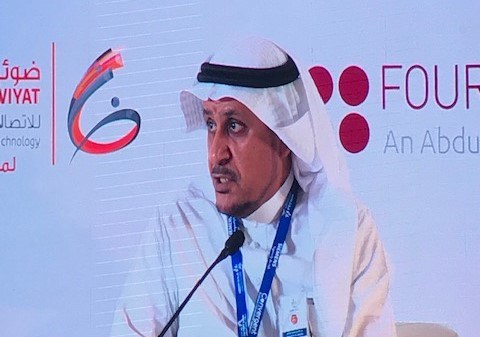

MODON minister Khalid Al Salem: “We have about 1,700 female workers in factories”
- Khalid Al Salem: “In MODON we have about 17,000 female workers in our factories”
- Future Factory Show conference was organized by MODON


Latest updates


© 2026 SAUDI RESEARCH & PUBLISHING COMPANY, All Rights Reserved And subject to Terms of Use Agreement.