WASHINGTON: President Donald Trump said Thursday he has informed Venezuela’s acting president, Delcy Rodríguez, that he will open up all commercial airspace over Venezuela and Americans will soon be able to visit.
Trump said he instructed his transportation secretary, Sean Duffy, and US military leaders to take steps to open the airspace for travel by the end of the day.
“American citizens will be very shortly able to go to Venezuela, and they’ll be safe there,” the Republican president said.
Venezuela’s government did not immediately comment.
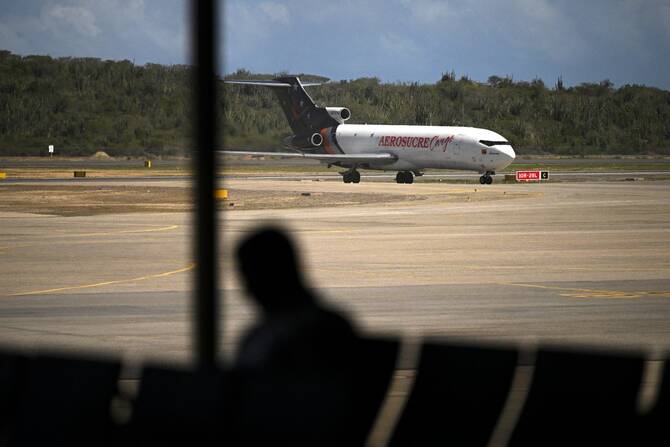
While the State Department continued warning Americans against traveling to Venezuela, at least one US airline announced its intention to resume direct flights between the countries soon.
American Airlines was the last US airline flying to Venezuela when in 2019 it suspended flights between Miami and the capital, Caracas, as well as the oil hub city of Maracaibo. The airline said Thursday it would share additional details about the return to service in the coming months as it works with federal authorities on security assessments and necessary permissions.
“We have a more than 30-year history connecting Venezolanos to the US, and we are ready to renew that incredible relationship,” Nat Pieper, American’s chief commercial officer, said in a statement. “By restarting service to Venezuela, American will offer customers the opportunity to reunite with families and create new business and commerce with the United States.”
Before Venezuela came undone in the mid-2010s, it was not uncommon for Venezuelans to take weekend leisure trips to Miami. US airlines stopped flying to Venezuela before the Department of Homeland Security in 2019 ordered an indefinite suspension, arguing that conditions in Venezuela threatened the “safety and security of passengers, aircraft, and crew.”
Earlier this week, Trump’s administration notified Congress that it was taking the first steps to possibly reopen the shuttered US Embassy in Caracas as it explores restoring relations with the country after the US military raid that ousted then-President Nicolás Maduro. In a notice to lawmakers dated Monday and obtained by The Associated Press, the State Department said it was sending in a regular and growing contingent of temporary staffers to conduct “select” diplomatic functions.
Diplomatic relations between the two countries collapsed in 2019.
Even as Trump suggested Americans will be safe in Venezuela, his State Department kept in place its highest-level travel advisory: “Do not travel,” a warning of a high risk of wrongful detention, torture, kidnapping and more.
The department did not immediately respond to a message inquiring whether it would be changing that warning.
In November, as Trump was ramping up pressure on Maduro, the American president said the airspace “above and surrounding” Venezuela should be considered as “closed in its entirety.”
The Federal Aviation Administration, which has jurisdiction generally over the United States and its territories, told pilots to be cautious flying around Venezuela because of heightened military activity.
After that FAA warning, international airlines began canceling flights to Venezuela.
The FAA issued a similar 60-day warning in January, urging US aircraft operators to “exercise caution” when flying over the eastern Pacific Ocean near Mexico, Central America and parts of South America. The warning was issued after Maduro’s capture but as the US threatened to continue military strikes on alleged drug trafficking boats in the area.
The FAA on Thursday said it was lifting four Notices to Airmen (NOTAMs) for the region that it said were “issued as precautionary measures and are no longer necessary.”
“Safety remains our top priority,” the FAA said in a statement, “And we look forward to facilitating the return of regular travel between the US and Venezuela.”


![]()

Trump says Venezuelan airspace will reopen to commercial travel and Americans soon can visit
Short Url
https://arab.news/pc5pc
Trump says Venezuelan airspace will reopen to commercial travel and Americans soon can visit
- “American citizens will be very shortly able to go to Venezuela, and they’ll be safe there,” Trump said
- American Airlines was the last US airline flying to Venezuela when in 2019 it suspended flights


Latest updates



© 2026 SAUDI RESEARCH & PUBLISHING COMPANY, All Rights Reserved And subject to Terms of Use Agreement.