

Saudi Aramco sets IPO share price between 30-32 riyals for ‘sale of the century’

1 / 2
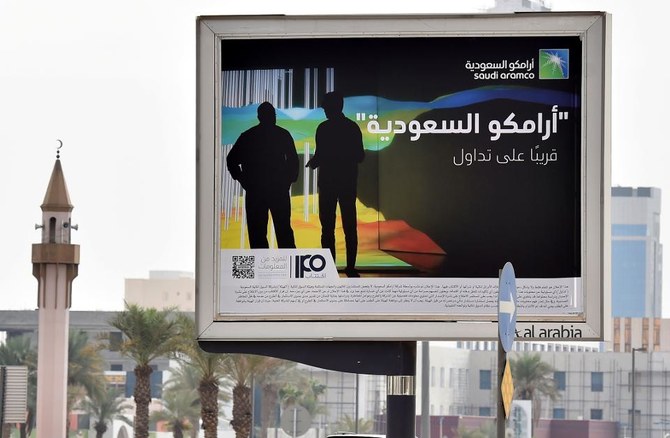
A billboard displaying an advert for Aramco is pictured in Riyadh, Sauid Arabia on November 11, 2019.( AFP Photo)
2 / 2
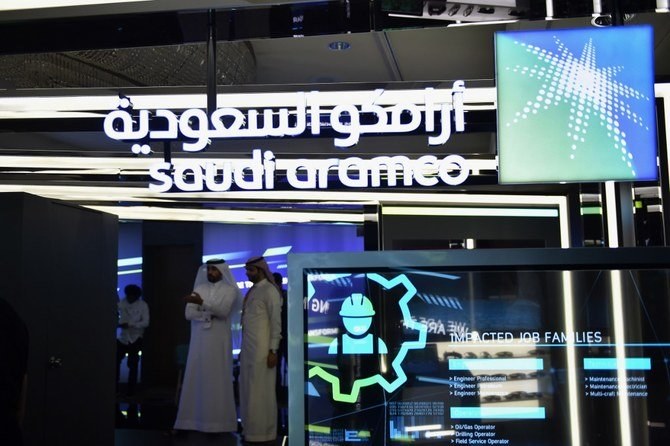
Saudi Aramco also intends to buy $1 billion worth of shares for employees under a plan to incentivize executives and staff members. (AFP)
Updated 18 November 2019
Follow

Saudi Aramco sets IPO share price between 30-32 riyals for ‘sale of the century’

  • Final pricing for the Aramco shares would be announced on Dec. 5
  • The IPO could be worth least $24 billion, and values the state-owned oil giant at up to $1.71 trillion

DUBAI: The Saudi Arabian “sale of the century” — the initial public offering of shares in Saudi Aramco — moved into top gear with the announcement of pricing details and official valuation of the most profitable company in the world.

The Kingdom will sell a total of 3 billion shares in Aramco — around 1.5 percent of the total — at a valuation between SR30 ($8) and SR32 per shares, giving a total valuation of between $1.6 trillion and $1.7 trillion, making it the most valuable company in history.

Investment professionals welcomed the valuation, which was lower than the highest estimates of Aramco’s worth, as a “compromise” between the Kingdom and the financial world.

Tarek Fadhallah, CEO of Nomura Asset Management in the Middle East, said: “My first impression is that the price is a sensible compromise and that it will sell the IPO.”

*********

READ MORE: 

For more of our coverage of the Aramco IPO, click here.

To view key Aramco IPO documents, click here.

*********

Setting the price range and the number of shares to be sold starts the “book building” process during which Aramco and its advisers will consult with potential investors and await bids from the institutions and private investors to decide at what level the shares will finally be sold.

A final pricing decision will come on Dec. 5, and trading is expected to start on the Tadawul shortly after.

Private investors — Saudi nationals, resident expatriates and Gulf nationals — will have to decide how many shares they want at the SR32 level, and wait to see if their application will be met in full.

If the final price is set lower than the top of the range, investors can have their money refunded or take up extra shares to an equivalent value. Aramco has decided not to market the shares via “roadshows” in certain markets because of a relaxation of Riyadh market rules that will allow foreign investors to buy shares on Tadawul.

The value of the stock on offer in the IPO will be between $24 billion and $25.6 billion — beating the existing record for a share issue set by Alibaba on the New York Stock exchange in 2014.

The proceeds from the sale — earmarked for investment into the diversification of the Saudi economy under the Vision 2030 reform plans — could go even higher depending on demand, with an extra chunk of shares allocated to advisers as part of the price stabilization mechanism.

Aramco is also committed to buying $1 billion in shares for its employees in an incentive scheme.


Saudi Arabia, Japan trade rises 38% between 2016 and 2024, minister says

Updated 11 January 2026
Follow

Saudi Arabia, Japan trade rises 38% between 2016 and 2024, minister says

RIYADH: Trade between Saudi Arabia and Japan has increased by 38 percent between 2016 and 2024 to reach SR138 billion ($36 billion), the Kingdom’s investment minister revealed.

Speaking at the Saudi-Japanese Ministerial Investment Forum 2026, Khalid Al-Falih explained that this makes the Asian country the Kingdom’s third-largest trading partner, according to Asharq Bloomberg.

This falls in line with the fact that Saudi Arabia has been a very important country for Japan from the viewpoint of its energy security, having been a stable supplier of crude oil for many years.

It also aligns well with how Japan is fully committed to supporting Vision 2030 by sharing its knowledge and advanced technologies.

“This trade is dominated by the Kingdom's exports of energy products, specifically oil, gas, and their derivatives. We certainly look forward to the Saudi private sector increasing trade with Japan, particularly in high-tech Japanese products,” Al-Falih said.

He added: “As for investment, Japanese investment in the Kingdom is good and strong, but we look forward to raising the level of Japanese investments in the Kingdom. Today, the Kingdom offers promising opportunities for Japanese companies in several fields, including the traditional sector that links the two economies: energy.”

The minister went on to note that additional sectors that both countries can also collaborate in include green and blue hydrogen, investments in advanced industries, health, food security, innovation, entrepreneurship, among others.

During his speech, Al-Falih shed light on how the Kingdom’s pavilion at Expo 2025 in Osaka achieved remarkable success, with the exhibition receiving more than 3 million visitors, reflecting the Japanese public’s interest in Saudi Arabia.

“The pavilion also organized approximately 700 new business events, several each day, including 88 major investment events led by the Ministry of Investment. Today, as we prepare for the upcoming Expo 2030, we look forward to building upon Japan’s achievements,” he said.

The minister added: “During our visit to Japan, we agreed to establish a partnership to transfer the remarkable Japanese experience from Expo Osaka 2025 to Expo Riyadh 2030. I am certain that the Japanese pavilion at Expo Riyadh will rival the Saudi pavilion at Expo Osaka in terms of organization, innovation, and visitor turnout.”

Al-Falih also shed light on how Saudi-Japanese relations celebrated their 70th anniversary last year, and today marks the 71st year of these relations as well as how they have flourished over the decades, moving from one strategic level to an even higher one.