

Saudi Arabia surpasses $400bn in investment volume, minister announces

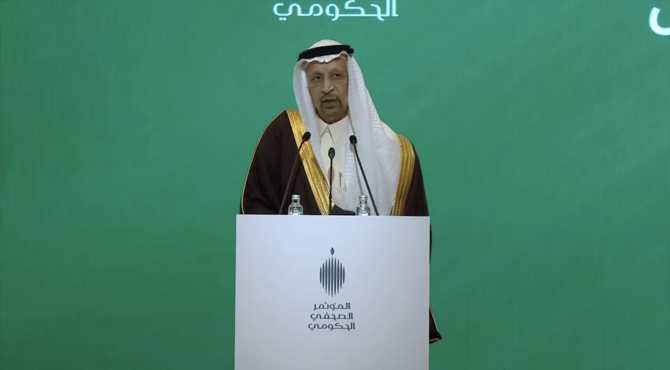
Minister of Investment Khalid Al-Falih speaking at a press conference. Screenshot
Short Url
Updated 26 January 2026
Follow

Saudi Arabia surpasses $400bn in investment volume, minister announces

RIYADH: Saudi Arabia’s total investment volume surpassed SR1.5 trillion ($400 billion) for the first time in 2025, the Kingdom’s minister of investment has announced.

Speaking at the Government Press Conference in Riyadh, Khalid Al-Falih highlighted unprecedented growth across the financial landscape, with foreign capital inflows playing a central role.

The Kingdom is aiming to attract $100 billion in annual foreign direct investment by the end of the decade as part of its Vision 2030 economic diversification plan. 

“We expect foreign investment flows into Saudi Arabia in 2025 to range between SR140 billion and SR150 billion,” Al-Falih said, noting that this projection represents a five-fold increase from the SR28 billion recorded in 2017, a sign of rising global investor confidence.

The surge in international business activity is further reflected in the number of foreign companies operating in the Kingdom. Al-Falih revealed that licensed foreign firms have reached 62,000, a dramatic increase from just 6,000 in 2016.

Furthermore, the nation has attracted more than 700 regional headquarters for leading global corporations, solidifying its position as a premier commercial hub for the Middle East and North Africa.

The investment boom is creating substantial opportunities for Saudis. The minister highlighted that 800,000 new jobs have been created in the Saudi economy, with private sector wages rising by 45 percent. He also noted that women’s labor force participation has doubled, marking a significant societal shift.

The domestic entrepreneurial spirit remains robust, with the number of active commercial registrations held by Saudi investors reaching 1.86 million by the end of 2025.

Al-Falih also stated that 500,000 Saudis have been employed out of 1.5 million workers in foreign companies, and that three major companies have begun automobile manufacturing in the Kingdom.

The economic outcomes cited by Al-Falih are direct results of the nation’s Vision 2030 reform agenda. This transformation is being accelerated by the systematic opening of Saudi Arabia’s capital markets. 

On Feb. 1, the Capital Market Authority will allow all foreign investors direct access to the Main Market, eliminating previous qualification barriers. This follows a period of rapid growth in international participation, with foreign ownership exceeding SR590 billion by the third quarter of 2025. 

On this, the minister said that Tadawul is “prideworthy,” noting that it’s now one of the biggest 10 stock markets worldwide. He stated that the old restrictions on foreign investors were found to limit market access for all international investors. He confirmed that the new rules, which will be announced soon, are designed to be “balanced.”


Growing pressure on Arab banks amid complex cross-border contracts, legal risks 

Updated 7 sec ago
Follow

Growing pressure on Arab banks amid complex cross-border contracts, legal risks 

DAMMAM: Arab banks — numbering around 520 this year — are facing mounting challenges, led by the growing complexity of cross-border banking contracts and rising legal risks tied to modern financial products, Wissam Fattouh, secretary-general of the Union of Arab Banks, told Al-Eqtisadiah. 

Fattouh said addressing these challenges, driven by global economic and financial shifts, requires Arab banks — whose combined assets exceed $5.5 trillion — to strengthen risk management, continue structural reforms, and expand cooperation with foreign banks and financial institutions in line with the nature of global financial markets. 

He noted that the “Certified International Arbitrator” credential offered by the UAB to Arab banks is one of the professional tools supporting governance in banking transactions and providing effective, specialized alternatives to traditional litigation, particularly in cross-border disputes. 

Growing complexity of financial products and services 

Fattouh said the certification represents a specialized professional program aimed at preparing qualified banking and legal professionals to handle international commercial and banking disputes, particularly those linked to the financial sector, as financial products and services become more complex, regulations tighten, and global compliance requirements increase. 

In November, the UAB told Al-Eqtisadiah that the assets of 11 Saudi banks included among the 100 largest Arab banks last year, accounted for 24 percent of the total, reaching $1.1 trillion out of $4.5 trillion. 

The top 10 Arab banks were led by Qatar National Bank, followed by First Abu Dhabi Bank, Saudi National Bank, Emirates NBD, Al-Rajhi Bank, Abu Dhabi Commercial Bank, National Bank of Egypt, National Bank of Kuwait, Riyad Bank, and Kuwait Finance House. 

Fattouh said Arab banks have demonstrated a clear ability in recent years to withstand global economic shocks, supported by solid capitalization and liquidity levels, as well as a relative improvement in asset quality, strengthening the sector compared with several other emerging markets. 

Betting on continued development of regulatory frameworks 

Fattouh expects the Arab banking sector to continue playing a pivotal role in financing productive sectors, supporting small and medium-sized enterprises, and contributing to funding the transition toward a green economy, as well as advancing digital transformation across Arab economies. 

He stressed that this role depends on the continued development of regulatory frameworks and stronger risk management, particularly amid rising cyber risks, compliance challenges, and global market volatility. 

He added that digitalization has become essential for improving operational efficiency, noting that the UAB will focus in 2026 on enhancing dialogue between Arab banks and regulators, supporting the development of banking and financial policies, and contributing to regional financial stability. 

He further said that the Union also plans to organize specialized training programs in risk management, compliance, digitalization, and finance.