

Pakistan stresses critical role of GSP Plus in enhancing trade amid India-EU deal

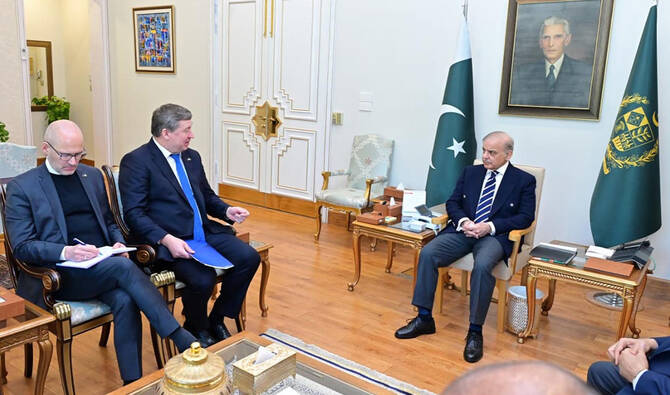
Prime Minister of Pakistan, Shehbaz Sharif (right), in conversation with EU Ambassador Raimundas Karoblis (center) in Islamabad on January 29, 2026. (PID)
Short Url
Updated 29 January 2026
Follow

Pakistan stresses critical role of GSP Plus in enhancing trade amid India-EU deal

  • Prime Minister Shehbaz Sharif meets EU Ambassador Raimundas Karoblis to discuss bilateral trade, investment, GSP Plus scheme
  • Pakistan says is reviewing EU’s recent free trade deal with India that analysts fear may erode its tariff advantage under GSP Plus

ISLAMABAD: Prime Minister Shehbaz Sharif on Thursday stressed the critical role of the Generalized Scheme of Preferences (GSP) Plus in enhancing trade with the European Union (EU), as Islamabad reviews the implications of India’s free trade deal with Europe. 

India and the EU confirmed this week that they had agreed to a new free trade deal that grants Indian exporters sweeping tariff-free access to the EU. Pakistan’s foreign office said Islamabad is aware of the agreement and will continue to view its trade relationship with the EU as mutually beneficial. 

Pakistani financial analysts and exporters have voiced concerns that the deal may erode its tariff advantage under the GSP Plus, which allows duty-free access for many Pakistani exports to the EU in return for commitments on labor rights, human rights and governance.

Sharif met EU’s Ambassador to Pakistan Raimundas Karoblis at the Prime Minister’s House to discuss bilateral ties, trade, investment and other areas of interest between the two sides.

 “The Prime Minister emphasized upon the critical role of the GSP Plus scheme in enhancing trade between Pakistan and the EU,” Sharif’s office said in a statement. 

“And said the Government of Pakistan is committed to working closely with the EU on mutually beneficial trade enhancement initiatives, especially through the GSP Plus.”

The Pakistani premier reaffirmed Islamabad’s commitment to further strengthen cooperation with the EU in all areas of mutual interest, particularly trade, investment, development, security, migration and climate change.

Karoblis assured Sharif he would continue to work to strengthen Pakistan-EU relations across all spheres. He said the EU would continue to engage closely with Pakistan on enhancing trade under the GSP Plus and through trade promotion activities.

Under GSP Plus scheme, Pakistan currently enjoys duty-free access on around 66% of EU tariff lines, while Indian textile and apparel products previously faced duties of up to 12%.

The shift comes at a fragile moment for Pakistan’s exports. After rising 5% to $32.1 billion last fiscal year, exports fell 9% to $15.2 billion in the first half of the current year through December, according to Pakistan Bureau of Statistics data.


Pakistan slashes power tariff for industries by Rs4.4 per unit to spur growth

Updated 12 min 40 sec ago
Follow

Pakistan slashes power tariff for industries by Rs4.4 per unit to spur growth

  • The development comes as Pakistan seeks to boost exports to ensure economic recovery under a $7 billion IMF program
  • PM Sharif also announces lowering export refinance rate from 7.5 percent to 4.5 percent, and electricity wheeling charges to Rs9 per unit

ISLAMABAD: Prime Minister Shehbaz Sharif on Friday announced a Rs4.4 ($0.014) cut in electricity tariffs for industrial consumers, saying the move is aimed at lowering production costs and spurring economic activity in Pakistan.

Manufacturers in Pakistan have long complained of high electricity price, i.e. Rs22.98 per unit, for industrial consumers, arguing that it has dampened industrial growth and made local products less competitive globally.

The reduction in power tariffs for industries is expected to lower production costs that will allow exporters to offer more competitive prices in international markets and increase profit margins through higher capacity utilization.

Addressing businessmen and exporters at a ceremony in Islamabad, Sharif said there was no alternative to export-driven economic growth and his government will devise all future economic policies in consultation with them.

“Four rupees and four paisas per unit are being reduced in electricity tariffs for industry,” the prime minister announced at the ceremony. “If it were up to me, I would reduce it by another 10 rupees, but my hands are tied.”

The development comes as Pakistan, which has long struggled with boom-bust cycles, seeks to boost foreign investment and increase exports as it navigates a long path to economic recovery under a $7 billion International Monetary Fund (IMF) program.

The prime minister said they have reduced the export refinance rate from 7.5 percent to 4.5 percent.

“I believe this is a very significant facility being extended to you,” he said. “God willing, it will help Pakistan’s exports rebound and it will certainly be of immense benefit, especially to those who need financing.”

During his address, Sharif also announced lowering wheeling charges for industries by Rs9 ($0.032) per unit, noting the country’s economy had stabilized, inflation had come down to single digits and the policy rate stood at 10.5 percent.

In Pakistan, wheeling charges refer to fees paid by electricity consumers and generators to use the national grid’s transmission and distribution network to move electricity from suppliers to end-users under the Competitive Trading Bilateral Contracts Market (CTBCM).

“I think this should help you sell your power to neighboring industries,” he told businesspersons at the event.