
PESHAWAR: Outside the Peshawar sports complex, three women in black burqas stood watching a female athlete in a red tracksuit jog over to the other side of the wrought iron gates, as soldiers in pick-up trucks patrolled the streets.
Partly hidden in an alcove of the facility hosting Pakistan’s biggest domestic sporting event after nine years, a group of Hazara women glided together in a combative dance, practicing minutes before their karate match began at the 33rd National Games this week.
The karateka are among 3,500 women taking part in the event held in the conservative northwestern city which borders Afghanistan. They belong to the country’s Hazara minority Shi’ite community, for decades the target of ethnic and sectarian violence by hard-line militant groups.
But this week, dozens of Hazaras traveled the length of the country from their heavily fortified neighborhoods in southwestern Quetta city to stand face to face with 10,000 other participants, all competing for gold in 32 sporting formats.
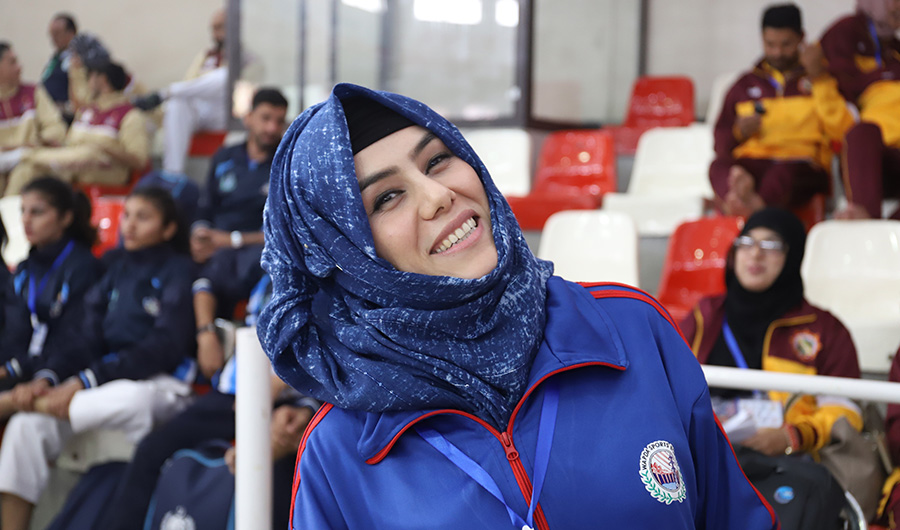
Kulsoom Hazara, Balochistan’s first woman karateka, smiles for the camera before a packed audience during a karate match at the 33rd National Games held in northwestern city of Peshawar, Pakistan. Nov 13, 2019 (AN Photo)
“In 2002, I would go to the karate club and all the boys would laugh at me, but my brother-in-law, who was my karate master, told me to keep going,” Kulsoom Hazara, Balochistan’s first female karateka and a leading international karate champion, told Arab News.
In 2005, Kulsoom’s family fled to Karachi to escape an onslaught of target killings in Quetta, but militant violence followed them to the bustling southern metropolis, and Kulsoom’s brother-in-law was killed by militants.
After that, she said, she continued karate with renewed force, in memory of the man who had taught her to fight.
“When my master jee died, we lost everything,” she said. “Believe me, in those days, I didn’t have money to buy shampoo for my long hair. I had to chop it all off. But I fought in the ring, I won gold in India-- for him.”
“Look around you at what he did,” she said, gesturing at the packed stands behind her. “He changed minds through teaching just one girl karate. Now, most of the (karate) participants and champions in the country are Hazara,” she said.
In Pakistan, violence against minorities is a familiar story. But the Hazaras, said to be descendants of the Mongols and easily distinguishable by their facial features, are more vulnerable to attacks by the death squads of the banned Lashkar-e-Jhangvi (LeJ), and Daesh in Pakistan and neighboring Afghanistan.
Three young Hazara women in the stands of the field hockey stadium said they had lost their match earlier because they often went months without practice— for fear of militant attacks if they ventured too far out.
“We don’t even have a turf to practice on. And if we go outside our neighborhood, we are in danger of target killings,” 16 year old Abida Hakimi said matter-of-factly. “There’s a stadium in Quetta, but we’ve never seen it.”
“We play for our country,” she continued. “We love Pakistan, even though it has taken too much from us. But love is love. How can you explain where it comes from?”
The irony of playing in Peshawar, the site of dozens of bombings at the hands of militants in recent years, is not lost on the women. The city is the capital of Khyber Pakhtunkhwa province, where Nobel Prize winner Malala Yousafzai was famously shot in the head by a Taliban gunman over her blog advocating for girls’ education.
Earlier in 2009, in a stark example of this hatred, 137 people, mostly women, died when a powerful bomb ripped through a busy women’s marketplace, less than 7 km away from the sports complex.
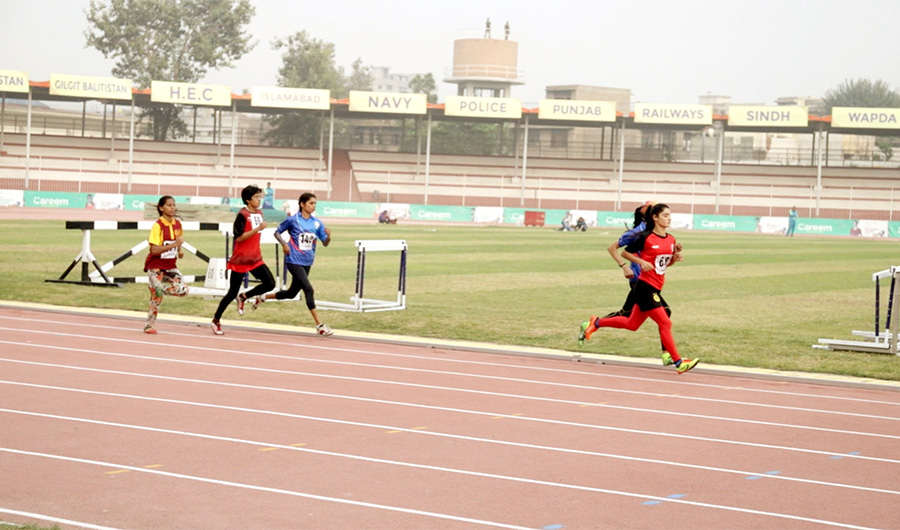
Women athletes during the 1500 meter race to the finish line at the 33rd National Games held in the northwestern city of Peshawar, Pakistan. Nov 13, 2019 (AN Photo)
But on Wednesday, ten years later, a group of women athletes ran the 1500 meter final race around Qayyum Stadium’s clay track, cheered on by hundreds in the stands.
In a remarkable moment of sportsmanship, when the afternoon Adhaan sounded over the city’s loudspeakers, the loud cheers fell silent in a show of respect, while the women continued racing to the still-raised fists of the quiet spectators.
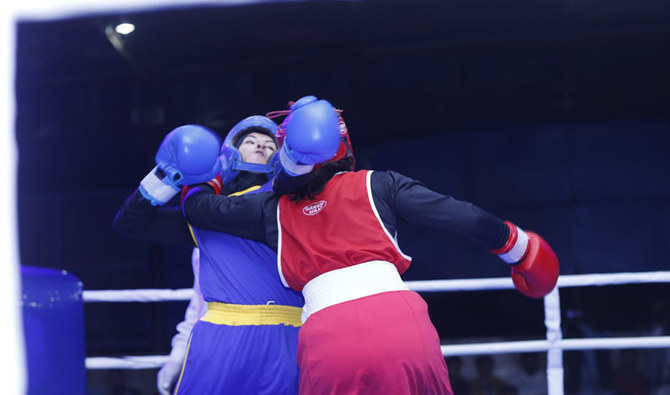
“She fought like a man today!” an official at the women’s boxing match yelled across the ring to his colleagues, as teenage boxing wonder Malaika Zahid from Balochistan raised her gloved fists in victory.
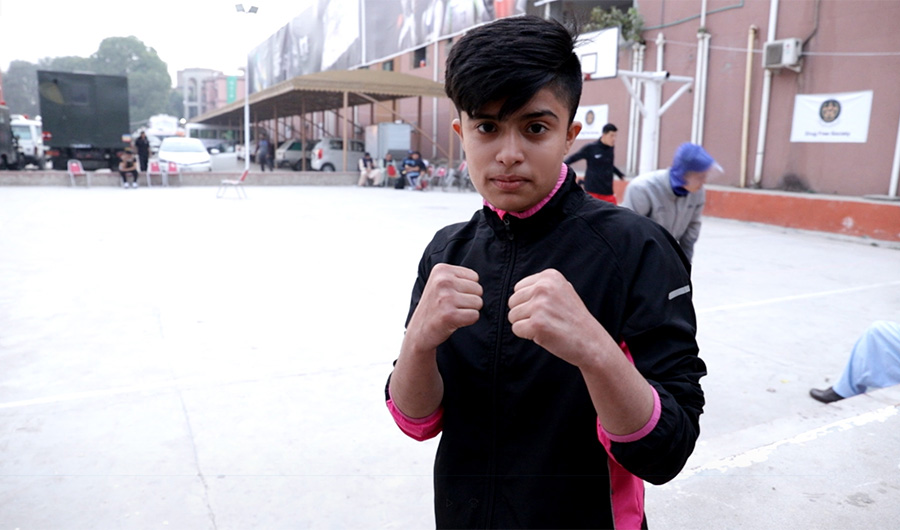
Malaika Zahid, teenage boxing wonder from Balochistan, said she has the full support of her parents, after winning the women’s boxing finals in her category at the 33rd National Games held in the northwestern city of Peshawar, Pakistan. Nov 13, 2019 (AN Photo)
Inside the karate hall where a final was underway, Farshad Hussain Qureshi, a karate coach from Hyderabad in southeastern Sindh province, said he had raised five daughters-- all of them national champions.
“But now, four of them are married, so they have other responsibilities,” Qureshi told Arab News. “After marriage, women have to look after their children, their homes and husbands. Until then, I train them to be champions.”
But the young women participating in the games this week seemed to have no plans of slowing down, though most conceded marriage would spell the end of their sporting dreams. In a corner of the stadium, not far from the site of a school attack where 132 schoolchildren were gunned down by militants five years ago, a group of teenage athletes high-fived each other, motioning to a cameraman to take a photo of them in their jerseys.
On the count of three, the women threw their fists in the air and roared: ‘Pakistan Zindabad.’