

Violent protests grip major Iranian cities over gas price rise 

1 / 5
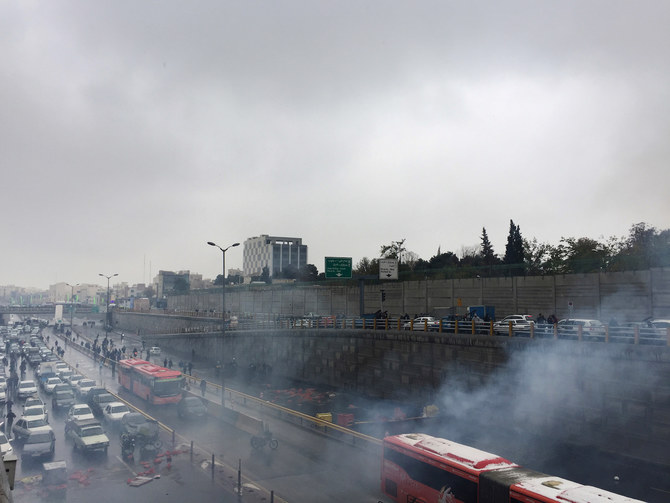
The demonstrations took place in over a dozen cities in the hours following President Rouhani’s decision at midnight on Friday to cut gasoline subsidies. (AFP )
2 / 5
People stop their cars on a highway to protest against increased gas price in Tehran, Iran November 16, 2019. (Reuters)
3 / 5
Riot police tries to disperse people as they protest on a highway against increased gas price in Tehran, Iran November 16, 2019. (Reuters)
4 / 5
Riot police tries to disperse people as they protest on a highway against increased gas price in Tehran, Iran November 16, 2019. (Reuters)
5 / 5
People protest against increased gas price, on a highway in Tehran, Iran November 16, 2019. (Reuters)
Updated 17 November 2019
Follow

Violent protests grip major Iranian cities over gas price rise 

  • One protester was killed in the central city of Sirjan, where people tried to set fire to a fuel depot
  • US Secretary of State Mike Pompeo tweeted in support of protests in Iran

TEHRAN: Protesters angered by Iran raising government-set gasoline prices by 50 percent blocked traffic in major cities and occasionally clashed with police on Saturday after a night of demonstrations punctuated by gunfire, in violence that reportedly killed at least one person.

The death occurred in the central city of Sirjan, where people tried to set fire to a fuel depot but were thwarted by security forces including police, the Revolutionary Guards and Basij militia, the semi-official ISNA news agency reported.

The protests put renewed pressure on Iran’s government as it struggles to overcome the US sanctions strangling the country after President Donald Trump unilaterally withdrew America from Tehran’s nuclear deal with world powers.

Though largely peaceful, demonstrations devolved into violence in several instances, with online videos purporting to show police officers firing tear gas at protesters and mobs setting fires. 

Dr. Majid Rafizadeh, a Harvard educated Iranian-American political scientist, told Arab News that the Islamic Republic appears to be scrambling to compensate for the loss of revenues that it is encountering due to a major decline in the regime’s oil exports. “US sanctions on the country have exerted significant pressure on the ruling clerics.”

He said: “Tehran is desperate to generate revenue, in order to fund its military interests in the wider region and support its proxies everywhere from Yemen to Lebanon. 

“It is important to point out that the current protests in Iran are expression of broad frustration with the clerical regime.  While representing a political risk for President Hassan Rouhani ahead of February parliamentary elections, it also shows the widespread anger among Iran’s 80 million people who have seen their savings evaporate amid scarce jobs and the national rial currency’s collapse.
 

Opinion

This section contains relevant reference points, placed in (Opinion field)

The demonstrations took place in over a dozen cities in the hours following Rouhani’s decision at midnight Friday to cut gasoline subsidies to fund handouts for Iran’s poor. 

Gasoline in the country still remains among the cheapest in the world, with the new prices jumping up to a minimum of 15,000 rials per liter of gas — 50 percent up from the day before. That’s 13 cents a liter, or about 50 cents a gallon. A gallon of regular gasoline in the US costs $2.60 by comparison.

Iran imposed petrol rationing and raised pump prices by at least 50 percent on Friday, saying the move was aimed at helping citizens in need with cash handouts. 

President Hassan Rouhani said on Saturday that currently 75 percent of Iranians were “under pressure” and the extra revenues from the petrol price hike would go to them, and not the treasury.

Rouhani had tried to hike fuel prices in December but was blocked by parliament in the wake of protests that rocked Iran for days.The speaker at the time ruled out the move as unpopular and said it was “not in the interests of the country.”

The rationing and price hike come at a sensitive time as Iran prepares for a parliamentary election in February.

The measure was expected to bring in $2.55 billion per annum, the head of the country’s Planning and Budget Organization, Mohammad Bagher Nobakht, said on state television.

About 60 million Iranians in need would get payments ranging from $4.68 for couples to slightly more than $17.46 for families with five members or more, he said.

Under the scheme, drivers with fuel cards will pay 13 US cents a liter for the first 60 liters of petrol bought each month, with each additional liter costing them 71 US cents.

But in a nation where many get by as informal taxi drivers, cheap gasoline is considered a birthright. Iran is home to the world’s fourth-largest crude oil reserves. While expected for months, the decision still caught many by surprise and sparked immediate demonstrations overnight.
 

Violence broke out Friday night in Sirjan, a city some 800 km southeast of Tehran. The state-run IRNA news agency said “protesters tried to set fire to the oil depot, but they were stopped by police.” 

It did not elaborate, but online videos circulating on Iranian social media purported to show a fire at the depot as sirens wailed in the background. Another showed a large crowd shouting: “Rouhani, shame on you! Leave the country alone!”

Mohammad Mahmoudabadi, an Interior Ministry official in Sirjan, later told state television that police and demonstrators exchanged gunfire, wounding several.

It was a “calm gathering” that was exploited by some who “destroyed public property, damaged fuel stations and also wanted to access the oil company’s main fuel depots and set fire to them,” he said.

Besides Sirjan, “scattered” protests were also held on Friday in other cities including Abadan, Ahvaz, Bandar Abbas, Birjand, Gachsaran, Khoramshahr, Mahshahr, Mashhad and Shiraz, state news agency IRNA said.

But they were mostly limited to blocking traffic and were over by midnight, IRNA reported.

Fresh demonstrations were held on Saturday in the cities of Doroud, Garmsar, Gorgan, Ilam, Karaj, Khoramabad, Mehdishahr, Qazvin, Qom, Sanandaj, Shahroud and Shiraz, IRNA said.

“Some drivers have protested the new petrol price by turning off their cars and creating traffic jams,” the official news agency added.


Iranian strikes kill two in UAE, injure eight in Qatar as regional conflict escalates

Updated 01 March 2026
Follow

Iranian strikes kill two in UAE, injure eight in Qatar as regional conflict escalates

  • UAE defense ministry said Iran fired 137 missiles and 209 drones at the territory
  • Qatar intercepted most of the 65 missiles and 12 drones launched by Iran, said officials

ABU DHABI: Explosions rocked cities across the Gulf on Saturday, killing two people in Abu Dhabi, while smoke and flames rose from Dubai landmark The Palm as Iran launched waves of attacks in retaliation for US and Israeli strikes.

The attacks hit airports in Abu Dhabi, Dubai and Kuwait, as well as Gulf military bases and residential areas, raising fears of a wider conflict and rattling a region long seen as a haven of peace and security.

Across the UAE, Iran fired 137 missiles and 209 drones at the territory, the country’s defense ministry said, as projectiles streaked across the skies of every Gulf state but Oman, a mediator in the recent US-Iran talks.

The UAE defense ministry said most of the missiles and drones were intercepted but at Abu Dhabi’s Zayed International Airport officials said at least one person was killed and seven wounded in an “incident.”

Earlier, falling debris killed a Pakistani civilian in Abu Dhabi, the United Arab Emirates’ capital, officials said.

At Dubai International Airport four people were injured according to airport authorities and four others were also hurt at the luxury Palm development.

In Qatar, officials said Iran launched 65 missiles and 12 drones toward the Gulf state, most of which were intercepted, but eight people were injured in the salvos, with one of them in critical condition.

“We are scared of what the future is for us now, and we can’t say how the next few days are going to be,” Maha Manbaz, a nursing student in Doha told AFP.

Terrified’

Smoke poured from US bases in Abu Dhabi and Bahrain’s capital Manama, home of the American navy’s Fifth Fleet, witnesses saw.

A drone struck Kuwait’s international airport and a base housing US personnel was targeted. Three Kuwaiti soldiers and 12 other people were wounded, authorities said.

After Iran’s Revolutionary Guards reported missile strikes, US Central Command (CENTCOM) said on X that no American naval vessels were hit, damage to US facilities was minimal, and no US casualties had been reported.

Residential buildings were also targeted in Manama, with officials saying firefighters and civil defense teams had been dispatched to the scene.

“The sound of the first explosion terrified me,” said a 50-year-old retiree living near the US base in Manama’s Juffair area, where residents were quickly evacuated.

The UAE, Saudi Arabia and Qatar warned they reserved the right to respond to the attacks.

The oil-and-gas-rich Arab monarchies, lying just across the Gulf from Iran, are long-term American allies and host a clutch of US military bases.

“The Gulf states are sandwiched between Iran and Israel, and have to bear the worst inclinations of both,” said Bader Al-Saif, an assistant professor at Kuwait University.

“Iran’s attacks on the Gulf are misplaced. They’ll only alienate its neighbors and invite further distancing from Iran,” he added.

Conflict is unusual in the Gulf, which has traded on its reputation for stability to become the Middle East’s commercial and diplomatic hub.

‘Significant damage’

The unprecedented barrage targeted Qatar’s Al Udeid base, the region’s biggest US military base, as well as Riyadh and eastern Saudi Arabia.

The UAE, Qatar and Kuwait all announced that their airspace was closed.

An AFP journalist in Qatar saw one missile destroyed in a puff of white smoke, while another in Dubai saw a volley of Patriot interceptors taking off.

Iran fired missiles at Al Udeid last June after US strikes targeted Iranian nuclear facilities during a brief war with Israel.

The escalation also saw Saudi Crown Prince Mohammed bin Salman and UAE President Mohamed bin Zayed speak for the first time since a public row in late December.

The Saudi de facto ruler called the Emirati president and the pair discussed Iran’s retaliatory strikes on the Gulf and expressed solidarity and sympathy.

In Kuwait, an Iranian missile attack caused “significant damage” to the runway at an air base hosting Italian air force personnel, Italian Foreign Minister Antonio Tajani was quoted by the ANSA news agency as saying.

Late on Saturday, Kuwaiti officials said a drone targeted a naval base there with air defense forces intercepting the projectile, according to a post by the defense ministry on X.

For many residents in the Gulf, which has drawn a cosmopolitan, largely expat population, the reaction was one of shock.

“I heard the explosions, I don’t know what I felt,” a Lebanese woman living in Riyadh told AFP.

“We came to the Gulf because it’s known to be safer than Lebanon. Now I don’t know what to do or how to think really.”