BEIJING: A sharp escalation of violence in Hong Kong is once again raising the question of how China’s central government will respond: Will it intervene, or allow the chaos to persist?
The Liaison Office, which represents mainland authorities in Hong Kong, said Wednesday that actions in the semi-autonomous territory were “slipping into the abyss of terrorism.” It pointed out that a man was set on fire Monday during an argument with demonstrators, leaving him in critical condition.
On the same day, a police officer shot a protester who was then taken to a hospital, also in critical condition.
The unabating tumult, now in its sixth month, may give China’s ruling Communist Party the justification it needs to take more direct action, analysts said.
“Beijing is hoping that the Hong Kong community will start blaming the protesters and support the restoration of order,” said Jean-Pierre Cabestan, a political science professor at Hong Kong Baptist University.
The central government must wait for the right moment to step in, Cabestan said, adding that if China acts before public opinion is fully on its side, it could exacerbate existing discontent.
While the movement began peacefully in June to oppose a now-withdrawn extradition bill, it has been increasingly defined by smaller groups of hard-core demonstrators bent on sowing chaos. Their actions, which have included setting cars on fire and smashing storefronts, have alienated many residents.
The Liaison Office described the act of setting the man on fire as “flagrant terrorism,” and pledged support for Hong Kong authorities taking measures to curb “various illegal acts of violence and acts of terrorism.”
Whereas Chinese authorities previously called the demonstrators “rioters” with behavior “close to terrorism,” they are now calling them “murderers” and tying them more explicitly to terrorism. This label may presage more severe enforcement measures and impact how demonstrators are ultimately prosecuted.
A former British colony, Hong Kong was returned to China in 1997 under the framework of “one country, two systems,” a policy that promises Hong Kong certain democratic rights not granted to the mainland. But the arrests of pro-democracy activists and booksellers in recent years have raised fears among Hong Kong residents that Beijing is encroaching on the city’s freedoms.
During a key meeting of the party’s Central Committee at the end of October, Chinese leaders proposed establishing and strengthening the “legal system and enforcement mechanism for safeguarding national security” in special administrative regions like Hong Kong and Macao.
A meeting summary from China’s official Xinhua news agency did not elaborate on what this would entail, but Chinese officials have variously pointed to Article 14, Article 18 and Article 23 of the Basic Law, Hong Kong’s de facto constitution.
Article 14 allows the Hong Kong-based garrison of the Chinese military to help with public order maintenance at the request of the local government. Article 18 states that national laws may be applied in Hong Kong if China’s ceremonial parliament decides that the region is in a “state of emergency” that endangers national unity or security.
“When necessary, the People’s Armed Police Force and the People’s Liberation Army Hong Kong Garrison will back you up,” the nationalistic Global Times said in an editorial Monday, addressing the Hong Kong police.
Zhang Xiaoming, head of the Cabinet’s Hong Kong and Macao Affairs Office, said over the weekend that Hong Kong has yet to fulfill Article 23, which stipulates that the city will “enact laws on its own to prohibit any act of treason, secession, sedition, subversion” against the central government. These laws should also ban the theft of state secrets and prevent foreign political organizations from conducting political activities in Hong Kong. Beijing has repeatedly accused foreign forces of fomenting the unrest.
Proposing new national security legislation is likely to further inflame the protests, though China may not be opposed to that, said Joseph Cheng, a pro-democracy advocate and retired City University of Hong Kong political scientist.
China has made it clear that it intends to maintain a hard line politically, refusing to make any concessions to protesters while pushing ahead with unpopular security legislation, Cheng said.
A further concern is that Beijing might order the postponement of Hong Kong’s local assembly elections scheduled for Nov. 24, freezing in place the current pro-China makeup of the body and avoiding possible embarrassment for the administration of Hong Kong’s leader, Chief Executive Carrie Lam.
Although Lam has been criticized for a lack of leadership and her inflexibility, she has faithfully carried out Beijing’s will. During meetings last week in Shanghai and Beijing, Chinese President Xi Jinping expressed support for her work.
At least for now, the central government appears to be leaving enforcement to local authorities, said Ben Bland, a research fellow at Australia’s Lowy Institute and author of “Generation HK: Seeking Identity in China’s Shadow.”
This approach allows the party to keep the issue tied to Hong Kong, as opposed to one that requires intervention at a higher level, Bland said, adding that while Beijing has several options for cracking down on the protests, each carries its own risks and could aggravate tensions.
As protesters’ tactics have become increasingly extreme, crippling regular operations in the city and plunging various districts into mayhem, Hong Kong’s government has shifted its focus toward the violence and away from the democratic reforms the movement intended to advocate.
“We all feel very depressed because we don’t see the light at the end of the tunnel,” Cheng said.

China mulls its options as Hong Kong descends into chaos
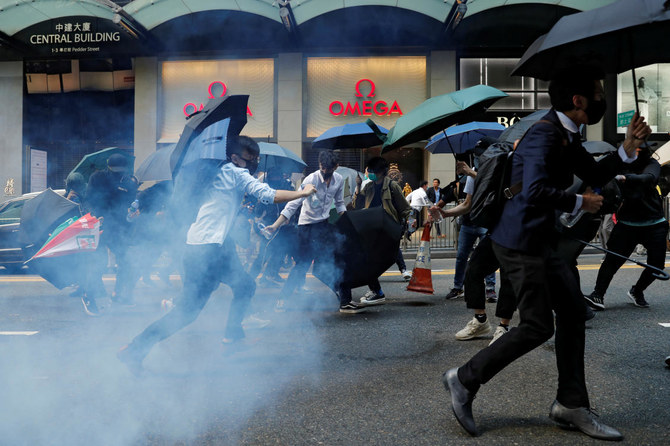
- Actions in the semi-autonomous territory were ‘slipping into the abyss of terrorism’
- ‘When necessary, the People’s Armed Police Force and the People’s Liberation Army Hong Kong Garrison will back you up’
Trump, sharing leaked texts and AI mock-ups, vows ‘no going back’ on Greenland
DAVOS, Switzerland/COPENHAGEN: US President Donald Trump on Tuesday vowed there was “no going back” on his goal to control Greenland, refusing to rule out taking the Arctic island by force and rounding on allies as European leaders struggled to respond.
Trump’s ambition — spelled out in social media posts and mock-up AI images — to wrest sovereignty over Greenland from fellow NATO member Denmark has threatened to blow apart the alliance that has underpinned Western security for decades.
It has also threatened to reignite a trade war with Europe that rattled markets and companies for months last year, though Trump’s Treasury Secretary Scott Bessent pushed back against what he called “hysteria” over Greenland.
“As I expressed to everyone, very plainly, Greenland is imperative for National and World Security. There can be no going back — On that, everyone agrees!” Trump said after speaking to NATO Secretary General Mark Rutte.
To drive home the message, Trump posted an AI image of himself in Greenland, holding a US flag. Another showed him speaking to leaders next to a map showing Canada and Greenland as part of the United States.
Separately, he leaked messages including from French President Emmanuel Macron, who questioned what Trump was “doing on Greenland.” Trump, who has vowed to impose tariffs on countries who stood in his way, had earlier threatened to hammer French wines and champagnes with a 200 percent tariff.
BESSENT PUSHES BACK AGAINST ‘HYSTERIA’
The European Union has threatened to hit back with trade measures. One option is a package of tariffs on 93 billion euros ($109 billion) of US imports that could automatically kick in on February 6 after a six-month suspension.
Another option is the “Anti-Coercion Instrument” (ACI), which has never yet been used. It could limit access to public tenders, investments or banking activity, or restrict trade in services, the sector in which the US has a surplus with the bloc, including the lucrative digital services provided by US tech giants.
“This is not a question about the Kingdom of Denmark, it is about the entire transatlantic relationship,” Denmark’s Economy Minister Stephanie Lose told journalists ahead of an EU meeting of economy and finance ministers in Brussels.
“At this point in time, we do not believe that anything should be ruled out. This is a serious situation that, although we would like to de-escalate, there are others who are contributing to escalating it right now, and therefore we will have to keep all options on the table as we move forward.”
Bessent, on the sidelines of the World Economic Forum annual meeting in Davos, Switzerland, said a solution would be found that ensures national security for the United States and Europe.
“It’s been 48 hours. As I said, sit back, relax,” he said. “I am confident that the leaders will not escalate and that this will work out in a manner that ends up in a very good place for all.”
Asked about the prospect of a prolonged trade war between the United States and Europe, Bessent replied: “Why are we jumping there? Why are you taking it to the worst case?... Calm down the hysteria. Take a deep breath.”
However, in her own speech in Davos, European Commission President Ursula von der Leyen said the series of recent geopolitical shocks will force the EU to build a new independent Europe.
“We will only be able to capitalize on this opportunity if we recognize that this change is permanent,” she said.
RUSSIA QUESTIONS DANISH SOVEREIGNTY OVER GREENLAND
Trump will also this week attend the Davos gathering of the global political and business elite. Swiss newspaper NZZ reported that protesters marched in Zurich, Switzerland, late on Monday, carrying a giant banner saying: “TRUMP NOT WELCOME. NO WEF! NO OLIGARCHY! NO IMPERIALIST WARS!“
The foreign minister of Russia, which has been watching with glee as Trump’s drive to acquire Greenland widens splits with Europe, said on Tuesday that Greenland was not “a natural part” of Denmark.
Trump’s renewed tariff threats against European allies have revived talk of the ‘Sell America’ trade that emerged in the aftermath of his sweeping levies last April.
Stock markets bore the brunt on Monday of fears that the trade war could re-escalate, with European equities dropping over 1 percent and US stock futures taking a similar hit that points to weakness following Monday’s US public holiday.
The dollar was on the back foot too, a sign that the world’s No.1 reserve currency was also in the crosshairs of Trump’s threat on Saturday to increase tariffs on Europe.
Trump’s ambition — spelled out in social media posts and mock-up AI images — to wrest sovereignty over Greenland from fellow NATO member Denmark has threatened to blow apart the alliance that has underpinned Western security for decades.
It has also threatened to reignite a trade war with Europe that rattled markets and companies for months last year, though Trump’s Treasury Secretary Scott Bessent pushed back against what he called “hysteria” over Greenland.
“As I expressed to everyone, very plainly, Greenland is imperative for National and World Security. There can be no going back — On that, everyone agrees!” Trump said after speaking to NATO Secretary General Mark Rutte.
To drive home the message, Trump posted an AI image of himself in Greenland, holding a US flag. Another showed him speaking to leaders next to a map showing Canada and Greenland as part of the United States.
Separately, he leaked messages including from French President Emmanuel Macron, who questioned what Trump was “doing on Greenland.” Trump, who has vowed to impose tariffs on countries who stood in his way, had earlier threatened to hammer French wines and champagnes with a 200 percent tariff.
BESSENT PUSHES BACK AGAINST ‘HYSTERIA’
The European Union has threatened to hit back with trade measures. One option is a package of tariffs on 93 billion euros ($109 billion) of US imports that could automatically kick in on February 6 after a six-month suspension.
Another option is the “Anti-Coercion Instrument” (ACI), which has never yet been used. It could limit access to public tenders, investments or banking activity, or restrict trade in services, the sector in which the US has a surplus with the bloc, including the lucrative digital services provided by US tech giants.
“This is not a question about the Kingdom of Denmark, it is about the entire transatlantic relationship,” Denmark’s Economy Minister Stephanie Lose told journalists ahead of an EU meeting of economy and finance ministers in Brussels.
“At this point in time, we do not believe that anything should be ruled out. This is a serious situation that, although we would like to de-escalate, there are others who are contributing to escalating it right now, and therefore we will have to keep all options on the table as we move forward.”
Bessent, on the sidelines of the World Economic Forum annual meeting in Davos, Switzerland, said a solution would be found that ensures national security for the United States and Europe.
“It’s been 48 hours. As I said, sit back, relax,” he said. “I am confident that the leaders will not escalate and that this will work out in a manner that ends up in a very good place for all.”
Asked about the prospect of a prolonged trade war between the United States and Europe, Bessent replied: “Why are we jumping there? Why are you taking it to the worst case?... Calm down the hysteria. Take a deep breath.”
However, in her own speech in Davos, European Commission President Ursula von der Leyen said the series of recent geopolitical shocks will force the EU to build a new independent Europe.
“We will only be able to capitalize on this opportunity if we recognize that this change is permanent,” she said.
RUSSIA QUESTIONS DANISH SOVEREIGNTY OVER GREENLAND
Trump will also this week attend the Davos gathering of the global political and business elite. Swiss newspaper NZZ reported that protesters marched in Zurich, Switzerland, late on Monday, carrying a giant banner saying: “TRUMP NOT WELCOME. NO WEF! NO OLIGARCHY! NO IMPERIALIST WARS!“
The foreign minister of Russia, which has been watching with glee as Trump’s drive to acquire Greenland widens splits with Europe, said on Tuesday that Greenland was not “a natural part” of Denmark.
Trump’s renewed tariff threats against European allies have revived talk of the ‘Sell America’ trade that emerged in the aftermath of his sweeping levies last April.
Stock markets bore the brunt on Monday of fears that the trade war could re-escalate, with European equities dropping over 1 percent and US stock futures taking a similar hit that points to weakness following Monday’s US public holiday.
The dollar was on the back foot too, a sign that the world’s No.1 reserve currency was also in the crosshairs of Trump’s threat on Saturday to increase tariffs on Europe.
© 2026 SAUDI RESEARCH & PUBLISHING COMPANY, All Rights Reserved And subject to Terms of Use Agreement.


